


KCET · Maths · Inverse Trigonometric Functions
If \(\sin^{-1} x + \sin^{-1} y = \dfrac{\pi}{2}\), then \(x^2\) is equal to
- A \(1 - y^2\)
- B \(\sqrt{1 - y^2}\)
- C \(-\sqrt{1 - y^2}\)
- D \(1 + y^2\)
Answer & Solution
Correct Answer
(A) \(1 - y^2\)
Step-by-step Solution
Detailed explanation
Given \(\sin^{-1} x + \sin^{-1} y = \dfrac{\pi}{2}\)
\(\sin^{-1} x = \dfrac{\pi}{2} - \sin^{-1} y\)
Using the inverse trigonometric identity \(\sin^{-1} y + \cos^{-1} y = \dfrac{\pi}{2}\), we get:
\(\sin^{-1} x = \cos^{-1} y\)
Taking sine on both sides:
\(x = \sin(\cos^{-1} y)\)
Since \(\sin(\cos^{-1} y) = \sqrt{1 - y^2}\), we have:
\(x = \sqrt{1 - y^2}\)
Squaring both sides:
\(x^2 = 1 - y^2\)
Answer: \(1 - y^2\)
\(\sin^{-1} x = \dfrac{\pi}{2} - \sin^{-1} y\)
Using the inverse trigonometric identity \(\sin^{-1} y + \cos^{-1} y = \dfrac{\pi}{2}\), we get:
\(\sin^{-1} x = \cos^{-1} y\)
Taking sine on both sides:
\(x = \sin(\cos^{-1} y)\)
Since \(\sin(\cos^{-1} y) = \sqrt{1 - y^2}\), we have:
\(x = \sqrt{1 - y^2}\)
Squaring both sides:
\(x^2 = 1 - y^2\)
Answer: \(1 - y^2\)
See the Complete Solution
Get step-by-step explanations for this and 2.5 Lakh+ more JEE, NEET & CET questions.
- Unlock all solutions
- Practice the full chapter
- Track accuracy across PYQs
4.8 rated on Google Play · 14,000+ reviews
More questions from Maths
- The order and degree of the differential equation \(\left[1+\left(\frac{d y}{d x}\right)^{5}\right]^{\frac{1}{3}}=\frac{d^{2} y}{d x^{2}}\) are respectivelyKCET 2007 Easy
- Let \(M\) be \(2 \times 2\) symmetric matrix with integer entries, then \(M\) is invertible ifKCET 2021 Easy
- The line \( \frac{x-2}{3}=\frac{y-3}{4}=\frac{z-4}{5} \) is parallel to the planeKCET 2014 Easy
- The shaded region is the solution set of the inequalities
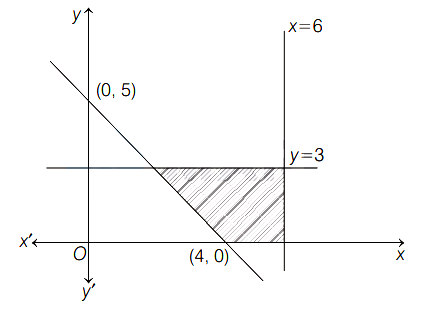 KCET 2021 Easy
 - \(P\) is the point of contact of the tangent form the origin to the curve \(y=\log _{e} x\). The length of the perpendicular drawn form the origin to the normal at \(P\) isKCET 2010 Hard
- If \(A\) is a square matrix of order \(3 \times 3, \operatorname{det} A=3\), then the value of \(\operatorname{det}\left(3 A^{-1}\right)\) isKCET 2025 Medium
More PYQs from KCET
- The angle between two diagonals of a cube is \( 30^{\circ} \)KCET 2014 Medium
- 2n16 in a primary spermatocyte which is in metaphase of first meiotic division. What shall be the total number of chromatids in each of the secondary spermatocyte?KCET 2009 Hard
- The domain of the function \( f: R \rightarrow R \) defined by \( f(x)=\sqrt{x^{2}-7 x+12} \) isKCET 2019 Easy
- Approximate change in the volume \( V \) of a cube of side \( x \) metres caused by increasing the side
by \( 3 \% \) isKCET 2018 Medium - In ruby laser, the stimulated emission is due to transition fromKCET 2009 Medium
- An organic compound \( A \) on reduction gives compound \( B \), which on reaction with trichloro
methane and caustic potash forms \( C \). The compound ' \( C \) ' on catalytic reduction gives \( N \)-methyl
benzenamine, the compound ' \( \mathrm{A} \) ' is,KCET 2016 Hard