


KCET · Chemistry · Biomolecules
The two forms of D-Glucopyranose are called
- A Diastereomers
- B Anomers
- C Epimers
- D Enantiomers
Answer & Solution
Correct Answer
(B) Anomers
Step-by-step Solution
Detailed explanation
The two forms of D-glucopyranose and called anomers as they differ in their configuration at \( C-1 \) atom only
See the Complete Solution
Get step-by-step explanations for this and 2.5 Lakh+ more JEE, NEET & CET questions.
- Unlock all solutions
- Practice the full chapter
- Track accuracy across PYQs
4.8 rated on Google Play · 14,000+ reviews
More questions from Chemistry
- Intramolecular hydrogen bonding is formed inKCET 2013 Easy
- Number of stereoisomers exhibited by \(\left[\mathrm{Co}(\mathrm{en})_{2} \mathrm{Cl}_{2}\right]^{+}\)isKCET 2020 Easy
- Sulphide ore on roasting gives a gas \(X . X\) reacts with \(\mathrm{Cl}_{2}\) in the presence of activated charcoal to give \(Y\). \(Y\) isKCET 2020 Easy
- Chlorobenzene reacts with bromine gas in the presence of \(\mathrm{Anhyd.} \mathrm{AlBr}_3\) to yield p-Bromochlorobenzene. This reaction is classified as ____KCET 2025 Easy
- The correct sequence of steps involved in the mechanism of Cannizaro's reaction isKCET 2010 Easy
- Which of the following on heating gives an ether as major products?
(P) \(\mathrm{C}_6 \mathrm{H}_5 \mathrm{CH}_2 \mathrm{Br}+\mathrm{CH}_3 \mathrm{ONa}\)
(Q) \(\mathrm{C}_6 \mathrm{H}_5 \mathrm{ONa}+\mathrm{CH}_3 \mathrm{Br}\)
(R) \(\left(\mathrm{CH}_3\right)_3 \mathrm{C}-\mathrm{Cl}+\mathrm{CH}_3 \mathrm{ONa}\)
(S) \(\mathrm{C}_6 \mathrm{H}_5 \mathrm{CH}=\mathrm{CHCl}+\mathrm{CH}_3 \mathrm{ONa}\)KCET 2020 Medium
More PYQs from KCET
- Which of the following is not correct?KCET 2025 Easy
- In the following scheme of reaction.
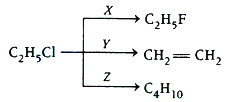
\(X, Y\) and \(Z\) respectively areKCET 2024 Hard - If \(f: \mathbb{R} \rightarrow \mathbb{R}\) is defined by \(f(x)=2 x+3\), then \(\mathrm{f}^{-1}(\mathrm{x})\)KCET 2012 Medium
- Which of the following is least soluble in water at \( 298 \mathrm{~K} ? \)KCET 2019 Medium
- A cubical Gaussian surface has side of length \(a=10 \mathrm{~cm}\). Electric field lines are parallel to \(X\)-axis as shown in figure. The magnitudes of electric fields through surfaces \(A B C D\) and \(E F G H\) are \(6 \mathrm{kNC}^{-1}\) and \(9 \mathrm{kNC}^{-1}\) respectively. Then, the total charge enclosed by the cube is
[Take, \(\varepsilon_0=9 \times 10^{-12} \mathrm{Fm}^{-1}\) ]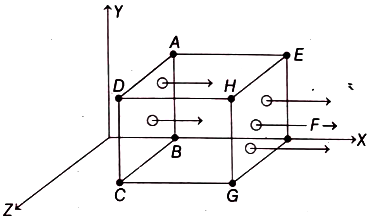 KCET 2023 Medium
 - Which one of these is not true for benzene?KCET 2010 Easy