


KCET · Chemistry · Alcohols Phenols and Ethers
The reaction which involves dichlorocarbene as an electrophile is,
- A Reimer-Tiemann reaction
- B Kolbe's reaction
- C Friedel-Craft's acylation
- D Fittig's reaction
Answer & Solution
Correct Answer
(A) Reimer-Tiemann reaction
Step-by-step Solution
Detailed explanation
The reaction which involves dichlorocarbene as an electrophile is Reimer-Tiemann reaction.
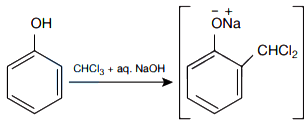
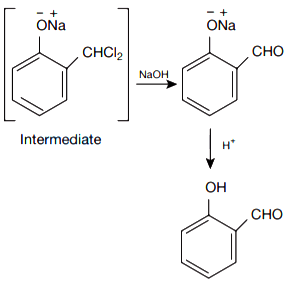
Intermediate
Salicylaldehyde
Intermediate
Salicylaldehyde
See the Complete Solution
Get step-by-step explanations for this and 2.5 Lakh+ more JEE, NEET & CET questions.
- Unlock all solutions
- Practice the full chapter
- Track accuracy across PYQs
4.8 rated on Google Play · 14,000+ reviews
More questions from Chemistry
- In the reaction; \( \mathrm{F} e(\mathrm{OH})_{3}(\mathrm{~s}) \rightleftharpoons \mathrm{F} e^{3+}(a q)+3 \mathrm{OH}^{-}(a q) \), if the concentration of \( \mathrm{OH}^{-} \)ions is
decreased by \( \frac{1}{4} \) times, then the equilibrium concentration of \( F e^{3+} \) will increase by,KCET 2016 Medium - Catalytic dehydrogenation of a primary alcohol gives aKCET 2008 Easy
- When \(\mathrm{KBr}\) is dissolved in water, \(\mathrm{K}^{+}\)ions areKCET 2007 Easy
- \(80 \mathrm{~g}\) of oxygen contains as many atoms as inKCET 2008 Easy
- In the preparation of sodium fusion extract, the purpose of fusing organic compound with a piece of sodium metal is toKCET 2025 Medium
- The IUPAC name of
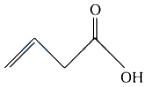
isKCET 2011 Easy
More PYQs from KCET
- In Bougainvillea and Cucurbita, the axillary bud is modified into thorn and tendril respectively. This is an example ofKCET 2019 Medium
- Which is the intermediate compound that links the end product of Glycolysis with TCA Cycle?KCET 2024 Easy
- Recent studies suggest that \(12\%\) of the world population is left handed. Depending on parents' hand usage, the chances of having left handed children are as follows:
A: Both parents are left handed, chances of having left handed children \(= 24\%\)
B: Both parents are right handed, chances of having left handed children \(= 9\%\)
C: Father left handed and mother right handed, chances of having left handed children \(= 17\%\)
D: Father right handed and mother left handed, chances of having left handed children \(= 22\%\)
Given \(P(A) = P(B) = P(C) = P(D) = 1/4\) and L denotes child is left handed. What is the probability that \(P(A \mid L)\)?KCET 2026 Medium - Which class of algae reproduces asexually by non-motile spores and sexually by non-motile gamates?KCET 2017 Hard
- Solution 'A contains acetone dissolved in chloroform and solution 'B' contains acetone
dissolved in carbon disulphide. The type of deviations from Raoult's law shown by solutions A
and \( B \), respectively areKCET 2019 Easy - The value of \(\int \frac{1}{1+\cos 8 x} d x\) isKCET 2007 Easy