


KCET · Chemistry · Redox Reactions
Reduction of ketones cannot be carried outwith which of the following
reagents ?
- A Sodium borohydride or lithium aluminium hydride
- B Zinc amalgam and concentrated HCl
- C Hydrazine and \( \mathrm{KOH} \) in ethylene glycol
- D Hydrogen in presence of palladium inBarium sulphate and quinoline
Answer & Solution
Correct Answer
(D) Hydrogen in presence of palladium inBarium sulphate and quinoline
Step-by-step Solution
Detailed explanation
Ketones are reduced to secondary alcohols by sodium borohydride \( \left(\mathrm{N} a \mathrm{BH}_{4}\right) \) or lithium aluminum hydride \( \left(\mathrm{LiAl} \mathrm{H}_{4}\right) \)
as well as by catalytic hydrogenation.
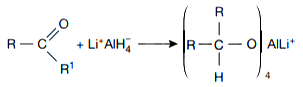
\[
\left(R-\stackrel{i}{C}_{\frac{1}{R}}^{\frac{\pi}{1}}\right)_{4} A l^{-}+4 H^{+}(a q) \rightarrow R-\stackrel{1}{C}-O H+A l^{3+}(a q)
\]
Carbonyl carbon of ketones are reduced to \( -\mathrm{CH}_{2}- \) group in treatment with zinc amalgam and conc. \( \mathrm{HCl}(\mathrm{Clemmensen} \)
reduction) or with hydrazine followed by heating with sodium or \( \mathrm{KOH} \) in high boiling solvent such as ethylene glycol
(Wolff-Kishner reduction).
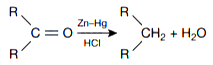
Clemmensen reduction
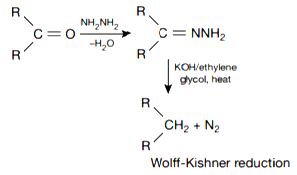
Wolff-Kishner reduction
as well as by catalytic hydrogenation.
\[
\left(R-\stackrel{i}{C}_{\frac{1}{R}}^{\frac{\pi}{1}}\right)_{4} A l^{-}+4 H^{+}(a q) \rightarrow R-\stackrel{1}{C}-O H+A l^{3+}(a q)
\]
Carbonyl carbon of ketones are reduced to \( -\mathrm{CH}_{2}- \) group in treatment with zinc amalgam and conc. \( \mathrm{HCl}(\mathrm{Clemmensen} \)
reduction) or with hydrazine followed by heating with sodium or \( \mathrm{KOH} \) in high boiling solvent such as ethylene glycol
(Wolff-Kishner reduction).
Clemmensen reduction
Wolff-Kishner reduction
See the Complete Solution
Get step-by-step explanations for this and 2.5 Lakh+ more JEE, NEET & CET questions.
- Unlock all solutions
- Practice the full chapter
- Track accuracy across PYQs
4.8 rated on Google Play · 14,000+ reviews
More questions from Chemistry
- Which of the following is incorrect in a galvanic cell?KCET 2016 Medium
- Time required for 100 per cent completion of a zero order reaction isKCET 2010 Medium
- Chlorobenzene reacts with bromine gas in the presence of \(\mathrm{Anhyd.} \mathrm{AlBr}_3\) to yield p-Bromochlorobenzene. This reaction is classified as ____KCET 2025 Easy
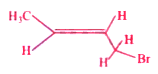
- IUPAC name of the compound
 KCET 2016 Easy
 - The correct order of electronegativities of \(\mathrm{N}, \mathrm{O}\), \(F\) and \(P\) isKCET 2012 Easy
- \( 2 \)-butyne is reduced to trans-but-2-ene usingKCET 2019 Easy
More PYQs from KCET
- The number of oxygen atoms in \( 4.4 \mathrm{gm} \) of \( \mathrm{CO}_{2} \) is,KCET 2016 Medium
- A simple pendulum is suspended from the ceiling of a lift. When the lift is at rest its time period is With what acceleration should the lift be accelerated upwards in order to reduce its period to \(\mathrm{T} / 2\) ? ( is acceleration due to gravity).KCET 2008 Hard
- Match the following.
Column-I Column-II (A) Cyclosporin - A (i) Clot busters (B) Streptokinase (ii) Antibiotic (C) Statins (iii) Immuno suppressive agent (D) Penicillin (iv) Blood cholesterol lowering agent KCET 2021 Easy - In domestic electric mains supply, the voltage and the current areKCET 2025 Easy
- Lines \( \frac{x-2}{1}+\frac{y-3}{1}=\frac{z-4}{-K} \) and \( \frac{x-1}{K}=\frac{y-4}{2}=\frac{z-5}{1} \) are co-planar ifKCET 2014 Medium
- Which of the following statements are true about \(\left[\mathrm{CoF}_6\right]^{3-}\) ion ?
I. The complex has octahedral geometry.
II. Coordination number of Co is 3 and oxidation state is +6 .
III. The complex is \(s p^3 d^2\) hybridised.
IV. It is a high spin complex.KCET 2024 Hard