


KCET · Chemistry · General Principles and Processes of Isolation of Metals
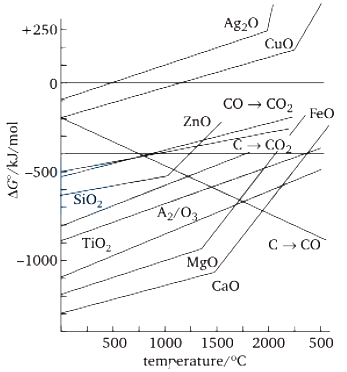
From the Ellingham graphs on carbon, which of the following statements is false?
- A \(\mathrm{CO}\) reduces \(\mathrm{Fe}_{2} \mathrm{O}_{3}\) to \(\mathrm{Fe}\) at less than \(983 \mathrm{~K}\)
- B \(\mathrm{CO}\) is less stable than \(\mathrm{CO}_{2}\) at more than \(983 \mathrm{~K}\)
- C \(\mathrm{CO}\) reduces \(\mathrm{Fe}_{2} \mathrm{O}_{3}\) to \(\mathrm{Fe}\) in the reduction zone of blast furnace
- D \(\mathrm{CO}_{2}\) is more stable than \(\mathrm{CO}\) at less than \(983 \mathrm{~K}\)
Answer & Solution
Correct Answer
(B) \(\mathrm{CO}\) is less stable than \(\mathrm{CO}_{2}\) at more than \(983 \mathrm{~K}\)
Step-by-step Solution
Detailed explanation
In Ellingham graph, initially the \(\Delta_{\mathrm{f}} \mathrm{G}^{\circ}\) more negative for \(\mathrm{CO}_{2}\), thus, \(\mathrm{CO}_{2}\) is more stable than CO but when the temperature becomes \(983 \mathrm{~K}\), the conditions inverted i.e., \(\Delta_{f} \mathrm{G}^{\circ}\) of \(\mathrm{CO}\) becomes more negative and hence above \(983 \mathrm{~K}\), CO becomes more stable than \(\mathrm{CO}_{2}\).
See the Complete Solution
Get step-by-step explanations for this and 2.5 Lakh+ more JEE, NEET & CET questions.
- Unlock all solutions
- Practice the full chapter
- Track accuracy across PYQs
4.8 rated on Google Play · 14,000+ reviews
More questions from Chemistry
- In Kolbe's reaction the reacting substances areKCET 2022 Easy
- Which of the following is incorrect in a galvanic cell?KCET 2016 Medium
- One mole of an organic compound A with the formula \(\mathrm{C}_{3} \mathrm{H}_{8} \mathrm{O}\) reacts completely with two moles of HI to form \(\mathrm{X}\) and \(\mathrm{Y}\). When \(\mathrm{Y}\) is boiled with aqueous alkali it forms Z. Z answers the iodoform test. The compound A isKCET 2010 Easy
- Which one of the following has a potential more than zero?KCET 2012 Easy
- Thyroxine produced in the thyroid gland is an iodinated derivative ofKCET 2023 Medium
- For alkali metals, which one of the following trends is incorrect?KCET 2010 Medium
More PYQs from KCET
- The correct order of ionisation energy of \(C, N, O\), \(F\) isKCET 2009 Easy
- Red light of wavelength \(625 \mathrm{~nm}\) is incident normally on an optical diffraction grating with \(2 \times 10^{5}\) lines \(/ \mathrm{m}\). Including central principal maxima, how many maxima may be observed on a screen which is far from the grating?KCET 2010 Hard
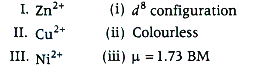
- Match the following.
CodesKCET 2024 Hard - During sewage treatment biogas produced includesKCET 2015 Hard
- A space station is at a height equal to the radius of the Earth. If ' \( V_{E} \) ' is the escape velocity on the surface of the Earth, the same on the space station is __ times \( V_{E} \).KCET 2018 Medium
- Which of the following colligative properties can provide molar mass of proteins, polymers and colloids with greater precision?KCET 2022 Easy