


KCET · Chemistry · General Principles and Processes of Isolation of Metals
Carbon cannot reduce \(\mathrm{Fe}_{2} \mathrm{O}_{3}\) to \(\mathrm{Fe}\) at a temperature below \(983 \mathrm{~K}\) because
- A free energy change for the formation of \(\mathrm{CO}\) is more negative than that of \(\mathrm{Fe}_{2} \mathrm{O}_{3}\)
- B \(\mathrm{CO}\) is thermodynamically more stable than \(\mathrm{Fe}_{2} \mathrm{O}_{3}\)
- C carbon has higher affinity towards oxygen than iron
- D iron has higher affinity towards oxygen than carbon
Answer & Solution
Correct Answer
(D) iron has higher affinity towards oxygen than carbon
Step-by-step Solution
Detailed explanation
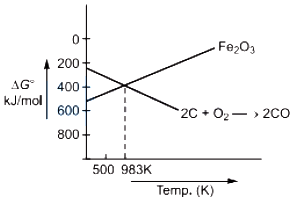
Below \(983 \mathrm{~K}\), conversion of iron to ferric oxide is more favourable.
See the Complete Solution
Get step-by-step explanations for this and 2.5 Lakh+ more JEE, NEET & CET questions.
- Unlock all solutions
- Practice the full chapter
- Track accuracy across PYQs
4.8 rated on Google Play · 14,000+ reviews
More questions from Chemistry
- When the pure solvent diffuses out of the solution through the semi-permeable membrane then
the process is calledKCET 2017 Medium - IUPAC name of \(\left(\mathrm{CH}_{3}\right)_{3} \mathrm{CCl}\) isKCET 2009 Easy
- The ore that is concentrated by froth floatation process isKCET 2009 Medium
- Which of the following can be used to test the acidic nature of ethanol?KCET 2019 Hard
- \(\alpha\)-maltose consists ofKCET 2011 Medium
- Which can adsorb larger volume of hydrogen gas?KCET 2022 Easy
More PYQs from KCET
- The order and degree of the differential equation \( \left[1+\left(\frac{d y}{d x}\right)^{2}+\sin \left(\frac{d y}{d x}\right)\right]^{\frac{3}{4}}=\frac{d^{2} y}{d x^{2}} \)KCET 2016 Easy
- With respect to DNA fragmentation
Statement A: Gel electrophoresis and elution are two important processes.
Statement B: After staining with ethidium bromide it has to be exposed to UV light.KCET 2015 Medium - Which one of the following characters favours the process of normal spermatogenesis in human male?KCET 2017 Easy
- X-rays, gamma rays and microwaves travelling in vacuum haveKCET 2012 Easy
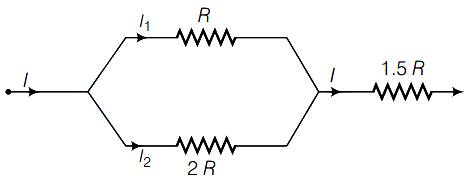
- In the circuit diagram, heat produces in \(R, 2 R\) and \(1.5 R\) are in the ratio of
 KCET 2013 Easy
 - If \( \left[\begin{array}{cc}1 & 1 \\ -1 & 1\end{array}\right]\left[\begin{array}{l}\mathrm{x} \\ \mathrm{y}\end{array}\right]=\left[\begin{array}{c}2 \\ 4\end{array}\right] \), then the values of \( \mathrm{x} \) and \( \mathrm{y} \) respectively areKCET 2018 Easy