


KCET · Chemistry · General Organic Chemistry
A correct statement is
- A \( \left[\begin{array}{lll}\mathrm{ZnBr}_{6} & ]^{3-} & \text { is tetrahedral. }\end{array}\right. \)
- B \( \left[N i\left(N H_{3}\right)_{6}\right]^{2+} \) is an inner orbital complex
- C \( \left[\mathrm{Co}\left(\mathrm{NH}_{3}\right)_{6}\right]^{2+} \) is paramagnetic.
- D \( \left[\mathrm{CoBr}_{2}(e n)_{2}\right]^{-} \)exhibits linkage isomerism.
Answer & Solution
Correct Answer
(C) \( \left[\mathrm{Co}\left(\mathrm{NH}_{3}\right)_{6}\right]^{2+} \) is paramagnetic.
Step-by-step Solution
Detailed explanation
Option (1) \(\left[\mathrm{MnBr}_{4}\right]^{2-}\)
\(\mathrm{Br}^{-}\)weak ligand does not allow pairing of \(e^{-} s\), therefore, hybridization of the Mn in complex is sp3 and geometry is
tetrahedral.
Option \((2)\left[\mathrm{Ni}\left(\mathrm{NH}_{3}\right)_{6}\right]^{2+}\)
\(\mathrm{NH}_{3}\) is a strong field ligand, therefore, pairing of electrons will take place. But due to insufficiency of vacant orbital,
pairing will not take place
Electronic configuration of \(\mathrm{Ni}(\mathrm{Z}=8)[\mathrm{Ar}] 3 d^{8} 4 s^{2}\)
Electronic configuration of \(N i^{2+}\) is \([\mathrm{Ar}] 3 d^{8}\)
\(N i^{2+}\) in the presence of strong field ligand
\begin{array}{|l|l|l|l|l|}
\hline 1 L & 1 L & 1 L & 1 & 1 \\
\hline
\end{array}
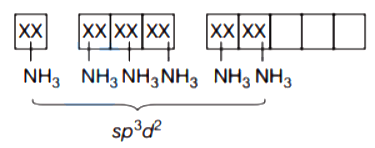
It is outer orbital complex and not an inner orbital complex Option (3) \(\left[\mathrm{Co}\left(\mathrm{NH}_{3}\right)_{6}\right]^{2+}\)
\(\mathrm{NH}_{3}\) is a strong field ligand, therefore, pairing will take place Electronic configuration of \(C_{0}(Z=27)\) is \([A r] 3 d^{74} S^{2}\) Electronic configuration of \(\mathrm{Co}^{2+}\) is \([\mathrm{Ar}] 3 d^{7}\) \(\mathrm{Co}^{2+}\) in the presence of strong field ligand.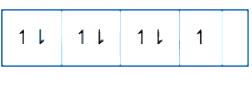
There is one unpaired \(e^{-}\)therefore, it is paramagnetic
Option (4) \(\left[\mathrm{CoBr}_{2}(e n)_{2}\right]^{-}\)does not have ambidentate ligands, therefore, is does not exhibits linkage isomerism.
\(\mathrm{Br}^{-}\)weak ligand does not allow pairing of \(e^{-} s\), therefore, hybridization of the Mn in complex is sp3 and geometry is
tetrahedral.
Option \((2)\left[\mathrm{Ni}\left(\mathrm{NH}_{3}\right)_{6}\right]^{2+}\)
\(\mathrm{NH}_{3}\) is a strong field ligand, therefore, pairing of electrons will take place. But due to insufficiency of vacant orbital,
pairing will not take place
Electronic configuration of \(\mathrm{Ni}(\mathrm{Z}=8)[\mathrm{Ar}] 3 d^{8} 4 s^{2}\)
Electronic configuration of \(N i^{2+}\) is \([\mathrm{Ar}] 3 d^{8}\)
\(N i^{2+}\) in the presence of strong field ligand
\begin{array}{|l|l|l|l|l|}
\hline 1 L & 1 L & 1 L & 1 & 1 \\
\hline
\end{array}
It is outer orbital complex and not an inner orbital complex Option (3) \(\left[\mathrm{Co}\left(\mathrm{NH}_{3}\right)_{6}\right]^{2+}\)
\(\mathrm{NH}_{3}\) is a strong field ligand, therefore, pairing will take place Electronic configuration of \(C_{0}(Z=27)\) is \([A r] 3 d^{74} S^{2}\) Electronic configuration of \(\mathrm{Co}^{2+}\) is \([\mathrm{Ar}] 3 d^{7}\) \(\mathrm{Co}^{2+}\) in the presence of strong field ligand.
There is one unpaired \(e^{-}\)therefore, it is paramagnetic
Option (4) \(\left[\mathrm{CoBr}_{2}(e n)_{2}\right]^{-}\)does not have ambidentate ligands, therefore, is does not exhibits linkage isomerism.
See the Complete Solution
Get step-by-step explanations for this and 2.5 Lakh+ more JEE, NEET & CET questions.
- Unlock all solutions
- Practice the full chapter
- Track accuracy across PYQs
4.8 rated on Google Play · 14,000+ reviews
More questions from Chemistry
- The test to differentiate between pentan-2-one and pentan-3-one isKCET 2022 Medium
- Which one of the following is the most energetic conformation of cyclohexane?KCET 2011 Medium
- For a chemical reaction,
\( \mathrm{mA} \rightarrow \mathrm{xB} \), the rate law is \( r=k[\mathrm{~A}]^{2} \).
If the concentration of \( A \) is doubled, the reaction rate will be,KCET 2016 Medium - \(9.65 \mathrm{C}\) of electric current is passed through fused alhydrous \(\mathrm{MgCl}_{2}\). The magnesium metal thus obtained is completely converted into a Grignard reagent. The number of moles of Grignard reagent obtained isKCET 2011 Medium
- Which of the following is least soluble in water at \( 298 \mathrm{~K} ? \)KCET 2019 Medium
- The number of chain isomers possible for the hydrocarbon with molecular formula \(\text{C}_5\text{H}_{12}\) isKCET 2026 Easy
More PYQs from KCET
- If \(y=\frac{\cos x}{1+\sin x}\), then
(a) \(\frac{d y}{d x}=\frac{-1}{1+\sin x}\)
(b) \(\frac{d y}{d x}=\frac{1}{1+\sin x}\)
(c) \(\frac{\mathrm{dy}}{\mathrm{dx}}=-\frac{1}{2} \sec ^2\left(\frac{\pi}{4}-\frac{\mathrm{x}}{2}\right)\)
(d) \(\frac{d y}{d x}=\frac{1}{2} \sec ^2\left(\frac{\pi}{4}-\frac{x}{2}\right)\)KCET 2025 Medium - \( x_{1} \) and \( x_{2} \) are susceptibility of a paramagnetic material at temperatures \( T_{1} K \) and \( T_{2} K \) respectively, thenKCET 2016 Easy
- The equation of the curve passing through the point \( (1,1) \) such that the slope of the tangent at
any point \( (x, y) \) is equal to the product of its co-ordinates isKCET 2019 Medium - Oils are liquids at room temperature since they contain higher percentage ofKCET 2013 Hard
- Match the reactant in Column - \( 1 \) with the reaction in Column - II
\begin{array}{|l|l|}
\hline I & II \\
\hline (i) Acetic acid & (a) Stephen \\
\hline (ii) Sodium phenate & (b) Friedel-Crafts \\
\hline (iii) Methyl cyanide & (c) HVZ \\
\hline (iv) Toluen & (d) Kolbe's \\
\hline
\end{array}KCET 2014 Easy - In India the action plans for family planning were initiated in the year.KCET 2017 Hard