


KCET · BIOLOGY · STD 12 - 5. Molecular Basis of Inheritance
Statement A: The primary transcript produced in eukaryotes is tanslated without undergoing any modification or processing.
Statement B: The hnRNA in humans has exons and introns.
- A Statement B is correct and statement A is wrong.
- B Both the statements A and B are correct.
- C Statement A is correct and statement B is wrong.
- D Both the statements A and B are wrong.
Answer & Solution
Correct Answer
(A) Statement B is correct and statement A is wrong.
Step-by-step Solution
Detailed explanation
(A) Statement B is correct and statement A is wrong.,
Only statement b is correct. Transcription in eukaryotes occurs within the nucleus and mRNA moves out of the nucleus into the cytoplasm for translation. The primary mRNA transcript is longer and localised into the nucleus, where it is also called heterogenous nuclear RNA (hnRNA) or pre- mRNA. It has both exons and introns.
Only statement b is correct. Transcription in eukaryotes occurs within the nucleus and mRNA moves out of the nucleus into the cytoplasm for translation. The primary mRNA transcript is longer and localised into the nucleus, where it is also called heterogenous nuclear RNA (hnRNA) or pre- mRNA. It has both exons and introns.
See the Complete Solution
Get step-by-step explanations for this and 2.5 Lakh+ more JEE, NEET & CET questions.
- Unlock all solutions
- Practice the full chapter
- Track accuracy across PYQs
4.8 rated on Google Play · 14,000+ reviews
More questions from BIOLOGY
- Silencing of a specific mRNA translation could be achieved throughKCET 2018 Medium
- The allele frequency of 'A' and 'a' in a population are 0.6 and 0.4 respectively. the expected frequency of heterozygous individuals isKCET 2018 Easy
- Which one of the following statements about the events of non cyclic photophosphorylation is not correctKCET 2010 Medium
- Match column-I with column-II.
Column-1 Column-II A. Sunflower p. Acanthaceae B. Tulsi q. Compositae C. Coffee r. Labiatae D. Vasaka s. Rubiaceae t. Euphorbiaceae KCET 2009 Easy - Identifying the cells representing P, Q, R and S in the given schematic representation of spermatogenesis
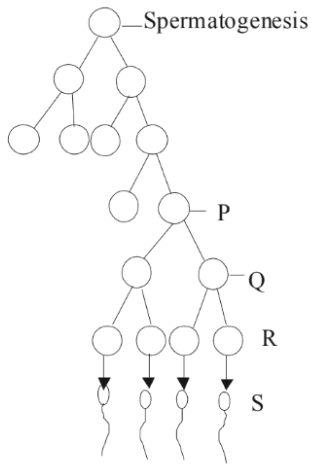 KCET 2019 Easy
 - Match the compounds of Column I with their function in Column II.
Column I Column II A. Trypsin (i) Fights infectious agents B. GLUT-4 (ii) Is an intercellular ground substance C. Collagen (iii) Works as an enzyme D. Antibody (iv) Enables glucose transport into cells KCET 2021 Medium
More PYQs from KCET
- Formic acid is a stronger acid than acetic acid.
This can be explained usingKCET 2011 Medium - Which of the following can be measured by the Ostwald-Walker dynamic method?KCET 2008 Easy
- For the reversible reaction.
\(\mathrm{A}(\mathrm{s})+\mathrm{B}(\mathrm{g}) \rightleftharpoons \mathrm{C}(\mathrm{g})+\mathrm{D}(\mathrm{g});\)
\(\Delta \mathrm{G}^{\circ}=-350 \mathrm{~kJ}\)
Which one of the following statements is true?KCET 2010 Easy - If the side of a cube is increased by \(5 \%\), then the surface area of a cube is increased byKCET 2020 Easy
- \[
\begin{array}{l}
M n O_{2}+H C l-\Delta \\
A_{(g)}+F_{2}(\text { excess })_{--}>->B_{(g)} \\
B_{(l)}+U_{(s)}-\cdots C_{(g)}+D_{(g)}
\end{array}
\]
The gases \( A, B, C \) and \( D \) are respectivelyKCET 2014 Medium - Progestasert is an IUD which makes the uterus unsuitable and cervix hostile to the sperms as they areKCET 2015 Easy