


KCET · BIOLOGY · STD 11 - 13. Plant Growth and Development
In the following diagrammatic representation showing stages of embryonic development, identify the type of growth phase labelled as M and N.
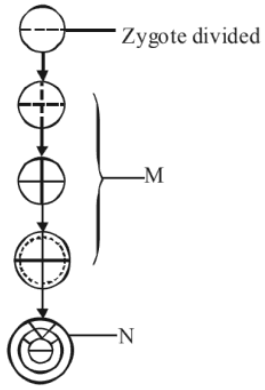
- A M is geometric phase and N are arithmetic phases.
- B Both M and N are arithmetic phases.
- C Mis arithmetic phase and N is geometric phase.
- D Both M and N are geometric phases.
Answer & Solution
Correct Answer
(A) M is geometric phase and N are arithmetic phases.
Step-by-step Solution
Detailed explanation
(A) M is geometric phase and N are arithmetic phases.,
In this diagram, M is representing the geometric phase that include all cells are dividing N is showing arithmetic phase.
In this diagram, M is representing the geometric phase that include all cells are dividing N is showing arithmetic phase.
See the Complete Solution
Get step-by-step explanations for this and 2.5 Lakh+ more JEE, NEET & CET questions.
- Unlock all solutions
- Practice the full chapter
- Track accuracy across PYQs
4.8 rated on Google Play · 14,000+ reviews
More questions from BIOLOGY
- Find the mismatch from the following pairs.KCET 2016 Hard
- In this diagram showing the L. S. of an embryo of grass identify the answer having the correct combination of alphabets with the right part.
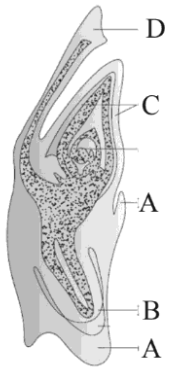 KCET 2014 Hard
 - Which of the following phyla possess body cavity as shown in the diagram below?
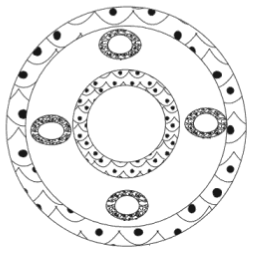 KCET 2019 Easy
 - Which of the following options shows the characters of mycoplasma?KCET 2017 Medium
- The correct equation depicting species-area relationship isKCET 2021 Medium
- What is the function of the enzyme 'recombinase' during meiosis?KCET 2016 Medium
More PYQs from KCET
- In which of the following phyla the adult shows radial symmetry, while the larva shows bilateral symmetry?KCET 2013 Medium
- The amount of energy released when one microgram of matter is annihilated isKCET 2009 Easy
- If \(\overrightarrow{\mathbf{a}}, \overrightarrow{\mathbf{b}}\) and \(\overrightarrow{\mathbf{c}}\) are unit vectors, such that \(\overrightarrow{\mathbf{a}}+\overrightarrow{\mathbf{b}}+\overrightarrow{\mathbf{c}}=\overrightarrow{\mathbf{0}}\), then \(3 \overrightarrow{\mathbf{a}} \cdot \overrightarrow{\mathbf{b}}+2 \overrightarrow{\mathbf{b}} \cdot \overrightarrow{\mathbf{c}}+\overrightarrow{\mathbf{c}} \cdot \overrightarrow{\mathbf{a}}\) isKCET 2010 Medium
- Which one of the following statements about the events of non cyclic photophosphorylation is not correctKCET 2010 Medium
- After adding non-volatile solute freezing point of water decreases to \( -0.186^{\circ} \mathrm{C} . \) Calculate
\( \Delta T_{b} \) if \( K_{\mathrm{f}}=1.86 K \mathrm{~kg} \mathrm{~mol}^{-1} \) and \( K_{b}=0.521 K \mathrm{~kg} \mathrm{~mol}^{-1} \)KCET 2015 Hard - In an experiment to study photoelectric effect the observed variation of stopping potential with frequency of incident radiation is as shown in the figure. The slope and \(y\)-intercept are respectively
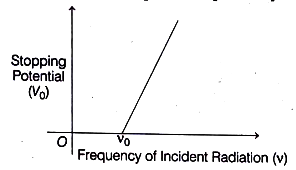 KCET 2023 Easy