


JEE Mains · Maths · STD 11 - 10.2 parabola,ellipse,hyperbola
The tangent and normal to the ellipse \(3x^2 + 5y^2 = 32\) at the point \(P(2, 2)\) meet the \(x-\) axis at \(Q\) and \(R,\) respectively. Then the area(in sq. units) of the triangle \(PQR\) is
- A \(\frac {34}{15}\)
- B \(\frac {68}{15}\)
- C \(\frac {14}{3}\)
- D \(\frac {16}{3}\)
Answer & Solution
Correct Answer
(B) \(\frac {68}{15}\)
Step-by-step Solution
Detailed explanation
\(3{x^2} + 5{y^2} = 32\) \({\left. {\frac{{dy}}{{dx}}} \right|_{\left( {2,2} \right)}} = - \frac{3}{5}\) tengent \(:y - 2 = - \frac{3}{5}\left( {x - 2} \right) \Rightarrow Q\left( {\frac{{16}}{3},0} \right)\) Normal…
See the Complete Solution
Get step-by-step explanations for this and 2.5 Lakh+ more JEE, NEET & CET questions.
- Unlock all solutions
- Practice the full chapter
- Track accuracy across PYQs
4.8 rated on Google Play · 14,000+ reviews
More questions from Maths
- If the four points, whose position vectors are \(3 \hat{ i }-4 \hat{ j }+2 \hat{ k }, \hat{ i }+2 \hat{ j }-\hat{ k },-2 \hat{ i }-\hat{ j }+3 \hat{ k } \quad\) and \(5 \hat{ i }-2 \alpha \hat{ j }+4 \hat{ k }\) are coplanar, then \(\alpha\) is equal toJEE Mains 2023 Medium
- Let \( \alpha_{1}, \alpha_{2}, \alpha_{3}, \alpha_{4} \) be an A.P. of four terms such that each term of the A.P. and its common difference \( l \) are integers. If \( \alpha_{1}+\alpha_{2}+\alpha_{3}+\alpha_{4}=48 \) and \( \alpha_{1},\alpha_{2},\alpha_{3},\alpha_{4}+l^{4}=361 \) then the largest term of the A.P. is equal toJEE Mains 2026 Medium
- The area (in sq. units) of the region bounded by the curve \(x^2 = 4y\) and the straight line \(x = 4y - 2\) isJEE Mains 2019 Hard
- If in a parallelogram \(ABDC\), the coordinates of \(A, B\) and \(C\) are respectively \((1, 2), (3, 4)\) and \((2, 5)\), then the equation of the diagonal \(AD\) isJEE Mains 2019 Hard
- Let \(p,q\in R.\) if \(2-\sqrt 3\) is a root of the quadratic equation, \(x^2 + px + q = 0,\) thenJEE Mains 2019 Hard
- For \(k \in R\), let the solutions of the equation \(\cos \left(\sin ^{-1}\left(x \cot \left(\tan ^{-1}\left(\cos \left(\sin ^{-1} x\right)\right)\right)\right)\right)=k, 0\,<\,|x|<\,\frac{1}{\sqrt{2}}\) be \(\alpha\) and \(\beta\), where the inverse trigonometric functions take only principal values. If the solutions of the equation \(x ^{2}- bx -5=0\) are \(\frac{1}{\alpha^{2}}+\frac{1}{\beta^{2}}\) and \(\frac{\alpha}{\beta}\), then \(\frac{b}{k^{2}}\) is equal to\(......\)JEE Mains 2022 Hard
More PYQs from JEE Mains
- If for the matrix, \(A =\left[\begin{array}{cc}1 & -\alpha \\ \alpha & \beta\end{array}\right], AA ^{ T }= I _{2},\) then the value of \(\alpha^{4}+\beta^{4}\) is ....... .JEE Mains 2021 Medium
- In a school, there are three types of games to be played. Some of the students play two types of games, but none play all the three games. Which Venn diagrams can justify the above statement ?
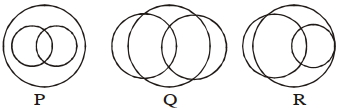 JEE Mains 2021 Easy
 - Let \(\vec{a}\) and \(\vec{b}\) be two unit vectors such that the angle between them is \(\frac{\pi}{3}\). If \(\lambda \vec{a}+2 \vec{b}\) and \(3 \vec{a}-\lambda \vec{b}\) are perpendicular to each other, then the number of values of \(\lambda\) in \([-1,3]\) is :JEE Mains 2025 Medium
- Let \(\mathrm{A}=\left[\mathrm{a}_{i j}\right]=\left[\begin{array}{cc}\log _5 128 & \log _4 5 \\ \log _5 8 & \log _4 25\end{array}\right]\).
If \(\mathrm{A}_{i j}\) is the cofactor of \(\mathrm{a}_{i j}, \mathrm{C}_{i j}=\sum_{\mathrm{k}=1}^2 \mathrm{a}_{i \mathrm{k}} \mathrm{A}_{j \mathrm{k}}, 1 \leq i, j \leq 2\), and \(\mathrm{C}=\left[\mathrm{C}_{i j}\right]\), then \(8|\mathrm{C}|\) is equal to :JEE Mains 2025 Easy - An electric instrument consists of two units. Each unit must function independently for the instrument to operate. The probability that the first unit functions is \(0.9\) and that of the second unit is \(0.8\). The instrument is switched on and it fails to operate. If the probability that only the first unit failed and second unit is functioning is \(\mathrm{p}\), then \(98\, \mathrm{p}\) is equal to ..... .JEE Mains 2021 Hard
- The sum of all the real solutions of the equation \( log_{(x+3)}(6x^{2}+28x+30)=5-2log_{(6x+10)}(x^{2}+6x+9) \) is equal to:JEE Mains 2026 Hard