


JEE Mains · Maths · STD 12 - 9. differential equations
Let \(\alpha\) be a non-zero real number. Suppose \(f: \mathrm{R} \rightarrow\) \(\mathrm{R}\) is a differentiable function such that \(f(0)=2\) and \(\lim _{\mathrm{x} \rightarrow-\infty} \mathrm{f}(\mathrm{x})=1\). If \(f^{\prime}(\mathrm{x})=\alpha f(x)+3\), for all \(\mathrm{x} \in \mathrm{R}\), then \(f\left(-\log _e 2\right)\) is equal to ...........
- A \(3\)
- B \(5\)
- C \(9\)
- D \(7\)
Answer & Solution
Correct Answer
(A) \(3\)
Step-by-step Solution
Detailed explanation
\( f(0)=2, \lim _{x \rightarrow-\infty} f(x)=1 \) \( f^{\prime}(x)-\alpha \cdot f(x)=3 \) \( \text { I.F }=e^{-\alpha x} \) \( y\left(e^{-\alpha x}\right)=\int 3 \cdot e^{-\alpha x} d x \) \( f(x) \cdot\left(e^{-\alpha x}\right)=\frac{3 e^{-\alpha x}}{-\alpha}+c \)…
See the Complete Solution
Get step-by-step explanations for this and 2.5 Lakh+ more JEE, NEET & CET questions.
- Unlock all solutions
- Practice the full chapter
- Track accuracy across PYQs
4.8 rated on Google Play · 14,000+ reviews
More questions from Maths
- In a school, there are three types of games to be played. Some of the students play two types of games, but none play all the three games. Which Venn diagrams can justify the above statement ?
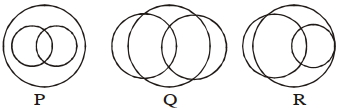 JEE Mains 2021 Easy
 - If the ellipse \(\frac{ x ^{2}}{ a ^{2}}+\frac{ y ^{2}}{ b ^{2}}=1\) meets the line \(\frac{x}{7}+\frac{y}{2 \sqrt{6}}=1\) on the \(x\)-axis and the line \(\frac{x}{7}-\frac{y}{2 \sqrt{6}}=1\) on the \(y\)-axis, then the eccentricity of the ellipse isJEE Mains 2022 Hard
- Let \(X=\{\mathrm{x} \in \mathrm{N}: 1 \leq \mathrm{x} \leq 17\}\) and \(\mathrm{Y}=\{\mathrm{ax}+\mathrm{b}: \mathrm{x} \in \mathrm{X}\) and \(\mathrm{a}, \mathrm{b} \in \mathrm{R}, \mathrm{a}>0\} .\) If mean and variance of elements of \(Y\) are \(17\) and \(216\) respectively then \(a + b\) is equal toJEE Mains 2020 Hard
- Let \(S_{ k }=\frac{1+2+\ldots .+ K }{ K }\) and \(\sum_{j=1}^n S_j^2=\frac{n}{A}\left( Bn ^2+ Cn + D \right)\), where \(A , B , C , D \in N\) and \(A\) has least value. ThenJEE Mains 2023 Hard
- If \(2 x^y+3 y^x=20\), then \(\frac{d y}{d x}\) at \((2,2)\) is equal toJEE Mains 2023 Hard
- Let \(\overrightarrow{a}=2 \hat{i}-\hat{j}+\hat{k}\) and \(\overrightarrow{b}=\lambda \hat{j}+2 \hat{k}, \lambda \in Z\) be two vectors, Let \(\overrightarrow{ c }=\overrightarrow{ a } \times \overrightarrow{ b }\) and \(\overrightarrow{ d }\) be a vector of magnitude 2 in yz-plane. If \(|\overrightarrow{ c |}=\sqrt{53}\), then the maximum possible value of \((\overrightarrow{ c } \cdot \overrightarrow{ d })^2\) is equal to :JEE Mains 2026 Hard
More PYQs from JEE Mains
- Let \([\cdot]\) denote the greatest integer function. If the domain of the function \(f(x) = \sin^{-1}\left(\dfrac{x+[x]}{3}\right)\) is \([\alpha, \beta)\), then \(\alpha^2 + \beta^2\) is equal to:JEE Mains 2026 Medium
- For some \(\theta \in\left(0, \frac{\pi}{2}\right),\) if the eccentricity of the hyperbola, \(x^{2}-y^{2} \sec ^{2} \theta=10\) is \(\sqrt{5}\) times the eccentricity of the ellipse, \(x^{2} \sec ^{2} \theta+y^{2}=5,\) then the length of the latus rectum of the ellipse isJEE Mains 2020 Hard
- Let \(I(x)=\int \sqrt{\frac{x+7}{x}} d x\) and \(I(9)=12+7 \log _e 7\) If I \((1)=\alpha+7 \log _e(1+2 \sqrt{2})\), then \(\alpha^4\) is equal to \(..........\).JEE Mains 2023 Hard
- If the curve \(x^{2}+2 y^{2}=2\) intersects the line \(x + y =1\) at two points \(P\) and \(Q ,\) then the angle subtended by the line segment \(PQ\) at the origin is ...... .JEE Mains 2021 Medium
- If the coefficient of \(x ^7\) in \(\left(a x-\frac{1}{b x^2}\right)^{13}\) and the coefficient of \(x^{-5}\) in \(\left(a x+\frac{1}{b x^2}\right)^{13}\) are equal, then \(a^4 b^4\) is equal to :JEE Mains 2023 Hard
- Let \(\left|\frac{\bar{z}-i}{2 \bar{z}+i}\right|=\frac{1}{3}, z \in C\), be the equation of a circle with center at \(C\). If the area of the triangle, whose vertices are at the points \((0,0), \mathrm{C}\) and \((\alpha, 0)\) is 11 square units, then \(\alpha^2\) equals:JEE Mains 2025 Hard