


JEE Mains · Maths · STD 11 - 4.2 Quadratic equations and inequations
Let \(\alpha\) and \(\beta\) be the roots of the equation \(5 x^{2}+6 x-2=0 .\) If \(S_{n}=\alpha^{n}+\beta^{n}, n=1,2,3 \ldots\) then :
- A \(5 \mathrm{S}_{6}+6 \mathrm{S}_{5}=2 \mathrm{S}_{4}\)
- B \(5 \mathrm{S}_{6}+6 \mathrm{S}_{5}+2 \mathrm{S}_{4}=0\)
- C \(6 \mathrm{S}_{6}+5 \mathrm{S}_{5}+2 \mathrm{S}_{4}=0\)
- D \(6 \mathrm{S}_{6}+5 \mathrm{S}_{5}=2 \mathrm{S}_{4}\)
Answer & Solution
Correct Answer
(A) \(5 \mathrm{S}_{6}+6 \mathrm{S}_{5}=2 \mathrm{S}_{4}\)
Step-by-step Solution
Detailed explanation
\(\alpha\) and \(\beta\) are roots of \(5 x^{2}+6 x-2=0\) \(\Rightarrow 5 \alpha^{2}+6 \alpha-2=0\) \(\Rightarrow 5 \alpha^{n+2}+6 \alpha^{n+1}-2 \alpha^{n}=0 \quad \ldots(1)\) (By multiplying \(\left.\alpha^{n}\right)\) Similarly…
See the Complete Solution
Get step-by-step explanations for this and 2.5 Lakh+ more JEE, NEET & CET questions.
- Unlock all solutions
- Practice the full chapter
- Track accuracy across PYQs
4.8 rated on Google Play · 14,000+ reviews
More questions from Maths
- If for the complex numbers \(z\) satisfying \(|z-2-2 i| \leq 1\), the maximum value of \(|3 i z+6|\) is attained at \(\mathrm{a}+i \mathrm{~b}\), then \(\mathrm{a}+\mathrm{b}\) is equal to .... .JEE Mains 2021 Hard
- The number of distinct real roots of the equation \(3 x^{4}+4 x^{3}-12 x^{2}+4=0\) is ..... .JEE Mains 2021 Hard
- If \(\vec a,\vec b\) and \(\vec c\) are unit vectors such that \(\vec a + 2\vec b + 2\vec c = \vec 0\), then \(\left| {\vec a \times \vec c} \right|\) is equal toJEE Mains 2018 Hard
- The tangent to the curve, \(y = xe^{x^2}\) passing, through the point \((1, e)\) also passes through the pointJEE Mains 2019 Hard
- If \(a > 0\) and \(z = \frac{{{{\left( {1 + i} \right)}^2}}}{{a - i}}\), has magnitude \(\sqrt {\frac{2}{5}} \), then \(\bar z\) is equal to:JEE Mains 2019 Hard
- Let \(y = y(x)\) be the solution curve of the differential equation \((1 + \sin x)\dfrac{dy}{dx} + (y+1)\cos x = 0\), \(y(0) = 0\). If the curve \(y = y(x)\) passes through the point \(\left(\alpha, \dfrac{-1}{2}\right)\), then a value of \(\alpha\) is :JEE Mains 2026 Easy
More PYQs from JEE Mains
- A value of \(x\) satisfying the equation \(\sin \left[ {{{\cot }^{ - 1}}\left( {1 + x} \right)} \right] = \cos \left[ {{{\tan }^{ - 1}}\,x} \right]\) , isJEE Mains 2017 Hard
- Let the sum of the maximum and the minimum values of the function \(f(x)=\frac{2 x^2-3 x+8}{2 x^2+3 x+8}\) be \(\frac{m}{n}\), where \(\operatorname{gcd}(\mathrm{m}, \mathrm{n})=1\). Then \(\mathrm{m}+\mathrm{n}\) is equal to :JEE Mains 2024 Hard
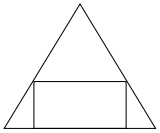
- If a rectangle is inscribed in an equilateral triangle of side length \(2 \sqrt{2}\) as shown in the figure, then the square of the largest area of such a rectangle is \(....\)
 JEE Mains 2021 Hard
 - Let \(A\left[\begin{array}{cc}1 & 2 \\ -1 & 4\end{array}\right] .\) If \(A^{-1}=\alpha I+\beta A, \alpha, \beta \in R, I\) is a \(2 \times 2\) identity matrix, then \(4(\alpha-\beta)\) is equal to:JEE Mains 2021 Medium
- The equation of a plane containing the line of intersection of the planes \(2x - y - 4 = 0\) and \(y + 2z - 4 = 0\) and passing through the point \((1, 1, 0)\) isJEE Mains 2019 Medium
- The number of distinct real roots of the equation \(|\mathrm{x}+1||\mathrm{x}+3|-4|\mathrm{x}+2|+5=0\), is ...........JEE Mains 2024 Hard