


JEE Advanced · Physics · 15. Oscillations
A block of mass \(5 \mathrm{~kg}\) moves along the \(x\)-direction subject to the force \(F=(-20 x+10) \mathrm{N}\), with the value of \(x\) in metre. At time \(t=0 \mathrm{~s}\), it is at rest at position \(x=1 \mathrm{~m}\). The position and momentum of the block at \(t=(\pi / 4) \mathrm{s}\) are
- A \(-0.5 \mathrm{~m}, 5 \mathrm{~kg} \mathrm{~m} / \mathrm{s}\)
- B \(0.5 \mathrm{~m}, 0 \mathrm{~kg} \mathrm{~m} / \mathrm{s}\)
- C \(0.5 \mathrm{~m},-5 \mathrm{~kg} \mathrm{~m} / \mathrm{s}\)
- D \(-1 \mathrm{~m}, 5 \mathrm{~kg} \mathrm{~m} / \mathrm{s}\)
Answer & Solution
Correct Answer
(C) \(0.5 \mathrm{~m},-5 \mathrm{~kg} \mathrm{~m} / \mathrm{s}\)
Step-by-step Solution
Detailed explanation
\(\mathrm{F}=-20\left(\mathrm{x}-\frac{1}{2}\right)=-20 \mathrm{X} \quad\left(\mathrm{X}=\mathrm{x}-\frac{1}{2}\right)\)
\(\therefore\) Particle will perform SHM about \(\mathrm{x}=\frac{1}{2}\) with \(\omega=2 \mathrm{rad} / \mathrm{sec} \Rightarrow \mathrm{T}=\pi \mathrm{sec}\).
\(\therefore\) Phase covered in \(t=\frac{\pi}{4}\) second \(=90^{\circ}\).
Given particle is at rest at \(\mathrm{x}=1 \mathrm{~m} \Rightarrow \mathrm{x}=1\) is extreme position.
\(\therefore\) In \(\frac{\pi}{4}\) sec, it will be at equilibrium
\(\therefore \mathrm{x}=0.5 \mathrm{~m}\) and momentum \(=\mathrm{m} \omega \mathrm{A}=5 \times 2 \times 0.5=5 \mathrm{~kg} \mathrm{~m} / \mathrm{s}\) Direction will be towards -ve \(\mathrm{x}\).
Hence option (3)
\(\therefore\) Particle will perform SHM about \(\mathrm{x}=\frac{1}{2}\) with \(\omega=2 \mathrm{rad} / \mathrm{sec} \Rightarrow \mathrm{T}=\pi \mathrm{sec}\).
\(\therefore\) Phase covered in \(t=\frac{\pi}{4}\) second \(=90^{\circ}\).
Given particle is at rest at \(\mathrm{x}=1 \mathrm{~m} \Rightarrow \mathrm{x}=1\) is extreme position.
\(\therefore\) In \(\frac{\pi}{4}\) sec, it will be at equilibrium
\(\therefore \mathrm{x}=0.5 \mathrm{~m}\) and momentum \(=\mathrm{m} \omega \mathrm{A}=5 \times 2 \times 0.5=5 \mathrm{~kg} \mathrm{~m} / \mathrm{s}\) Direction will be towards -ve \(\mathrm{x}\).
Hence option (3)
See the Complete Solution
Get step-by-step explanations for this and 2.5 Lakh+ more JEE, NEET & CET questions.
- Unlock all solutions
- Practice the full chapter
- Track accuracy across PYQs
4.8 rated on Google Play · 14,000+ reviews
More questions from Physics
- A series \(R-C\) combination is connected to an \(\mathrm{AC}\) voltage of angular frequency \(\omega=500 \mathrm{rad} / \mathrm{s}\). If the impedance of the \(R-C\) circuit is \(R \sqrt{1.25}\), the time constant (in millisecond) of the circuit isJEE Advanced 2011 Easy
- Paragraph:
The nuclear charge \((\mathrm{Ze})\) is non-uniformly distributed within a nucleus of radius \(R\). The charge density \(\rho(r)\) [charge per unit volume] is dependent only on the radial distance \(r\) from the centre of the nucleus as shown in figure. The electric field is only along the radial direction.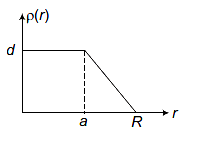
Question:
The electric field within the nucleus is generally observed to be linearly dependent on \(r\). This impliesJEE Advanced 2008 Medium - A free hydrogen atom after absorbing a photon of wavelength gets excited from the state to the state Immediately after that the electron jumps to state by emitting a photon of wavelength Let the change in momentum of atom due to the absorption and the emission are and respectively. If Which of the option(s) is/are correct?
[Use and are Planck's constant and speed of light, respectively]JEE Advanced 2019 Medium - Paragraph:
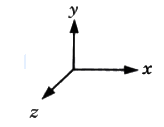
In a thin rectangular metallic strip a constant current \(I\) flows along the positive \(x\)-direction, as shown in the figure. The length, width and thickness of the strip are \(l, w\) and \(d\), respectively.
A uniform magnetic field \(\vec{B}\) is applied on the strip along the positive \(y\)-direction. Due to this, the charge carriers experience a net deflection along the \(z\)-direction. This results in accumulation of charge carriers on the surface \(P Q R S\) and appearance of equal and opposite charges on the face opposite to \(P Q R S\). A potential difference along the \(z\)-direction is thus developed. Charge accumulation continues until the magnetic force is balanced by the electric force. The current is assumed to be uniformly distributed on the cross section of the strip and carried by electrons.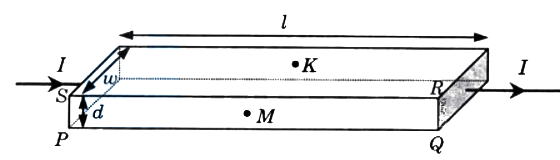
Question:
Consider two different metallic strips (\(1\) and \(2\)) of the same material. Their lengths are the same, widths are \(w_{1}\) and \(w_{2}\) and thicknesses are \(d_{1}\) and \(d_{2}\), respectively. Two points \(K\) and \(M\) are symmetrically located on the opposite faces parallel to the \(x-y\) plane (see figure). \(V_{1}\) and \(V_{2}\) are the potential differences between \(K\) and \(M\) in strips \(1\) and \(2\), respectively. Then, for a given current \(I\) flowing through them in a given magnetic field strength \(B\), the correct statement(s) is(are)JEE Advanced 2015 Medium - Two beads, each with charge \(q\) and mass \(m\), are on a horizontal, frictionless, non-conducting, circular hoop of radius \(R\). One of the beads is glued to the hoop at some point, while the other one performs small oscillations about its equilibrium position along the hoop. The square of the angular frequency of the small oscillations is given by
[ \(\varepsilon_0\) is the permittivity of free space.]JEE Advanced 2024 Hard - A physical quantity is defined as . where is electric field, is magnetic field and is the permeability of free space. The dimensions of are the same as the dimensions of which of the following quantity/quantities?JEE Advanced 2021 Easy
More PYQs from JEE Advanced
- Let \(\mathbf{a}=-\hat{\mathbf{i}}-\hat{\mathbf{k}}, \mathbf{b}=-\hat{\mathbf{i}}+\hat{\mathbf{j}}\) and \(\mathbf{c}=\hat{\mathbf{i}}+2 \hat{\mathbf{j}}+3 \hat{\mathbf{k}}\) be three given vectors. If \(\mathbf{r}\) is a vector such that \(\mathbf{r} \times \mathbf{b}=\mathbf{c} \times \mathbf{b}\) and \(\mathbf{r} \cdot \mathbf{a}=0\), then the value of \(\mathbf{r} \cdot \mathbf{b}\) isJEE Advanced 2011 Medium
- Statement 1 Bromobenzene, upon reaction with \(\mathrm{Br}_2 / \mathrm{Fe}\) gives 1, 4-dibromobenzene as the major product.
Statement 2 In bromobenzene, the inductive effect of the bromo group is more dominant than the mesomeric effect in directing the incoming electrophile.JEE Advanced 2008 Medium - Paragraph :
Phase space diagrams are useful tools in analyzing all kinds of dynamical problems. They are especially useful in studying the changes in motion as initial position and momentum are changed. Here we consider some simple dynamical systems in one-dimension. For such systems, phase space is a plane in which position is plotted along horizontal axis and momentum is plotted along vertical axis. The phase space diagram is \(x(t) v s p(t)\) curve in this plane. The arrow on the
curve indicates the time flow. For example, the phase space diagram for a particle moving with constant velocity is a straight line as shown in the figure. We use the sign convention in which position or momentum upwards (or to right) is positive and downwards (or to left) is negative.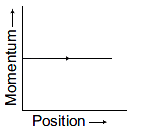
Question :
The phase space diagram for simple harmonic motion is a circle centered at the origin. In the figure, the two circles represent the same oscillator but for different initial conditions, and \(E_1\) and \(E_2\) are the total mechanical energies respectively. Then,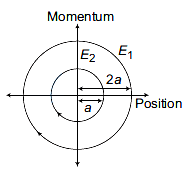 JEE Advanced 2011 Easy
 - Statement 1 The plot of atomic number ( \(Y\)-axis) versus number of neutrons ( \(x\)-axis) for stable nuclei shows a curvature towards \(X\)-axis from the line of \(45^{\circ}\) slope as the atomic number is increased.
Statement 2 Proton-proton electrostatic repulsions begin to overcome attractive forces involving protons and neutrons in heavier nuclides.JEE Advanced 2008 Easy - Let and be two biased coins such that the probabilities of getting head in a single toss are and , respectively. Suppose is the number of heads that appear when is tossed twice, independently, and suppose is the number of heads that appear when is tossed twice, independently. Then the probability that the roots of the quadratic polynomial are real and equal, isJEE Advanced 2020 Medium
- Let RS be the diameter of the circle where, is the point. Let be a variable point (other than ) on the circle and tangents to the circle at meet at the point. The normal to the circle at P intersects a line drawn through parallel to at point . Then, the locus of passes through the point (s):JEE Advanced 2016 Medium