


JEE Advanced · Chemistry · 2. Atomic Structure
The maximum number of electrons that can have principal quantum number, \(n=3\) and spin quantum number, \(m_s=-\frac{1}{2}\), is
- A 3
- B 6
- C 9
- D 12
Answer & Solution
Correct Answer
(C) 9
Step-by-step Solution
Detailed explanation
When \(n=3, l=0,1,2\) i.e., there are \(3 s, 3 p\) and \(3 d\) orbitals. If all these orbitals are completely occupied as

Total 18 electrons, 9 electrons with \(s=+\frac{1}{2}\) and 9 with \(s=-\frac{1}{2}\).
Alternatively In any \(n\)th orbit, there can be a maximum of \(2 n^2\) electrons. Hence, when \(n=3\), number of maximum electrons \(=18\). Out of these 18 electrons, 9 can have spin \(-\frac{1}{2}\) and remaining nine with spin \(=+\frac{1}{2}\).
Total 18 electrons, 9 electrons with \(s=+\frac{1}{2}\) and 9 with \(s=-\frac{1}{2}\).
Alternatively In any \(n\)th orbit, there can be a maximum of \(2 n^2\) electrons. Hence, when \(n=3\), number of maximum electrons \(=18\). Out of these 18 electrons, 9 can have spin \(-\frac{1}{2}\) and remaining nine with spin \(=+\frac{1}{2}\).
See the Complete Solution
Get step-by-step explanations for this and 2.5 Lakh+ more JEE, NEET & CET questions.
- Unlock all solutions
- Practice the full chapter
- Track accuracy across PYQs
4.8 rated on Google Play · 14,000+ reviews
More questions from Chemistry
- \(\mathrm{B}(\mathrm{OH})_3+\mathrm{NaOH} \rightleftharpoons \mathrm{NaBO}_2+\mathrm{Na}[\mathrm{B}\)\((\mathrm{OH})_4]+\mathrm{H}_2 \mathrm{O}\).
How can this reaction is made to proceed in forward direction?JEE Advanced 2006 Medium - The correct statement(s) related to processes involved in the extraction of metals is(are)JEE Advanced 2023 Medium
- Match the four starting materials (P, Q, R, S) given in List I with the corresponding reaction schemes (I, II, III, IV) provided in List II and select the correct answer using the code given below the lists.
List – I List – II A. 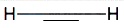
P. 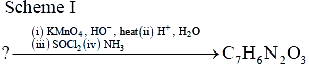
B. 
Q. 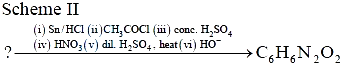
C. 
R. 
D. 
S.  JEE Advanced 2014 Hard
 - In the complex acetylbromidodicarbonylbis(triethylphosphine)iron (II), the number of bond (s) isJEE Advanced 2015 Medium
- The number of isomeric tetraenes (NOT containing sp-hybridized carbon atoms) that can be formed from the following reaction sequence is _____ .
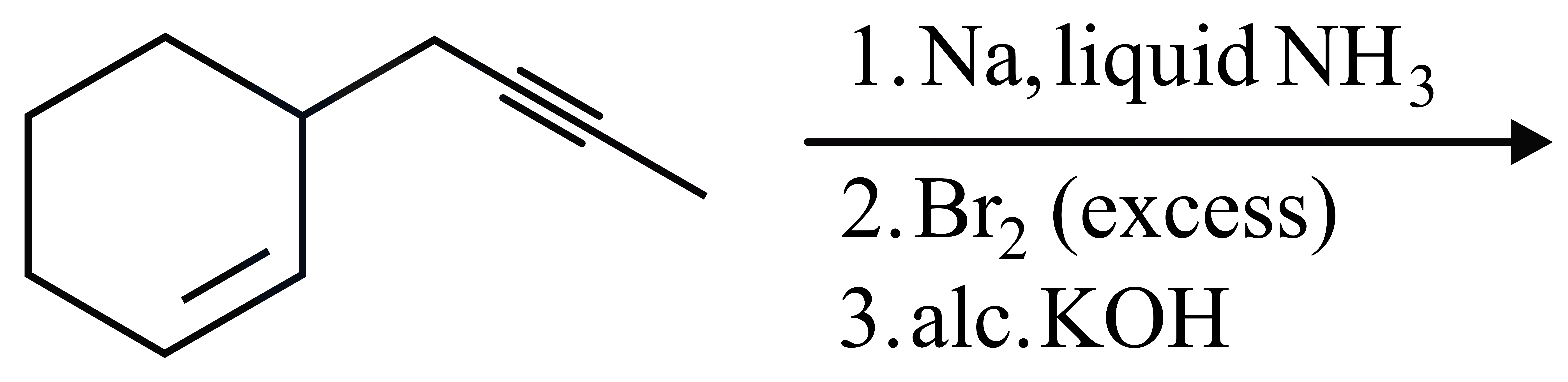 JEE Advanced 2022 Hard
 - At \(298 \mathrm{~K}\), the limiting molar conductivity of a weak monobasic acid is \(4 \times 10^{2} \mathrm{~S} \mathrm{~cm}^{2} \mathrm{~mol}^{-1}\). At \(298 \mathrm{~K}\), for an aqueous solution of the acid the degree of dissociation is \(\boldsymbol{\alpha}\) and the molar conductivity is \(\mathbf{y} \times 10^{2} \mathrm{~S} \mathrm{~cm}^{2} \mathrm{~mol}^{-1}\). At \(298 \mathrm{~K}\), upon 20 times dilution with water, the molar conductivity of the solution becomes \(3 \mathbf{y} \times 10^{2} \mathrm{~S} \mathrm{~cm}^{2} \mathrm{~mol}^{-1}\)
The value of is _______ .JEE Advanced 2021 Hard
More PYQs from JEE Advanced
- Let \(\mathbb{R}\) denote the set of all real numbers. Then the area of the region \(\left\{(x, y) \in \mathbb{R} \times \mathbb{R}: x>0, y>\frac{1}{x}, 5 x-4 y-1>0,4 x+4 y-17 <0\right\}\) isJEE Advanced 2025 Hard
- After completion of the reactions (I and II), the organic compound(s) in the reaction mixtures is(are):
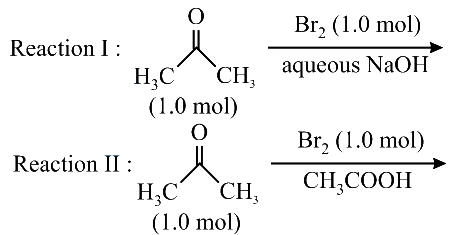
 JEE Advanced 2013 Hard
 - The minimum value of the sum of real numbers \(a^{-5}, a^{-4}, 3 a^{-3}, 1, a^8\) and \(a^{10}\) with \(a>0\) isJEE Advanced 2011 Medium
- Liquids and form ideal solution for all compositions of and at . Two such solutions with and mole fractions of have the total vapor pressures of and bar, respectively. What is the vapor pressure of pure liquid in bar?JEE Advanced 2020 Medium
- For a real number if the system of linear equations, has infinitely many solutions, thenJEE Advanced 2017 Medium
- Two inductors (inductance , internal resistance ) and (inductance , internal resistance ), and a resistor (resistance ) are all connected in parallel across a battery. The circuit is switched on at time . The ratio of the maximum current drawn from the battery is:JEE Advanced 2016 Medium