


AP EAMCET · PHYSICS · Capacitance
Three capacitors of capacitances \(C_1=2 \mu \mathrm{F}\), \(C_2=3 \mu \mathrm{F}\) and \(C_3=5 \mu \mathrm{F}\) are connected in series. A potential difference of \(155 \mathrm{~V}\) is applied across the combination. Choose the correct option.
- A Least potential difference is across \(C_3\). Equivalent capacitance of combination is \(\left(\frac{30}{31}\right) \mu \mathrm{F}\). The voltage across \(C_1\) is \(75 \mathrm{~V}\).
- B Least potential difference is across \(C_1\). Equivalent capacitance of combination is \(\left(\frac{30}{51}\right) \mu \mathrm{F}\). The voltage across \(C_2\) is \(50 \mathrm{~V}\).
- C Least potential difference is across \(C_1\). Equivalent capacitance of combination is \(\left(\frac{30}{31}\right) \mu \mathrm{F}\). The voltage across \(C_3\) is \(30 \mathrm{~V}\).
- D Least potential difference is across \(\mathrm{C}_2\). Equivalent capacitance of combination is \(\left(\frac{30}{31}\right) \mu \mathrm{F}\). The voltage across \(C_1\) is \(50 \mathrm{~V}\).
Answer & Solution
Correct Answer
(A) Least potential difference is across \(C_3\). Equivalent capacitance of combination is \(\left(\frac{30}{31}\right) \mu \mathrm{F}\). The voltage across \(C_1\) is \(75 \mathrm{~V}\).
Step-by-step Solution
Detailed explanation
The given situation is shown in the following figure. Equivalent capacitance is given as \(\frac{1}{C}=\frac{1}{C_1}+\frac{1}{C_2}+\frac{1}{C_3}=\frac{1}{2}+\frac{1}{3}+\frac{1}{5}=\frac{31}{30} \Rightarrow C=\frac{30}{31} \mu \mathrm{F}\) In series combination of capacitances,…
See the Complete Solution
Get step-by-step explanations for this and 2.5 Lakh+ more JEE, NEET & CET questions.
- Unlock all solutions
- Practice the full chapter
- Track accuracy across PYQs
4.8 rated on Google Play · 14,000+ reviews
More questions from PHYSICS
- Which one of the following is the property of a monochromatic, plane electromagnetic wave in free space?AP EAMCET 2021 Easy
- Adiabatic bulk modulus of a gas at a pressure ' \(\mathrm{P}^{\prime}\) is ( \(\gamma\)-ratio of specific heat capacities of the gas)AP EAMCET 2023 Hard
- A ball falls from a height \(h\) and rebounds after striking the floor. The coefficient of restitution is \(e\). The maximum distance covered before it comes to rest isAP EAMCET 2010 Hard
- In steady state, a capacitor of capacitance \(2 \mu \mathrm{F}\) is charged to \(4 \mu \mathrm{C}\), as shown in figure. If the internal resistance of the cell is \(0.5 \Omega\), then the emf of the cell is
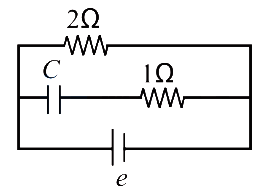 AP EAMCET 2017 Easy
 - If \(A\) represents Boltzmann constant, \(B\) represents Planck's constant and \(C\) represents speed of light in vacuum, then the quantity having the dimensions of \(A^4 B^{-3} C^{-2}\) isAP EAMCET 2018 Medium
- The displacement of a damped oscillator is \(x(t)=\exp\) \((-0.2 \mathrm{t}) \cos (3.2 \mathrm{t}+\Phi)\) where \(t\) is time in second. The time required for the amplitude of the oscillator to become \(\frac{1}{e^{1.2}}\) times its initial amplitude isAP EAMCET 2024 Medium
More PYQs from AP EAMCET
- Which one of the following statements is correct for adsorption of solutes on solids in solutions?AP EAMCET 2019 Easy
- Two statements are given below.
Statement I: \(\mathrm{SnF}_4, \mathrm{PbF}_4\) are ionic in nature
Statement II: \(\mathrm{GeCl}_2\) is more stable than \(\mathrm{GeCl}_4\)
The correct answer isAP EAMCET 2024 Medium - \(\lim _{x \rightarrow \infty}\left(\frac{2+\sin x}{x^2+3}\right)\) is equal toAP EAMCET 2021 Easy
- Which of the following statements are correct?
A. The \(\mathrm{C}-\mathrm{Cl}\) bond in chlorobenzene is shorter than in chloromethane.
B. It is difficult to replace chlorine from chlorobenzene than from benzyl chloride.
C. The \(\mathrm{C}-\mathrm{Cl}\) bond in chlorobenzene has some double bond character.
D. Chlorobenzene on chlorination gives m-dichlorobenzeneAP EAMCET 2019 Medium - If \(\frac{2 x^2+5 x+6}{(x+2)^3}=\frac{a}{x+2}+\frac{b}{(x+2)^2}+\frac{c}{(x+2)^3}\) then \(\mathrm{a} . \mathrm{b}+\mathrm{b} . \mathrm{c}+\mathrm{c} . \mathrm{a}=\)AP EAMCET 2023 Easy
- The increasing order of the atomic radius of \(\mathrm{Si}, \mathrm{S}, \mathrm{Na}, \mathrm{Mg}, \mathrm{Al}\) isAP EAMCET 2014 Easy