


AP EAMCET · PHYSICS · Magnetic Effects of Current
Magnetic field to a current element at any point on its axis is _____
- A minimum
- B zero
- C yaries between minimum and maximum
- D depends on the position of the point
Answer & Solution
Correct Answer
(B) zero
Step-by-step Solution
Detailed explanation
From the Biot-Savart's law, Magnetic field due to current element dB=μoidlsinθ4πr2 The magnetic field on a current element is directly proportional to the sine of the angle between the current element and the position vector. The angle for a point on axis θ=0…
See the Complete Solution
Get step-by-step explanations for this and 2.5 Lakh+ more JEE, NEET & CET questions.
- Unlock all solutions
- Practice the full chapter
- Track accuracy across PYQs
4.8 rated on Google Play · 14,000+ reviews
More questions from PHYSICS
- A \(1 \mathrm{~N}\) pendulum bob is held at an angle \(\theta\) from the vertical by a \(2 \mathrm{~N}\) horizontal force \(\mathrm{F}\) as shown in the figure. The tension in the string supporting the pendulum bob (in newton) is
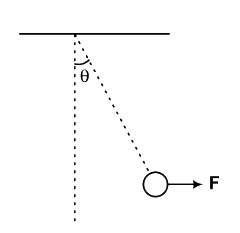 AP EAMCET 2011 Hard
 - Four logic gates are connected as shown in the figure. If the inputs are \(\mathrm{A}=0, \mathrm{~B}=1\) and \(\mathrm{C}=1\), then the values of \(y_1\) and \(y_2\) respectively are
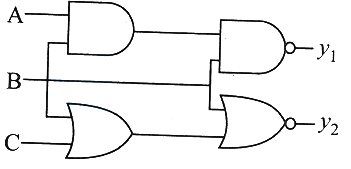 AP EAMCET 2024 Easy
 - The two surfaces of a biconvex lens has same radii of curvatures. This lens is made of glass of refractive index 1.5 and has a focal length \(10 \mathrm{~cm}\) in air. The lens is cut into two equal halves along a plane perpendicular to its principal axis to yield two plano-convex lenses. The two pieces are glued such that the convex surfaces touch each other. If this combination lens is immersed in water (refractive index \(=\) \(4 / 3\) ), its focal length (in \(\mathrm{cm}\) ) is :AP EAMCET 2006 Medium
- A slab B rests on a frictionless floor as shown in the figure. A block A rests on top of the slab- B. The coefficients of static and kinetic friction between the block A and the slab B are and respectively. When block-A is acted upon by a horizontal force of , as shown, find the resulting acceleration of the slab- B.
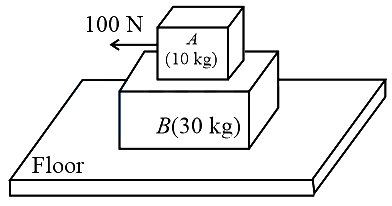 AP EAMCET 2021 Hard
 - Among the following, the equation representing a progressive wave is
(A) \(y=2 \cos 3 x \sin 10 t\)
(B) \(\mathrm{y}=2 \sqrt{\mathrm{x}-\mathrm{vt}}\)
(C) \(y=3 \sin (5 x-0.5 t)+4 \cos (5 x-0.5 t)\)
(D) \(y=\cos x \sin t+\cos 2 x \cdot \sin 2 t\)AP EAMCET 2022 Medium - To the free end of spring hanging from a rigid support, a block of mass \(m\) is hung and slowly allowed to come to its equilibrium position. Then stretching in the spring is \(d\). If the same block is attached to the same spring and allowed to fall suddenly, the amount of stretching is : (force constant, \(k\) )AP EAMCET 2006 Medium
More PYQs from AP EAMCET
- Carbon and germanium belong to the 14 th group. The maximum coordination number of carbon is less than germanium, because ofAP EAMCET 2021 Easy
- If \(y=\sin ^{-1} x\) then \(\left(1-x^2\right) y_2-x y_1=\)AP EAMCET 2024 Easy
- The number of four digit numbers that can be formed using the digits \(1,2,3,4,5,6,7,8,9\) which are divisible by 3 , when repetition of digits is allowed any number of times, isAP EAMCET 2017 Hard
- Consider the following reaction
\(A \longrightarrow\) Products
This reaction is completed in \(100 \mathrm{~min}\). The rate constant of this reaction at \(t_1=10\) \(\mathrm{min}\), is \(10^{-2} \mathrm{~min}^{-1}\). What is the rate constant \(\left(\right.\) in \(\min ^{-1}\) ) at \(t_2=20 \mathrm{~min} ?\)AP EAMCET 2022 Easy - When \(36 \mathrm{~g}\) of a non-volatile, non-electrolytic solute having the empirical formula \(\mathrm{CH}_2 \mathrm{O}\) is dissolved in \(1.2 \mathrm{~kg}\) of water, the solution freezes at \(-0.93^{\circ} \mathrm{C}\). The molecular formula of the solute is \(\left(K_f\right.\) of water \(\left.=1.86 \mathrm{~K} \mathrm{~kg} \mathrm{~mol}^{-1}\right)\)AP EAMCET 2018 Hard
- A person who tosses an unbiased coin gains two points for turning up a head and loses one point for a tail. If three coins are tossed and the total score \(X\) is observed, then the range of \(x\) isAP EAMCET 2004 Hard