


AP EAMCET · PHYSICS · Mechanical Properties of Fluids
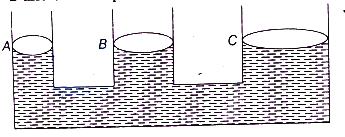
A hydraulic lift is shown in the figure. The movable pistons \(A, B\) and \(C\) are of radius \(10 \mathrm{~cm}, 100 \mathrm{~m}\) and \(5 \mathrm{~cm}\) respectively. If a body. of mass \(2 \mathrm{~kg}\) is placed on piston \(A\), the maximum masses that can be lifted by piston \(B\) and \(C\) are respectively.
- A \(200 \mathrm{~kg}\) and \(500 \mathrm{~kg}\)
- B \(20 \mathrm{~kg}\) and \(50 \mathrm{~kg}\)
- C \(200 \mathrm{~kg}\) and \(5000 \mathrm{~kg}\)
- D None of the above
Answer & Solution
Correct Answer
(D) None of the above
Step-by-step Solution
Detailed explanation
Given, \(r_A=10 \mathrm{~cm}=0.1 \mathrm{~m}\) \(\begin{aligned} & r_B=100 \mathrm{~m} \\ & r_C=5 \mathrm{~cm}=0.05 \mathrm{~m}\end{aligned}\) weight placed on piston \(A=m \times g\) \(=2 \mathrm{~g}\) Using Pascal's law; \(\frac{F_A}{A_A}=\frac{F_B}{A_B}=\frac{F_C}{A_C}\)…
See the Complete Solution
Get step-by-step explanations for this and 2.5 Lakh+ more JEE, NEET & CET questions.
- Unlock all solutions
- Practice the full chapter
- Track accuracy across PYQs
4.8 rated on Google Play · 14,000+ reviews
More questions from PHYSICS
- Light of wavelength in medium enters into medium through a plane surface. If the frequency of light is and the ratio of speed in medium to that is medium is , the absolute refractive index of medium is,AP EAMCET 2021 Medium
- Light of wavelength \(488 \mathrm{~nm}\) produced by an Agron laser is used in the photoelectric effect. When light from this spectral line is incident on the cathode, the stopping potential of the photoelectrons is \(0.38 \mathrm{~V}\). The work function of the cathode material isAP EAMCET 2019 Hard
- An electrostatic paint sprayer has a metal sphere of diameter \(18 \mathrm{~cm}\) and at a potential of \(25 \mathrm{kV}\). The charge on the metal sphere isAP EAMCET 2017 Easy
- Two point charges \(-q\) and \(+q\) are located at points \((0,0,-a)\) and \((0,0, a)\) respectively. The electric potential at a point \((0,0, z)\), where \(z>a\) isAP EAMCET 2009 Medium
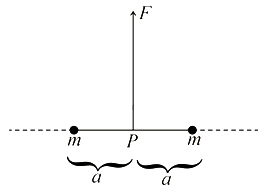
- As shown in the figure, two particles, each of mass tied at the ends of a light string of length are kept on a frictionless horizontal surface. When the mid point of the string is pulled vertically upwards with a small but constant force the particles move towards each other on the surface. Magnitude of acceleration of each particle, when the separation between them becomes is
 AP EAMCET 2018 Hard
 - Match Column A (layers in the ionosphere for skywave propagation) with Column B (their height range)
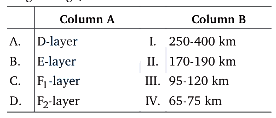
\(\begin{array}{llll}\mathrm{A} & \mathrm{B} & \mathrm{C} & \mathrm{D}\end{array}\)AP EAMCET 2012 Easy
More PYQs from AP EAMCET
- The equation of the common chord of the circles \(x^2+y^2+2 x+3 y+1=0\) and \(x^2+\) \(y^2-5 x-6 y+4=0\) isAP EAMCET 2020 Medium
- Which of the following forms holes in the ozone layer?AP EAMCET 2017 Easy
- Match the following
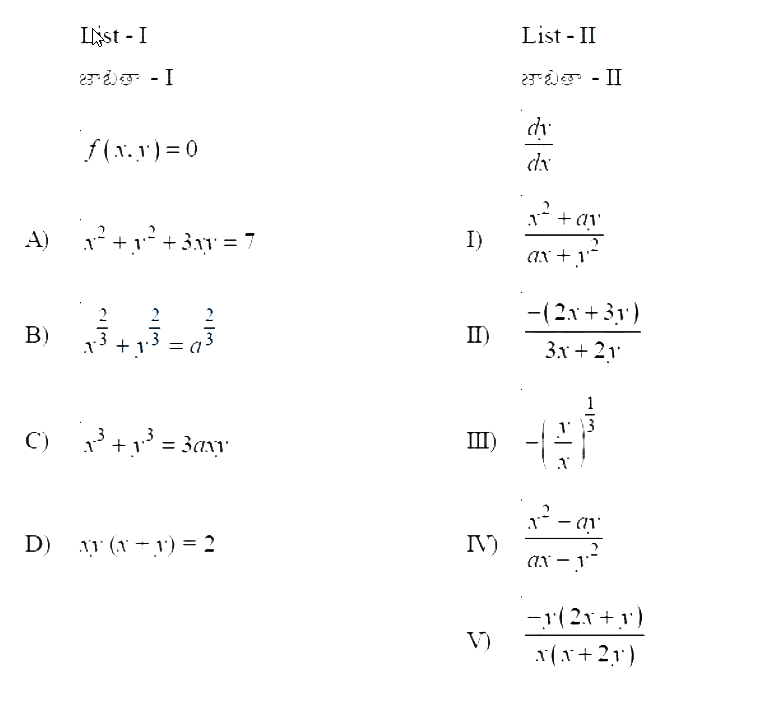
The correct answer isAP EAMCET 2018 Medium - From which of the following, the major product is formed, in the addition of \(\mathrm{HBr}\) to propene in the presence of peroxide?AP EAMCET 2017 Easy
- Let \(\vec{a}, \vec{b}, \vec{c}\) be three vectors such that \(\vec{a}\) is perpendicular to \(\overrightarrow{\mathrm{b}}\) and \(\overrightarrow{\mathrm{b}}\) is perpendicular to \(\overrightarrow{\mathrm{c}}\). If \(|\overrightarrow{\mathrm{a}}|=2,|\overrightarrow{\mathrm{b}}|=3,|\overrightarrow{\mathrm{c}}|=5\) and \(|\vec{a}+\vec{b}+\vec{c}|=4 \sqrt{3}\), then the angle between \(\vec{a}\) and \(\vec{c}\) isAP EAMCET 2023 Easy
- \(\int_0^1 x^{5 / 2}(1-x)^{3 / 2} \mathrm{~d} x=\)AP EAMCET 2025 Medium