


AP EAMCET · Maths · Inverse Trigonometric Functions
The interval in which the function \(f(x)=\operatorname{Tan}^{-1}(\sin x+\cos x)\) is an increasing function, is
- A \(\left(0, \frac{\pi}{2}\right)\)
- B \(\left(-\frac{\pi}{2}, \frac{\pi}{2}\right)\)
- C \(\left(-\frac{3 \pi}{4}, \frac{\pi}{4}\right)\)
- D \(\left(\frac{\pi}{4}, \frac{\pi}{2}\right)\)
Answer & Solution
Correct Answer
(C) \(\left(-\frac{3 \pi}{4}, \frac{\pi}{4}\right)\)
Step-by-step Solution
Detailed explanation
\(f'(x) = \frac{1}{1+(\sin x+\cos x)^2} (\cos x - \sin x)\) \(f'(x) > 0 \implies \cos x - \sin x > 0\) \(\cos x > \sin x\) \(\cos x - \sin x = \sqrt{2}\cos(x+\frac{\pi}{4})\) \(\sqrt{2}\cos(x+\frac{\pi}{4}) > 0 \implies \cos(x+\frac{\pi}{4}) > 0\)…
See the Complete Solution
Get step-by-step explanations for this and 2.5 Lakh+ more JEE, NEET & CET questions.
- Unlock all solutions
- Practice the full chapter
- Track accuracy across PYQs
4.8 rated on Google Play · 14,000+ reviews
More questions from Maths
- \(\begin{array}{r}
\left(1+\cos \frac{\pi}{8}\right)\left(1+\cos \frac{2 \pi}{8}\right) \\
\left(1+\cos \frac{3 \pi}{8}\right)\left(1+\cos \frac{4 \pi}{8}\right) \\
\left(1+\cos \frac{5 \pi}{8}\right)\left(1+\cos \frac{6 \pi}{8}\right)\left(1+\cos \frac{7 \pi}{8}\right)=
\end{array}\)AP EAMCET 2018 Medium - When the coordinate axes are rotated through an angle , the coordinates of a point in the new system are known to be . Then find the coordinates of in the original system.AP EAMCET 2021 Easy
- If \([a, b]\) is the range of the function \(\frac{x+2}{2 x^2+3 x+6}\) for \(x \in \mathbf{R}\), thenAP EAMCET 2020 Easy
- The radius of the circle which cuts the circles \(x^2+y^2-4 x\) \(-4 y+7=0, x^2+y^2+4 x-4 y+6=0\) and \(x^2+y^2+4 x+\) \(4 y+5=0\) orthogonally isAP EAMCET 2024 Medium
- Locus of the poles of focal chord of a parabola isAP EAMCET 2002 Medium
- The value of \(\left\{i^{22}-\left(\frac{1}{i}\right)^{35}\right\}^2\) isAP EAMCET 2021 Easy
More PYQs from AP EAMCET
- Let \([r]\) denote the largest integer not exceeding \(r\) and the roots of the equation \(3 x^2+6 x+5+\alpha\left(x^2+2 x+2\right)=0\) are complex numbers whenever \(\alpha\gt\mathrm{L}\) and \(\alpha \lt \mathrm{M}\). If \((\mathrm{L}-\mathrm{M})\) is minimum, then greatest value of \([r]\) such that \(\mathrm{L} y^2+\mathrm{M} y\) \(+r \lt 0\) for all \(y \in \mathbb{R}\) is,AP EAMCET 2024 Easy
- At \(256 \mathrm{~K}, \mathrm{rms}\) speed of \(\mathrm{SO}_2\) gas molecules is \(3.16 \times 10^2 \mathrm{~ms}^{-1}\). What is the most probable velocity (in \(\mathrm{ms}^{-1}\) ) of same gas at same temperature?AP EAMCET 2025 Medium
- Match the following graphs of a gas with their corresponding \(y\) and \(x\) coordinates.
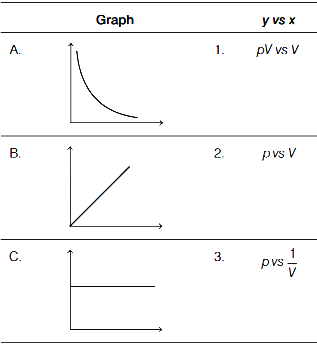 AP EAMCET 2020 Easy
 - If a function \(f(x)=\left\{\begin{array}{cc}\frac{\tan (\alpha+1) x+\tan 2 x}{x} & \text { if } x\gt0 \\ \beta & \text { at } x=0 \\ \frac{\sin 3 x-\tan 3 x}{x^3} & \text { if } x \lt 0\end{array}\right.\)
is continuous at \(x=0\) then \(|\alpha|+|\beta|=\)AP EAMCET 2024 Hard - In the expansion of \((1+x)^n\) the coefficients of \(p\) th and \((p+1)\) th terms are respectively \(p\) and \(q\), then \(p+q\) is equal toAP EAMCET 2002 Medium
- [4]
Aqueous solution of an organic compound, ' \(A\) ' on electrolysis liberates acetylene and \(\mathrm{CO}_2\) at anode. ' \(A\) ' isAP EAMCET 2007 Easy