


AP EAMCET · Maths · Quadratic Equation
let \(a, b, c\) be real numbers such that \(2 a+3 b+6 c=0\) and \(g(x) \equiv a x^2+b x+c=0\) has atleast one root in the interval \((1,2)\). If a function \(f:[1,2] \rightarrow R\) for which Rolle's mean value theorem holds is such that \(f(x)\) is a primitive of \(g(x)\), then \(f(x)=\)
- A \(x^3-3 x^2+2 x\)
- B \(3 x^3-6 x^2+2 x\)
- C \(12 x^3-14 x^2+3 x\)
- D \(3 x^3-x\)
Answer & Solution
Correct Answer
(A) \(x^3-3 x^2+2 x\)
Step-by-step Solution
Detailed explanation
Given, \(2 a+3 b+6 c=0\)...(i) and \(g(x)=a x^2+b x+c=0\) According to given information, \(\begin{aligned} & f(x)=\int g(x) d x=\int\left(a x^2+b x+c\right) d x \\ & f(x)=\frac{a}{3} x^3+\frac{b}{2} x^2+c x \end{aligned}\)…
See the Complete Solution
Get step-by-step explanations for this and 2.5 Lakh+ more JEE, NEET & CET questions.
- Unlock all solutions
- Practice the full chapter
- Track accuracy across PYQs
4.8 rated on Google Play · 14,000+ reviews
More questions from Maths
- A line L passing through the point \((2,0)\) makes an angle \(60^{\circ}\) with the line \(2 x-y+3=0\). If L makes an acute angle with the positive X -axis in the anticlockwise direction. then the Y -intercept of the line L isAP EAMCET 2024 Medium
- If \(L_1\) represents the radical axis of circles \(x^2+y^2-4 x-6 y+5=0\) and \(x^2+y^2-2 x-4 y-1=0\) and \(L_2\) represents the radical axis of \(x^2+y^2+2 x+2 y-7=0\) and \(x^2+y^2+x+y+9=0\), thenAP EAMCET 2021 Medium
- Suppose \(A, B\) be two events such that \(P(A)=0.9\) and \(P(B)=0.8\) and \(P(A \cap B) \geq 0.7\). Then, we can conclude that such a case is ____AP EAMCET 2020 Easy
- Let be a matrix such that is upper-triangular. ThenAP EAMCET 2021 Easy
- Solve the following equation \(\sin x+\sqrt{3} \cos x=\sqrt{2}\)AP EAMCET 2021 Easy
- The length of the chord intercepted by the circle \(x^2+y^2-4 x+6 y-12=0\) on the line \(4 x+3 y+1=0\) isAP EAMCET 2017 Easy
More PYQs from AP EAMCET
- A straight wire carrying a current of \(12 \mathrm{~A}\) is bent into a semi-circular arc of radius \(2 \mathrm{~cm}\) as shown in the figure. Then the magnetic field due to the straight segments at the centre of the arc is
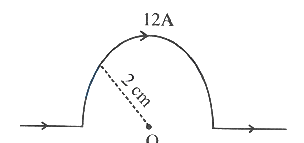 AP EAMCET 2023 Easy
 - If a circle is inscribed in an equilateral triangle of side a, then the area of any square (in sq. units) inscribed in this circle isAP EAMCET 2024 Medium
- A capacitor of capacity \(0.1 \mu \mathrm{F}\) connected in series to a resistor of \(10 \mathrm{M} \Omega\) is charged to a certain potential and then made to discharge through the resistor. The time in which the potential will take to fall to half its original value is (Given, \(\log _{10} 2=0.3010\) )AP EAMCET 2010 Hard
- If \(a x^2+6 x y+b y^2-10 x+10 y-6=0\) represents a pair of perpendicular lines, then the values of \(|a|\) equalsAP EAMCET 2021 Easy
- Let \(\mathbf{u}=-2 \hat{\mathbf{i}}+2 \hat{\mathbf{j}}+\hat{\mathbf{k}}\) and \(\mathbf{v}=\hat{\mathbf{i}}-2 \hat{\mathbf{j}}+2 \hat{\mathbf{k}}\). Then angle between \(\mathbf{u}\) and \(\mathbf{v}\) isAP EAMCET 2020 Easy
- The area (in square units) of the triangle formed by the lines \(x=0, y=0\) and \(3 x+4 y=12\) isAP EAMCET 2023 Easy