


AP EAMCET · Maths · Vector Algebra
Let \(\vec{a}, \vec{b}, \vec{c}\) be co-initial vectors and \(\vec{a}=2 \hat{i}-\hat{j}+5 \hat{k}\) and \(\overrightarrow{\mathrm{b}}=3 \hat{\mathrm{i}}+7 \hat{\mathrm{j}}-\hat{\mathrm{k}}\). Let \((\overrightarrow{\mathrm{a}}, \overrightarrow{\mathrm{b}})=\theta\) be an acute angle and \(\overrightarrow{\mathrm{c}}\) be the vector along the bisector of the angle \(\theta\). If \(\lambda, x\), \(\mathrm{y} \in \mathbb{R}\), then \(\overrightarrow{\mathbf{c}}=\)
- A \(\lambda(5 \hat{\mathrm{i}}+6 \hat{\mathrm{j}}+4 \hat{\mathrm{k}})\)
- B \(\lambda(-\hat{\mathrm{i}}-8 \hat{\mathrm{j}}+6 \hat{\mathrm{k}})\)
- C \((2 x+3 y) \hat{i}+(7 y-x) \hat{j}+(5 x-y) \hat{k}\)
- D \((2 x+3 y) \hat{i}+(x+7 y) \hat{j}+(5 x+y) \hat{k}\)
Answer & Solution
Correct Answer
(C) \((2 x+3 y) \hat{i}+(7 y-x) \hat{j}+(5 x-y) \hat{k}\)
Step-by-step Solution
Detailed explanation
\(\because \overrightarrow{\mathrm{a}}=2 \hat{\mathrm{i}}-\hat{\mathrm{j}}+5 \hat{\mathrm{k}}, \overrightarrow{\mathrm{b}}=3 \hat{\mathrm{i}}+7 \hat{\mathrm{j}}-\hat{\mathrm{k}}\) Now, the angle bisector of vector \(\vec{a} \& \vec{b}\) are…
See the Complete Solution
Get step-by-step explanations for this and 2.5 Lakh+ more JEE, NEET & CET questions.
- Unlock all solutions
- Practice the full chapter
- Track accuracy across PYQs
4.8 rated on Google Play · 14,000+ reviews
More questions from Maths
- \[
\int \sqrt{1+2 \cot x(\cot x+\operatorname{cosec} x)} d x=
\]AP EAMCET 2022 Medium - If the product of the perpendicular distances from any point on the hyperbola \(\frac{x^2}{a^2}-\frac{y^2}{b^2}=1\) to its asymptotes is 6 and eccentricity of the hyperbola is \(\sqrt{3}\), then the length of the conjugate axis of the hyperbola isAP EAMCET 2022 Medium
- If the line \(x+2 y-5=0\) and \(3 x-y-1=0\) denote two diameters of a circle of radius 5 units, then the equation of the circle isAP EAMCET 2021 Easy
- Let \(\alpha \neq 1\) be a real root of the equation \(x^3-a x^2+a x-1=0\), where \(a \neq-1\) is a rea number. Then, a root of this equation, among the following, isAP EAMCET 2010 Medium
- AP EAMCET 2022 Medium
- If a function \(f\) is differentiable on \(\mathbb{R}\) such that \(f^{\prime}(x) \leq 4\) for all \(x \in \mathbb{R}\); and if \(f(2)=-6\) and \(f(6)=8\), then the value of \(f(4)\) belongs to the intervalAP EAMCET 2018 Medium
More PYQs from AP EAMCET
- If the range of the function \(f(x)=-3 x-3\) is \(\{3,-6,-9,-18\}\), then which one of the following is not in the domain of f ?AP EAMCET 2025 Easy
- The value of \(a\) for which the equations \(x^3+a x+1=0\) and \(x^4+a x^2+1=0\) have a common root isAP EAMCET 2011 Easy
- Three infinitely long charged non-conducting sheets are placed as shown in the figure. The electric field at point ' \(\mathrm{P}\) ' is ( \(\sigma\) - charge density, \(\epsilon_0\) - permittivity of free space)
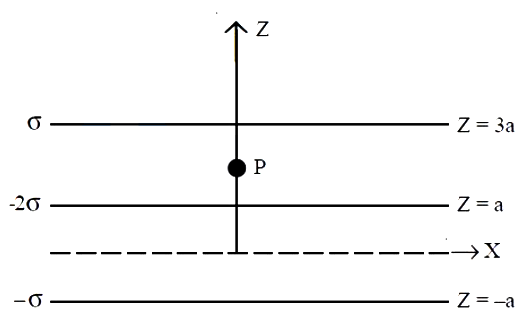 AP EAMCET 2017 Medium
 - Let \(f(x)=x^2+2 b x+2 c^2\) and \(g(x)=-x^2-2 c x+b^2, x \in R\). If \(b\) and \(c\) are nonzero real numbers such that \(\min f(x)>\max g(x)\), then \(\left|\frac{c}{b}\right|\) lies in the intervalAP EAMCET 2025 Medium
- The equation of the plane mid-parallel to the planes \(2 x-3 y+6 z+21=0\) and \(2 x-3 y+6 z-14=0\) is given byAP EAMCET 2020 Easy
- The synthetic detergent used in tooth paste is of type X. Animal starch is Y.
X and Y respectively areAP EAMCET 2025 Easy