


AP EAMCET · Maths · Binomial Theorem
In the binomial expansion of \((p-q)^{14}\), if the sum of \(7^{\text {th }}\) term and \(8^{\text {th }}\) term is zero, then \(\frac{p+q}{p-q}=\)
- A \(14\)
- B \(15\)
- C \(16\)
- D \(13\)
Answer & Solution
Correct Answer
(B) \(15\)
Step-by-step Solution
Detailed explanation
\(\binom{14}{6} p^8 (-q)^6 + \binom{14}{7} p^7 (-q)^7 = 0\) \(\binom{14}{6} p^8 q^6 - \binom{14}{7} p^7 q^7 = 0\) \(\binom{14}{6} p = \binom{14}{7} q\) \(\binom{14}{6} p = \left(\frac{14-7+1}{7}\right) \binom{14}{6} q\) \(p = \frac{8}{7} q\)…
See the Complete Solution
Get step-by-step explanations for this and 2.5 Lakh+ more JEE, NEET & CET questions.
- Unlock all solutions
- Practice the full chapter
- Track accuracy across PYQs
4.8 rated on Google Play · 14,000+ reviews
More questions from Maths
- \(\int \frac{1}{x \sqrt{x^6+1}} d x=\)AP EAMCET 2017 Medium
- \(\begin{aligned}
& \sin ^2 18^{\circ}+\sin ^2 24^{\circ}+\sin ^2 36^{\circ}+\sin ^2 42^{\circ}+\sin ^2 78^{\circ}+ \\
& \sin ^2 90^{\circ}+\sin ^2 96^{\circ}+\sin ^2 102^{\circ}+\sin ^2 138^{\circ}+\sin ^2 162^{\circ}=
\end{aligned}\)AP EAMCET 2024 Hard - If \(y=\log (\cosh x)\) then \(\frac{d^2 y}{d x^2}=\)AP EAMCET 2020 Easy
- In \(\triangle \mathrm{ABC}, \mathrm{r}_1+\mathrm{r}_2+\mathrm{r}_3-\mathrm{r}=\)AP EAMCET 2023 Medium
- The probability distribution of a random variable \(X\) is given below.
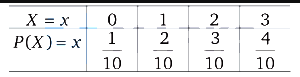
Then the variance of \(X\) isAP EAMCET 2011 Easy - Let \(f: \mathbf{R} \rightarrow \mathbf{R}\) be a continuous function such that for any two real numbers \(x\) and \(y\), \(|f(x)-f(y) \leq 10| x-.\left.y\right|^{201}\), thenAP EAMCET 2020 Hard
More PYQs from AP EAMCET
- The sag developed in a bar of length ' 1 ', breath 'b' and thickness ' \(\mathrm{d}\) ' when subjected to a load of ' \(w\) ' at center is (Y - Young's modulus of the material of the bar)
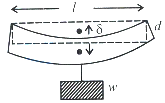 AP EAMCET 2023 Hard
 - A candidate takes three tests in succession and the probability of passing the first test is \(p\). The probability of passing each succeeding test is \(p\) or \(\frac{p}{2}\) according as he passes or fails in the preceding one. The candidate is selected, if he passes atleast two tests. The probability that the candidate is selected, isAP EAMCET 2014 Easy
- The potential difference between two parallel plates is \(10^4 \mathrm{~V}\). If the plates are separated by \(0.5 \mathrm{~cm}\), the force on an electron between the plates isAP EAMCET 2010 Easy
- The distance between the vertex and the focus of the parabola \(x^2-2 x+3 y-2=0\) isAP EAMCET 2016 Easy
- In \(\triangle P Q R\), let \(\angle P>\angle Q\). If the radian measures of \(\angle P\) and \(\angle Q\) satisfy the equation \(4 \sin ^3 x-3 \sin x+a=0,0 < a < 1\), then the radian measure of \(\angle R\) isAP EAMCET 2019 Medium
- Formic acid is heated with conc. \(\mathrm{H}_2 \mathrm{SO}_4\) at \(100^{\circ} \mathrm{C}\) to form \(A\) and \(B\). When \(\mathrm{Fe}_2 \mathrm{O}_3\) is heated strongly with \(B\), the products formed are \(C\) and \(D . C\) can also be obtained by reacting \(\mathrm{CaCO}_3\) with dil.HCl. What is \(D\) ?AP EAMCET 2019 Hard