


AP EAMCET · Maths · Matrices
In \(P\) and \(Q\) are square matrices such that \(P^{2006}=0\) and \(P Q=P+Q\), then \(\operatorname{det}(Q)\) will be
- A 0
- B 1 only
- C -1 only
- D \pm 1
Answer & Solution
Correct Answer
(A) 0
Step-by-step Solution
Detailed explanation
\begin{array}{llll} & P^{2006} =O \text { and } P Q=P+Q \\ \Rightarrow & P^{2006} Q =P^{2006}+Q \cdot P^{2005} \\ \Rightarrow & O =O+Q \cdot P^{2005} \\ \Rightarrow & P^{2005} \cdot Q =O \\ \Rightarrow & \operatorname{det} \cdot\left(P^{2005} \cdot Q\right) =O \\ \Rightarrow &…
See the Complete Solution
Get step-by-step explanations for this and 2.5 Lakh+ more JEE, NEET & CET questions.
- Unlock all solutions
- Practice the full chapter
- Track accuracy across PYQs
4.8 rated on Google Play · 14,000+ reviews
More questions from Maths
- Match the following
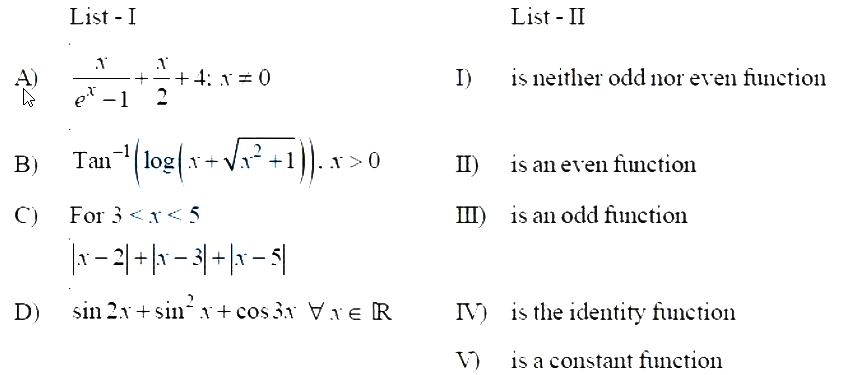 AP EAMCET 2018 Easy
 - What is the modulus of the complex number \((1+2 i)(-2+i)\) ?AP EAMCET 2020 Easy
- If \(y=\operatorname{Tan}^{-1} \sqrt{x^2-1}+\operatorname{Sinh}^{-1} \sqrt{x^2-1}, x>1\), then \(\frac{d y}{d x}=\)AP EAMCET 2025 Medium
- The three lines given by the combined equation \(y^3-4 x^2 y=0\) representsAP EAMCET 2021 Medium
- If \(\mathbf{a}, \mathbf{b}\) and \(\mathbf{c}\) are three vectors such that \(|\mathbf{a}|=|\mathbf{b}|=2, \mathbf{a} \cdot \mathbf{b}=2\) and \(\mathbf{a}+\mathbf{b}+\mathbf{c}=0\), then \(|\mathbf{c}|\) is equal toAP EAMCET 2021 Medium
- Let and be two vectors. Then, if and only ifAP EAMCET 2020 Medium
More PYQs from AP EAMCET
- A mixture of two non-reactive ideal gases is enclosed in a vessel consisting of one mole of a monatomic gas 'A' and 'n' moles of diatomic gas ' \(B\) ' at a temperature ' \(T\) '. If the adiabatic constant of the gaseous mixture is \(\frac{13}{9}\), then the value of ' \(n\) ' isAP EAMCET 2017 Easy
- The range of \(f(x)=\sqrt{\frac{a-|x|}{(a+1)-|x|}},(a>0)\) isAP EAMCET 2019 Easy
- The slope of the tangent of the curve
\[
\left(\frac{x}{31}\right)^n+\left(\frac{y}{1209}\right)^n=2 \text { at }(31,1209) \ldots \ldots
\]AP EAMCET 2020 Easy - The difference between the radii of \(n^{\text {th }}\) and \((n+1)^{\text {th }}\) orbits of hydrogen atom is equal to the radius of \((n-1)^{\text {th }}\) orbit of hydrogen. The angular momentum of the electron in the \(n^{\text {th }}\) orbit is _________ ( \(h\) is Planck's constant).AP EAMCET 2018 Medium
- Coefficient of \(x^2\) in the expansion of \(\left(x^2+x-2\right)^5\) isAP EAMCET 2025 Medium
- The number of solutions of the system of equations \(2 x+y-z=7, \quad x-3 y+2 z=1\), \(x+4 y-3 z=5\) isAP EAMCET 2003 Easy