


AP EAMCET · Maths · Probability
If \(\mathrm{X}_1, \mathrm{X}_2, \ldots \mathrm{X}_{\mathrm{n}}\) are \(\mathrm{n}\) independent events such that \(\mathrm{P}\left(\mathrm{X}_{\mathrm{r}}\right)\) \(=\frac{1}{r+1}, r=1,2, \ldots, n\), then the probability that none of the \(n\) events occur is
- A \(\frac{1}{n}\)
- B \(\frac{1}{n+1}\)
- C \(\frac{\mathrm{n}}{\mathrm{n}+1}\)
- D \(\frac{n+1}{n+2}\)
Answer & Solution
Correct Answer
(B) \(\frac{1}{n+1}\)
Step-by-step Solution
Detailed explanation
\(\mathrm{P}\left(\mathrm{X}_1^{\prime} \cap \mathrm{X}_2^{\prime} \cap \mathrm{X}_3^{\prime} \ldots \cap \mathrm{X}_{\mathrm{n}}^{\prime}\right)\)…
See the Complete Solution
Get step-by-step explanations for this and 2.5 Lakh+ more JEE, NEET & CET questions.
- Unlock all solutions
- Practice the full chapter
- Track accuracy across PYQs
4.8 rated on Google Play · 14,000+ reviews
More questions from Maths
- The triangle formed by the lines \(2 x^2+x y-6 y^2=0\) and \(x+y-1=0\) isAP EAMCET 2025 Medium
- If \(x^a y^b=e^m, x^c y^d=e^n, \Delta_1=\left|\begin{array}{ll}m & b \\ n & d\end{array}\right|, \Delta_2=\left|\begin{array}{ll}a & m \\ c & n\end{array}\right|, \Delta_3=\left|\begin{array}{ll}a & b \\ c & d\end{array}\right|\), then the values of \(x\) and \(y\) are respectively ( \(e\) is the base of natural logarithm)AP EAMCET 2025 Medium
- If \(x\) is complex, the expression \(\frac{x^2+34 x-71}{x^2+2 x-7}\) takes all values which lie in the interval \((a, b)\), find the value of \(a\) and \(b\).AP EAMCET 2020 Easy
- The length of the tangent drawn to the circle \(x^2+y^2-2 x+4 y-11=0\) from the point \((1,3)\) is :AP EAMCET 2006 Easy
- \(\int_0^{\pi / 2} \frac{\sin ^3 x \cos x d x}{\sin ^4 x+\cos ^4 x}=\)AP EAMCET 2019 Hard
- A special lottery is to be held to select a student who will live in the only deluxe room available in a hostel. 100 III year, 150 II year and 200 I year students have applied for the room. Each III year student's name is placed in the lottery 3 times, each II year student's name 2 times and I year student's name 1 time. The probability that a III year student gets the room isAP EAMCET 2022 Medium
More PYQs from AP EAMCET
- Sulphur containing amino acids of the following are
\begin{array}{cccc}
Serine & Cysteine & Lysine & methionine \\
A & B & C & D
\end{array}AP EAMCET 2023 Easy - Which of the following statements are correct?
A. Ocean is sink for \(CO_2\)
B. Greenhouse effect causes lowering of temperature of earth’s surface.
C. To control \(CO\) emission by automobiles, usually catalytic convertor are fitted into exhaust pipes.
D. \(H_2SO_4\), herbicides and insecticides form mist.AP EAMCET 2015 Easy - The velocity of a particle is given by the, equation \(v(x)\) \(=3 x^2-4 x\), where ' \(x\) ' is the distance covered by the particle. The expression for its acceleration isAP EAMCET 2024 Easy
- The orbital velocity of a body near the surface of a planet ' \(A\) ' is equal to escape velocity of a body from the planet ' \(B\) '. If the masses of planets A and B are same, the ratio of their radii isAP EAMCET 2023 Easy
- Consider the following standard electrode potentials ( \(\mathrm{E}^0\) in volts) in aqueous solution
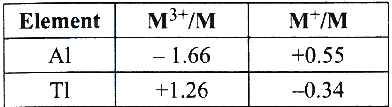
Based on this data, which of the following statements is correct?AP EAMCET 2024 Medium - \(\mathrm{E}_{\text {cell }}^0\) of the reaction \(\mathrm{Mg}_{(\mathrm{s})}+2 \mathrm{Ag}^{+}(0.0001 \mathrm{M}) \rightleftharpoons \mathrm{Mg}^{2+}(0.01 \mathrm{M})+2 \mathrm{Ag}_{(\mathrm{s})}\) is \(3.17 \mathrm{~V}\). The \(\mathrm{E}_{\text {cell }}\) of the reaction and its cell notation respectively are :AP EAMCET 2017 Easy