


AP EAMCET · Maths · Application of Derivatives
If the function \(f(x)=x^3+2 p x^2+27 x+16\) is strictly increasing for all \(x \in R\), then the range of \(p\) is
- A \(\left(-\infty, \frac{-9}{2}\right) \cup\left(\frac{9}{2}, \infty\right)\)
- B \((-\infty,-9) \cup(9, \infty)\)
- C \(\left(\frac{-9}{2}, \frac{9}{2}\right)\)
- D \((-9,9)\)
Answer & Solution
Correct Answer
(C) \(\left(\frac{-9}{2}, \frac{9}{2}\right)\)
Step-by-step Solution
Detailed explanation
\[ \begin{aligned} & f(x)=x^3+2 p x^2+27 x+16 \\ & f^{\prime}(x)=3 x^2+4 p x+27 \end{aligned} \] \(f(x)\) is strictly increasing function, so \(f^{\prime}(x)>0\) \[ \Rightarrow \quad 3 x^2+4 p x+27>0 \] Possible only when its \(D < 0\)…
See the Complete Solution
Get step-by-step explanations for this and 2.5 Lakh+ more JEE, NEET & CET questions.
- Unlock all solutions
- Practice the full chapter
- Track accuracy across PYQs
4.8 rated on Google Play · 14,000+ reviews
More questions from Maths
- If the error committed in measuring the radius of the circle is , then the corresponding error in calculating the area isAP EAMCET 2021 Medium
- The shortest distance between the line \(y-x=1\) and the curve \(x=y^2\) isAP EAMCET 2017 Medium
- If the distance \(s\) described in time ' \(t\) ' by a particle moving on a straight line is given by \(s=t^5-40 t^3+30 t^2+80 t-250\), then its minimum acceleration isAP EAMCET 2018 Medium
- The angles of a triangle are in the ratio \(3: 5: 10\). Then the ratio of the smallest side to the greatest side is :AP EAMCET 2006 Medium
- If thenAP EAMCET 2018 Easy
- AP EAMCET 2021 Easy
More PYQs from AP EAMCET
- \(\sum_{k=1}^6\left(\sin \frac{2 \pi k}{7}-i \cos \frac{2 \pi k}{7}\right)=\)AP EAMCET 2019 Medium
- A bag contains blue and an unknown number of red balls. Two balls are drawn at random. If the probability of both of them being blue is then the value of is equal toAP EAMCET 2020 Medium
- If \(\int_3^b \frac{x-1}{2 x-x^2} d x=\frac{1}{2}\), then \((b-1)^2=\)AP EAMCET 2023 Hard
- Identify the halogen exchange reaction from the following.AP EAMCET 2018 Easy
- The curves \(y=4 x^2+2 x-8\) and \(y=x^3-x+13\) touch each other at the pointAP EAMCET 2020 Easy
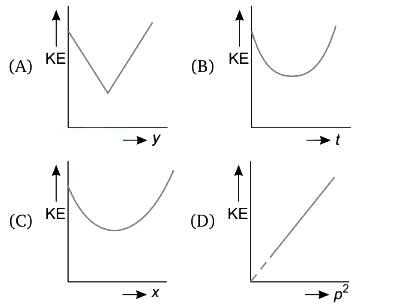
- A particle is projected up from a point at an angle \(\theta\) with the horizontal direction. At any time \(t\), if \(p\) is the linear momentum, \(y\) is the vertical displacement, \(x\) is horizontal displacement, the graph among the following which does not represent the variation of kinetic energy KE of the particle is
 AP EAMCET 2009 Hard