


AP EAMCET · Maths · Determinants
If the equations
\[
\begin{aligned}
& k x+(k+1) y+(k-1) z=0, \\
& (k-1) x+(k+2) y+k z=0 \text { and } \\
& (k+1) x+k y+(k+2) z=0
\end{aligned}
\]
have a non trivial solution, then the sum of all the possible values of \(k\) is
- A 0
- B \(-\frac{1}{2}\)
- C \(\frac{1}{2}\)
- D 1
Answer & Solution
Correct Answer
(B) \(-\frac{1}{2}\)
Step-by-step Solution
Detailed explanation
\( \begin{vmatrix} k & k+1 & k-1 \\ k-1 & k+2 & k \\ k+1 & k & k+2 \end{vmatrix} = 0 \) \( k((k+2)^2-k^2) - (k+1)((k-1)(k+2)-k(k+1)) + (k-1)(k(k-1)-(k+1)(k+2)) = 0 \) \( k(4k+4) - (k+1)(-2) + (k-1)(-4k-2) = 0 \) \( 4k^2+4k + 2k+2 - 4k^2+2k+2 = 0 \) \( 8k+4 = 0 \)…
See the Complete Solution
Get step-by-step explanations for this and 2.5 Lakh+ more JEE, NEET & CET questions.
- Unlock all solutions
- Practice the full chapter
- Track accuracy across PYQs
4.8 rated on Google Play · 14,000+ reviews
More questions from Maths
- The solution of \(\frac{d x}{d y}+\frac{x}{y}=x^2\) is :AP EAMCET 2006 Easy
- The points and areAP EAMCET 2021 Medium
- If \(\overrightarrow{\mathbf{a}}, \overrightarrow{\mathbf{b}}, \overrightarrow{\mathbf{c}}\) are three vectors such that \(\overrightarrow{\mathbf{a}}=\overrightarrow{\mathbf{b}}+\overrightarrow{\mathbf{c}}\) and the angle between \(\overrightarrow{\mathbf{b}}\) and \(\overrightarrow{\mathbf{c}}\) is \(\frac{\pi}{2}\), then:AP EAMCET 2003 Medium
- \(\lim _{x \rightarrow 0}\left(\frac{\sin a x}{\tan b x}\right)\) is equal toAP EAMCET 2021 Easy
- The differential equation formed by eliminating and from the equation isAP EAMCET 2019 Easy
- If \(\hat{\mathbf{a}}, \hat{\mathbf{b}}\) and \(\hat{\mathbf{c}}\) are vectors with magnitudes 2,3 and 4 respectively, then the best upper bound of \(|\hat{\mathbf{a}}-\hat{\mathbf{b}}|^2+|\hat{\mathbf{b}}-\hat{\mathbf{c}}|^2+|\hat{\mathbf{c}}-\hat{\mathbf{a}}|^2\) among the given values isAP EAMCET 2014 Hard
More PYQs from AP EAMCET
- The function of \(f(x)=|x|+\frac{|x|}{x}\) isAP EAMCET 2020 Easy
- An air column in a tube \(32 \mathrm{~cm}\) long, closed at one end, is in resonance with a tuning fork. The air column in another tube, open at both ends, of length \(66 \mathrm{~cm}\) is in resonance with
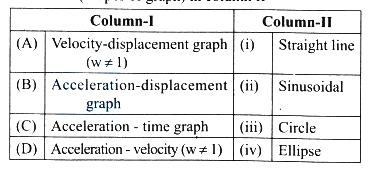
another tuning fork. When these two tuning forks are sounded together, they produce 8 beats per second. Then the frequencies of the two tuning forks are, (Consider fundamental frequencies only)AP EAMCET 2013 Hard - For a particle executing simple harmonic motion, match the following statements (conditions) from column I to statements (shapes of graph) in column II
 AP EAMCET 2024 Medium
 - If \(\mathrm{P}(2, \beta, \alpha)\) lies on the plane \(x+2 y-z-2=0\) an \(\mathrm{Q}(\alpha,-1, \beta)\) lies on the plane \(2 x-y+3 z+6=0\) then 1 direction cosines of the line PQ areAP EAMCET 2024 Easy
- When a \(5 \mathrm{C}\) charge is kept in a uniform electric field, a force of \(5000 \mathrm{~N}\) acts on it. Find the potential difference between two points in that field, separated by a distance of \(1 \mathrm{~cm}\).AP EAMCET 2020 Medium
- Two bodies of masses \(m_1\) and \(m_2\) initially at rest at infinite distance apart move towards each other under gravitational force of attraction. Their relative velocity of approach when they are separated by a distance \(r\) is ( \(\mathrm{G}=\) universal gravitational constant.)AP EAMCET 2019 Medium