


AP EAMCET · Maths · Definite Integration
If \(\mathrm{I}=\int_1^3 \sqrt{3+\mathrm{x}+\mathrm{x}^2} \mathrm{dx}\), then \(\mathrm{I}\) lies in the interval
- A \((2 \sqrt{5}, 2 \sqrt{15})\)
- B \((\sqrt{3}, 2 \sqrt{5})\)
- C \((\sqrt{23}, \sqrt{33})\)
- D \((2 \sqrt{15}, \sqrt{23})\)
Answer & Solution
Correct Answer
(A) \((2 \sqrt{5}, 2 \sqrt{15})\)
Step-by-step Solution
Detailed explanation
\(\mathrm{I}=\int_1^3 \sqrt{3+\mathrm{x}+\mathrm{x}^2} \mathrm{dx}=\int_1^3 \sqrt{\left(\mathrm{x}+\frac{1}{2}\right)^2+\left(\frac{\sqrt{11}}{2}\right)^2} \mathrm{dx}\)…
See the Complete Solution
Get step-by-step explanations for this and 2.5 Lakh+ more JEE, NEET & CET questions.
- Unlock all solutions
- Practice the full chapter
- Track accuracy across PYQs
4.8 rated on Google Play · 14,000+ reviews
More questions from Maths
- If \(\frac{1}{2} \leq \frac{x^2+x+a}{x^2-x+a} \leq 2 \forall x \in R\), then \(a=\)AP EAMCET 2025 Medium
- If \(A\) and \(B\) are any two events such that \(P(\overline{A \cup B})=\frac{1}{6}, P(A \cap B)=\frac{1}{4}\) and \(P(\bar{A})=\frac{1}{4}\), then the events \(A\) and \(B\) areAP EAMCET 2017 Easy
- If \(\quad \overrightarrow{\mathbf{a}}=\hat{\mathbf{i}}+\hat{\mathbf{j}}+\hat{\mathbf{k}}, \overrightarrow{\mathbf{b}}=\hat{\mathbf{i}}-\hat{\mathbf{j}}+\hat{\mathbf{k}}, \quad \overrightarrow{\mathbf{c}}=\hat{\mathbf{i}}+\hat{\mathbf{j}}-\hat{\mathbf{k}}\) and \(\overrightarrow{\mathbf{d}}=\hat{\mathbf{i}}-\hat{\mathbf{j}}-\hat{\mathbf{k}}\), then observe the following
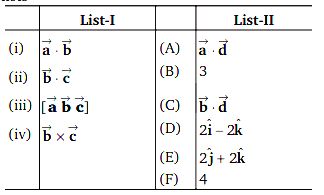
The correct match of List-I to List-II
\(\begin{array}{llll}\text { i } & \text { ii } & \text { iii } & \text { iv }\end{array}\)AP EAMCET 2008 Easy - If \(\alpha, \beta\) are the irrational roots of the equation \(x^5-5 x^4+9 x^3-9 x^2+5 x-1=0\), then the roots of the equation \((\alpha+\beta) x^2+2 \alpha \beta x-\alpha \beta=0\) areAP EAMCET 2018 Medium
- If \(\frac{3 x^2+x+1}{(x-1)^4}=\frac{a}{(x-1)}+\frac{b}{(x-1)^2}\) \(+\frac{c}{(x-1)^3}+\frac{d}{(x-1)^4}\)
then \(\left[\begin{array}{ll}a & b \\ c & d\end{array}\right]\) is equal toAP EAMCET 2010 Medium - Let \(a \neq 0\) and \(p(x)\) be a polynomial of degree greater than 2. If \(p(x)\) leaves remainders a and \(-a\) when divided respectively by \(x+a\) and \(x-a\), then the remainder when \(p(x)\) is divided by \(x^2-a^2\) is :AP EAMCET 2003 Medium
More PYQs from AP EAMCET
- If \(\mathbf{a} \neq \mathbf{0}, \mathbf{b} \neq \mathbf{0}, \mathbf{c} \neq 0, \mathbf{a} \times \mathbf{b}=\mathbf{0}\) and \(\mathbf{b} \times \mathbf{c}=0\), then \(\mathbf{a} \times \mathbf{c}\) is equal toAP EAMCET 2013 Easy
- For \(x>0\), if \(\int(\log x)^5 d x\) is equal to \(x\left[A(\log x)^5+\right.\) \(\left.B(\log x)^4+C(\log x)^3+D(\log x)^2+E(\log x)+F\right]+\) constant, then \(A+B+C+D+E+F\) is equal toAP EAMCET 2016 Medium
- If the line \(2 x+5 y=12\) intersects the ellipse \(4 x^2+5 y^2=20\) in two distinct points \(A\) and \(B\), then mid-point of \(A B\) isAP EAMCET 2012 Easy
- On increasing temperature, the equilibrium constant of exothermic and endothermic reactions, respectivelyAP EAMCET 2015 Medium
- Power radiated by a black body at temperature \(T_1\) is \(P\) and it radiates maximum energy at a wavelength \(\lambda_1\). If the temperature of the black body is changed from \(T_1\) to \(T_2\), it radiates maximum energy at a wavelength \(\frac{\lambda_1}{2}\). The power radiated at \(T_2\) isAP EAMCET 2012 Easy
- If the normal drawn at the point \(P\left(\frac{\pi}{4}\right)\) on the ellipse \(x^2+4 y^2-4=0\) meets the ellipse again at \(\mathrm{Q}(\alpha, \beta)\), then \(\alpha=\)AP EAMCET 2025 Medium