


AP EAMCET · Maths · Differential Equations
If \(\frac{d y}{d x}=f(x, y)\) is a homogeneous differential equation, then the general form of \(f(x, y)\) is
- A \(\mathrm{x}^{\mathrm{n}} \phi\left(\frac{\mathrm{y}}{\mathrm{x}}\right), \mathrm{n} \neq 1\)
- B \(y^n \phi\left(\frac{x}{y}\right), n \neq 1\)
- C \(\phi\left(\frac{y}{x}\right)\)
- D \(\mathrm{K}^{\mathrm{n}} \mathrm{f}(\mathrm{x}, \mathrm{y}), \mathrm{n} \neq 1\)
Answer & Solution
Correct Answer
(C) \(\phi\left(\frac{y}{x}\right)\)
Step-by-step Solution
Detailed explanation
Since \(\frac{d y}{d x}=f(x, y)\) is said to be a homogeneous differential equation if \(\mathrm{f}(x, y)\) is a homogenous function of degree zero. i.e. \(\frac{d y}{d x}=f(x, y)=\phi(y / x)\)
See the Complete Solution
Get step-by-step explanations for this and 2.5 Lakh+ more JEE, NEET & CET questions.
- Unlock all solutions
- Practice the full chapter
- Track accuracy across PYQs
4.8 rated on Google Play · 14,000+ reviews
More questions from Maths
- \(\int\left(\sum_{r=0}^{\infty} \frac{x^r 2^r}{r!}\right) d x=\)AP EAMCET 2025 Medium
- If \(\cos \alpha=\operatorname{sech} \beta\), then \(\beta=\)AP EAMCET 2025 Medium
- If the slope of one of the lines represented by be the square of the other, then isAP EAMCET 2021 Medium
- If \(y=\cos ^{-1}\left(\frac{a^2-x^2}{a^2+x^2}\right)+\sin ^{-1}\left(\frac{2 a x}{a^2+x^2}\right)\), then \(\frac{d y}{d x}\) is equal toAP EAMCET 2010 Hard
- Let \(A\) and \(B\) be two events with \(P(A)=\frac{1}{7}\), \(P\left(\frac{A}{B}\right)=\frac{2}{3}\) and \(P(B)=\frac{2}{7}\). Then, the value \(P\left(\frac{B}{A}\right)\) isAP EAMCET 2021 Easy
- If \(A=\left[\begin{array}{cc}1 & -2 \\ 4 & 5\end{array}\right]\) and \(f(t)=t^2-3 t+7\), then \(f(A)+\left[\begin{array}{cc}3 & 6 \\ -12 & -9\end{array}\right]\) is equal toAP EAMCET 2008 Medium
More PYQs from AP EAMCET
- The equation of the ellipse with its focus at \((6,2)\) centre at \((1,2)\) and which passes through the point \((4,6)\) isAP EAMCET 2020 Medium
- What are \(Y\) and \(Z\) in the following reaction sequence?
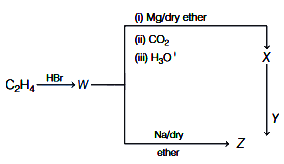 AP EAMCET 2019 Hard
 - The formula of the product formed, when sodium thiosulphate solution is added to silver bromide isAP EAMCET 2007 Medium
- Assertion (A) When a wire of aluminium and another wire of silicon are heated from room temperature to \(80^{\circ} \mathrm{C}\), the conductivity of aluminium increases and that of silicon decreases.
Reason (R) Aluminium has positive temperature coefficient of resistivity and silicon has negative temperature coefficient of resistivity.AP EAMCET 2019 Easy - A parallel plate capacitor whose plates are separated by is charged to , and then the charging source is removed. When a slab of dielectric constant and thickness is placed between the plates, find the change in the potential difference across the capacitor?AP EAMCET 2021 Hard
- Identify the fibre \((\mathrm{X})\) and elastomer \((\mathrm{Y})\) from the followingAP EAMCET 2017 Easy