


AP EAMCET · Maths · Functions
If a square \(A B C D\), where \(A(0,0), B(2,0), C(2,2)\) and \(D(0,2)\) undergoes the following transformations successively, then the final figure would be a
(i) \(f_1(x, y) \longrightarrow(y, x)\)
(ii) \(f_2(x, y) \longrightarrow(x+3 y, y)\)
(iii) \(f_3(x, y) \longrightarrow\left(\frac{x-y}{2}, \frac{x+y}{2}\right)\)
- A square
- B rhombus
- C rectangle
- D parallelogram
Answer & Solution
Correct Answer
(D) parallelogram
Step-by-step Solution
Detailed explanation
Given, square \(A B C D\) when \(A(0,0), B(2,0), C(2,2)\),\(D(0,2)\) undergoes the following transformations. (i) \(f_1(x, y) \rightarrow(y, x)\) (ii) \(f_2(x, y) \rightarrow(x+3 y, y)\) (iii) \(f_3(x, y) \rightarrow\left(\frac{x-y}{2}, \frac{x+y}{2}\right)\) By the…
See the Complete Solution
Get step-by-step explanations for this and 2.5 Lakh+ more JEE, NEET & CET questions.
- Unlock all solutions
- Practice the full chapter
- Track accuracy across PYQs
4.8 rated on Google Play · 14,000+ reviews
More questions from Maths
- The vector \(\mathbf{c} .(\mathbf{b}+\mathbf{c}) \times(\mathbf{a}+\mathbf{b}+\mathbf{c})\) is equal toAP EAMCET 2004 Easy
- \(A(2,3), B(-1,1)\) are two points. If \(P\) is a variable point such that \(\angle A P B=90^{\circ}\) then locus of \(P\) isAP EAMCET 2024 Easy
- If the line passing through the points \((5,1, a)\) and \((3, b, 1)\) crosses the YZ plane at the point \(\left(0, \frac{17}{2}, \frac{-18}{2}\right)\), then \(a+b=\)AP EAMCET 2023 Medium
- \(3 \overline{\mathrm{i}}+\overline{\mathrm{j}}+\overline{\mathrm{k}}, 2 \overline{\mathrm{i}}+\overline{\mathrm{k}}, \overline{\mathrm{i}}+5 \overline{\mathrm{j}}\) are the position vectors of three non collinear points \(A, B, C\) respectively. If the perpendicular drawn from \(C\) onto \(\overline{A B}\) meets \(\overline{A B}\) at the point \(a \bar{i}+b \bar{j}+c \bar{k}\), then \(a+b+c=\)AP EAMCET 2025 Medium
- If \(3 \sqrt{2} x-4 y=12\) is a tangent to the hyperbola \(\frac{x^2}{a^2}-\frac{y^2}{b^2}=1\) and \(\frac{5}{4}\) is its eccentricity, then \(a^2-b^2=\)AP EAMCET 2025 Medium
- The number of all four digit numbers which do not have four distinct digits isAP EAMCET 2017 Medium
More PYQs from AP EAMCET
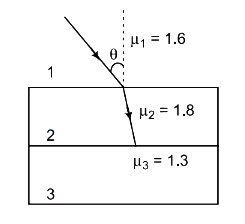
- A ray of light refracts from medium 1 into a thin layer of medium 2, crosses the layer and is incident at the critical angle on the interface between the medium 2 and 3 as shown in the figure. If the angle of incidence of ray is \(\theta\), the value of \(\theta\) is
 AP EAMCET 2011 Medium
 - \(\int \tan ^{-1}\left(\sqrt{\frac{1-x}{1+x}}\right) d x\) is equal toAP EAMCET 2007 Hard
- The increasing order of densities of the following alkyl halides is
1. \(n-\mathrm{C}_3 \mathrm{H}_7 \mathrm{Br}\)
II. \(n-\mathrm{C}_3 \mathrm{H}_7 \mathrm{Cl}\)
m. \(n-\mathrm{C}_3 \mathrm{H}_7 \mathrm{I}\)AP EAMCET 2020 Easy - If \(f^{\prime}(x)=\sqrt{2 x^2-1}\) and \(y=f\left(x^3\right)\), then find the value of \(\frac{d y}{d x}\) at \(x=1\)AP EAMCET 2021 Easy
- If the points with position vectors \(60 \hat{\mathbf{i}}+3 \hat{\mathbf{j}}, 40 \hat{\mathbf{i}}-8 \hat{\mathbf{j}}\) and \(a \hat{\mathbf{i}}-52 \hat{\mathbf{j}}\) are collinear, then \(a\) is equal toAP EAMCET 2008 Easy
- Two charges \(+80 \mu \mathrm{C}\) and \(+20 \mu \mathrm{C}\) are separated by a distance in air. An unknown third charge \(q\) is placed at the centre of the line joining the two charges. If the charges are in equilibrium, then \(q\).AP EAMCET 2021 Medium