


AP EAMCET · Maths · Vector Algebra
If \(\overrightarrow{\mathrm{a}}=\hat{\mathrm{i}}+3 \hat{\mathrm{j}}+13 \hat{\mathrm{k}}\) and \(\overrightarrow{\mathrm{b}}=2 \hat{\mathrm{i}}-4 \hat{\mathrm{j}}+3 \hat{\mathrm{k}}\) are two vectors, then the component vector of \(\vec{a}\) perpendicular to \(\vec{b}\) is
- A \(\hat{\mathrm{i}}-\hat{\mathrm{j}}-2 \hat{\mathrm{k}}\)
- B \(3 \hat{i}+3 \hat{j}+2 \hat{k}\)
- C \(-\hat{\mathrm{i}}+7 \hat{\mathrm{j}}+10 \hat{\mathrm{k}}\)
- D \(4 \hat{\mathrm{i}}+5 \hat{\mathrm{j}}+4 \hat{\mathrm{k}}\)
Answer & Solution
Correct Answer
(C) \(-\hat{\mathrm{i}}+7 \hat{\mathrm{j}}+10 \hat{\mathrm{k}}\)
Step-by-step Solution
Detailed explanation
Given \(\overrightarrow{\mathrm{a}}=\hat{\mathrm{i}}+3 \hat{\mathrm{j}}+13 \hat{\mathrm{k}}, \overrightarrow{\mathrm{b}}=2 \hat{\mathrm{i}}-4 \hat{\mathrm{j}}+3 \hat{\mathrm{k}}\) Let the component of vector \(\vec{a}\) perpendicular to \(\vec{b}\) is \(\vec{x}\)…
See the Complete Solution
Get step-by-step explanations for this and 2.5 Lakh+ more JEE, NEET & CET questions.
- Unlock all solutions
- Practice the full chapter
- Track accuracy across PYQs
4.8 rated on Google Play · 14,000+ reviews
More questions from Maths
- If three consecutive vertices of a parallelogram are \(A(4,3,5), B(0,6,0)\), \(C(-8,1,4)\) and \(D\) is the fourth vertex, then the angle between \(\mathbf{A C}\) and \(\mathbf{B D}\) isAP EAMCET 2021 Medium
- If three unit vectors \(\overrightarrow{\mathbf{a}}, \overrightarrow{\mathbf{b}}, \overrightarrow{\mathbf{c}} \quad\) satisfy \(\overrightarrow{\mathbf{a}}+\overrightarrow{\mathbf{b}}+\overrightarrow{\mathbf{c}}=\overrightarrow{\mathbf{0}}\), then the angle between \(\overrightarrow{\mathbf{a}}\) and \(\overrightarrow{\mathbf{b}}\) isAP EAMCET 2010 Easy
- If the harmonic mean of the roots of the equation \(\sqrt{2} \mathrm{x}^2-\mathrm{bx}+(8-2 \sqrt{5})=0\) is 4, then the value of \(b\) isAP EAMCET 2025 Medium
- The pair of lines joining the origin to the points of intersection of the line \(x-y=2\) with the curve \(5 x^2+12 x y-8 y^2+8 x-4 y+12=0\) are equally inclined to the pair of linesAP EAMCET 2017 Hard
- The area (in sq. units) of the region bounded by the curves \(y=4|\cos x|\) and \(y=-|\cos x|\) from \(x=-\frac{\pi}{2}\) to \(\frac{\pi}{2}\) isAP EAMCET 2023 Medium
- \(\mathbf{a}, \mathbf{b}\) are two vectors such that \(|\mathbf{a}|=\sqrt{3},|\mathbf{b}|=\sqrt{2}\). If \(\mathbf{x}\) is unit vector satisfying \(\mathbf{x} \times \mathbf{a}=\mathbf{b}\), then \(\mathbf{x}=\)AP EAMCET 2022 Easy
More PYQs from AP EAMCET
- A rectangular wire loop of sides \(5 \mathrm{~cm}\) and \(3 \mathrm{~cm}\) with a small cut is moving away from an infinitely long straight wire carrying a current of \(30 \mathrm{~A}\) with a velocity of \(20 \mathrm{~ms}^{-1}\) as shown in the figure. The emf induced across the cut is
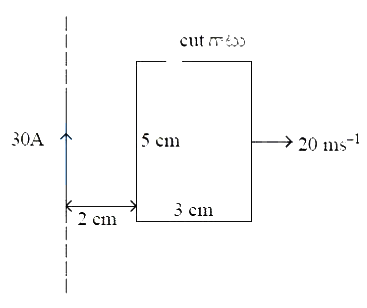 AP EAMCET 2018 Easy
 - If \(\mathrm{f}: \mathbb{R} \backslash\{0\} \rightarrow \mathbb{R}\) is defined by \(\mathrm{f}(\mathrm{x})=\mathrm{x}+\frac{1}{\mathrm{x}}\), then the value of \((\mathrm{f}(\mathrm{x}))^2=\)AP EAMCET 2023 Easy
- \(\frac{(1+i) x-2 i}{3+i}+\frac{(2-3 i) y}{3-i}=i \Rightarrow x+y=\)AP EAMCET 2022 Easy
- Let \(l_1\) be the line passing through the point \(3 \bar{i}+4 \bar{j}-2 \bar{k}\) and parallel to the vector \(-\bar{i}+2 \bar{j}+\bar{k}\). Let \(l_2\) be another line passing through the point \(\bar{i}-7 \bar{j}-2 \bar{k}\) and parallel to the vector \(\bar{i}+3 \bar{j}+2 \bar{k}\). Then the shortest distance between the lines \(l_1\) and \(l_2\) isAP EAMCET 2018 Medium
- A man of \(50 \mathrm{~kg}\) is standing at one end on a boat of length \(25 \mathrm{~m}\) and mass \(200 \mathrm{~kg}\). If he starts running and when he reaches the other end, he has a velocity \(2 \mathrm{~ms}^{-1}\) with respect to the boat. The final velocity of the boat is : (in \(\mathrm{ms}^{-1}\) )AP EAMCET 2006 Easy
- In a regular hexagon \(A B C D E F\), \(\mathbf{A D}+\mathbf{E B}+\mathbf{F C}=(\beta \lambda-8) \mathbf{A B}\). Then \(\lambda=\)AP EAMCET 2020 Medium