


AP EAMCET · Maths · Continuity and Differentiability
If a function \(f(x)\) defined on \([a, b]\) is discontinuous at \(x=\alpha \in(a, b)\), then
- A \(\lim _{x \rightarrow \alpha^{-}} f(x)=\lim _{x \rightarrow \alpha^{+}} f(x)=f(\alpha)\)
- B \(\lim _{x \rightarrow \alpha^{+}} f(x) \neq f(\alpha)\)
- C \(\lim _{x \rightarrow a^{-}} f(x)=f(a)\)
- D \(\lim _{x \rightarrow b^{+}} f(x)=f(b)\)
Answer & Solution
Correct Answer
(B) \(\lim _{x \rightarrow \alpha^{+}} f(x) \neq f(\alpha)\)
Step-by-step Solution
Detailed explanation
\(f(x)\) is defined on \([a, b]\) and discontinuous at \(x=\alpha \in(a, b)\) Since \(f(x)\) is discontinuous at \(x=\alpha \in(a, b)\) Hence option (a) will never be true but \(\lim _{x \rightarrow \alpha} f(x) \neq f(\alpha)\) is showing that \(f(x)\) is discontinuous at…
See the Complete Solution
Get step-by-step explanations for this and 2.5 Lakh+ more JEE, NEET & CET questions.
- Unlock all solutions
- Practice the full chapter
- Track accuracy across PYQs
4.8 rated on Google Play · 14,000+ reviews
More questions from Maths
- For which value of ' \(k\) ', the roots of equation \(2 x^2+5 x+k=0\) are rational?AP EAMCET 2020 Medium
- If the middle term in the expansion of \((1+x)^{2 n}\) is the greatest term, then \(x\) lies in the intervalAP EAMCET 2016 Hard
- Let F and \(\mathrm{F}^1\) be the foci of the ellipse \(\frac{x^2}{4}+\frac{y^2}{b^2}=1(b \lt 2)\) and \(B\) is one end of the minor axis. If the area of the triangle \(\mathrm{FBF}^1\) is \(\sqrt{3}\) sq. units, then the eccentricity of the ellipse isAP EAMCET 2024 Hard
- Define \(f: C \rightarrow \mathrm{R}\) by \(f(z)=|z|, \forall z \in C\). Then, which of the following is false ?AP EAMCET 2021 Medium
- If \({ }^9 C_3+{ }^9 C_5={ }^{10} C_r\) for some \(r \in \mathbb{N}\), then \(r=\)AP EAMCET 2022 Easy
- If the position vectors of the vertices \(A, B\) and \(C\) of \(\triangle A B C\) are \(\hat{\mathbf{i}}+2 \hat{\mathbf{j}}-5 \hat{\mathbf{k}},-2 \hat{\mathbf{i}}+2 \hat{\mathbf{j}}+\hat{\mathbf{k}}\) and \(2 \hat{\mathbf{i}}+\hat{\mathbf{j}}-\hat{\mathbf{k}}\) respectively, then \(\angle B=\)AP EAMCET 2019 Easy
More PYQs from AP EAMCET
- The period of revolution of planet \(A\) around the sun is 8 times that of \(B\). The distance of \(A\) from sun is how many times greater than that of \(B\) from the sun?AP EAMCET 2020 Easy
- If \(\frac{1}{6} \sin \theta, \cos \theta\) and \(\tan \theta\) are in geometric progression, then the solution set of \(\theta\) isAP EAMCET 2016 Medium
- Sulphur containing amino acids of the following are
\begin{array}{cccc}
Serine & Cysteine & Lysine & methionine \\
A & B & C & D
\end{array}AP EAMCET 2023 Easy - The solubility of \(A_2 X_3\) is ' \(y\) ' M. Its solubility product is \(\mathrm{M}^5\).AP EAMCET 2020 Medium
- If \(x=\log _e\left[\cot \left(\frac{\pi}{4}+\theta\right)\right]\) where \(|\theta| < \frac{\pi}{4}\) then \(\sinh x=\)AP EAMCET 2017 Easy
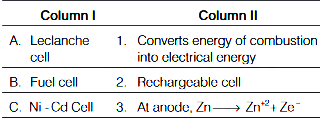
- Match the entries from Column I and Column II and choose the correct order.
 AP EAMCET 2020 Easy