


AP EAMCET · Maths · Parabola
Find the equation to the parabola, whose axis parallel to the \(y\)-axis and which passes through the points \((0,4),(1,9)\) and \((4,5)\) is
- A \(y=-x^2+x+4\)
- B \(y=-x^2+x+1\)
- C \(y=\frac{-19}{12} x^2+\frac{79}{12} x+4\)
- D \(y=\frac{-19}{12} x^2+\frac{89}{12}+1\)
Answer & Solution
Correct Answer
(C) \(y=\frac{-19}{12} x^2+\frac{79}{12} x+4\)
Step-by-step Solution
Detailed explanation
The equation of parabola parallel to \(y\)-axis is \(y=A x^2+B x+C\) ...(i) The point \((0,4),(1,9)\) and \((4,5)\) lies on Eq. (i). Then, \(\quad 4=0+0+C \Rightarrow C=4\) ...(ii) \(9=A+B+C\) or \(\quad 9=A+B+4 \quad(\because C=4)\) \(A+B=5\) ...(iii) and…
See the Complete Solution
Get step-by-step explanations for this and 2.5 Lakh+ more JEE, NEET & CET questions.
- Unlock all solutions
- Practice the full chapter
- Track accuracy across PYQs
4.8 rated on Google Play · 14,000+ reviews
More questions from Maths
- If the slope of one of the lines represented by be the square of the other, then isAP EAMCET 2021 Medium
- If \(X\) is a Poisson random variate with mean 3, then \(P(|X-3| < 2)=\)AP EAMCET 2022 Easy
- Let \(\pi_1\) be the plane determined by the vectors \(\hat{i}+\hat{j}\) and \(\hat{j}+\hat{k}, \pi_2\) be the plane determined by the vectors \(\hat{i}-\hat{j}\) and \(\hat{i}+\hat{j}-\hat{k}\). Let \(\vec{a}\) be a vector parallel to the line of intersection of \(\pi_1\) and \(\pi_2\). If \(|\vec{a}|=\sqrt{14}\), then \(|\vec{a} \cdot(\hat{i}+\hat{j}+\hat{k})|=\)AP EAMCET 2023 Easy
- In a \(\triangle A B C, D, E\) and \(F\) respectively are the points of contact of the incircle with the sides \(A B, B C\) and \(C A\) such that \(A D=\alpha, B E=\beta\) and \(C F=\gamma\), then \(\frac{\alpha \beta \gamma}{\alpha+\beta+\gamma}=\)AP EAMCET 2018 Easy
- If \(g(x)=\frac{x}{[x]}\) for \(\mathrm{x}>2\), then \(\lim _{x \rightarrow 2} \frac{g(x)-g(2)}{x-2}\) is equal toAP EAMCET 2015 Easy
- \(\int_2^3 \frac{d x}{x^2-x}\) is equal toAP EAMCET 2002 Medium
More PYQs from AP EAMCET
- A thin uniform rod of length \(L\) is resting against a wall and the floor as shown in the figure. Its lower end \(A\) is pulled towards left with a constant velocity \(v\). Then the downward velocity \(v^{\prime}\) of the other end \(B\) when the rod makes an angle \(\theta\) with the floor is
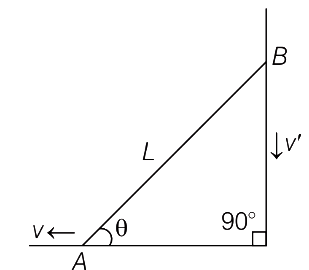 AP EAMCET 2019 Hard
 - An electrically charged particle enters into a uniform magnetic induction field in a direction perpendicular to the field with a velocity \(v\). Then, it travelsAP EAMCET 2014 Easy
- The area of the circle passing through the points isAP EAMCET 2022 Easy
- \(\mathrm{G}(1,0,1)\) is the centroid of the triangle ABC. If \(\mathrm{A}=(1,-4,2)\) and \(\mathrm{B}=(3,1,0)\) then \(\mathrm{AG}^2+\mathrm{CG}^2=\)AP EAMCET 2025 Medium
- The minimum excitation energy of an electron revolving in the first orbit of hydrogen isAP EAMCET 2023 Easy
- If \(z=x+i y\) and if the point \(P\) in the Argand diagram represents \(z\), then the locus of the point \(P\) satisfying the equation \(2|z-2-3 i|=3|z+i-2|\) is a circle with centreAP EAMCET 2025 Medium