


AP EAMCET · Maths · Indefinite Integration
\(\int \frac{d x}{\cos ^2(x)+\sin (2 x)}=\)
- A \(\frac{1}{2} \log |1+2 \cos (x)|+c\)
- B \(\frac{1}{2} \log |1-2 \tan (x)|+c\)
- C \(\frac{1}{2} \log |1+2 \tan (x)|+c\)
- D \(\frac{1}{2} \log |1+2 \cot (x)|+c\)
Answer & Solution
Correct Answer
(C) \(\frac{1}{2} \log |1+2 \tan (x)|+c\)
Step-by-step Solution
Detailed explanation
\(I=\int \frac{d x}{\cos ^2 x+\sin 2 x}=\int \frac{\sec ^2 x d x}{1+2 \tan x}\) Put \(1+2 \tan x=t \Rightarrow \sec ^2 x d x=\frac{d t}{2}\) So, \(I=\frac{1}{2} \int \frac{d t}{t}=\frac{1}{2} \log _e|t|+C=\frac{1}{2} \log _e|1+2 \tan x|+C\) Hence, option (c) is correct.
See the Complete Solution
Get step-by-step explanations for this and 2.5 Lakh+ more JEE, NEET & CET questions.
- Unlock all solutions
- Practice the full chapter
- Track accuracy across PYQs
4.8 rated on Google Play · 14,000+ reviews
More questions from Maths
- If \(\frac{d y}{d x}+2 x \tan (x-y)=1\), then \(\sin (x-y)\) is equal toAP EAMCET 2012 Medium
- \(\lim _{n \rightarrow \infty}\left[\frac{1}{n}+\frac{1}{n+1}+\frac{1}{n+2}+\ldots+\frac{1}{3 n}\right]=\)AP EAMCET 2017 Hard
- If the pair of lines joining the origin and the points of intersection of the line and the curve are at right angles, then the locus of the point is a circle of radiusAP EAMCET 2019 Medium
- The set of solutions of the system of equations
\[
\begin{aligned}
x+y & =\frac{2 \pi}{3} \\
\text { and } \quad \cos x+\cos y & =\frac{3}{2},
\end{aligned}
\]
where \(x, y\) are real, isAP EAMCET 2013 Hard - If \(x=-5+2 \sqrt{-4}\), then the value of \(x^4+9 x^3+35 x^2-x+4\) isAP EAMCET 2022 Medium
- If \(z=x+i y, x, y \in R\) and the imaginary part of \(\frac{\bar{z}-1}{\bar{z}-i}\) is 1 , then the locus of \(z\) isAP EAMCET 2019 Easy
More PYQs from AP EAMCET
- When a light of wavelength \(4900 Å\) falls on a photosensitive metal, a negative \(2 \mathrm{~V}\) potential is required to stop the emitted electrons. Then, the work-function of the material is nearly
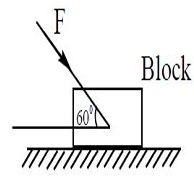
( given charge on electron \(=1.602 \times 10^{-19} \mathrm{C}\) and Planck's constant \(=6.625 \times 10^{-34} \mathrm{Js}\) )AP EAMCET 2021 Medium - As shown in the figure, a force \(F\) is applied on a block of mass \(\sqrt{3} \mathrm{~kg}\) placed on a rough horizontal surface. The maximum value of F for the block not to move is (Coefficient of static friction between the block and the surface is \(\frac{1}{2 \sqrt{3}}\) and acceleration due to gravity \(=10 \mathrm{~m} \mathrm{~s}^{-2}\) )
 AP EAMCET 2025 Medium
 - Let \(Q(x)\) be a polynomial of degree \(n\). If \(Q(\mathrm{l})=1\) and \(\frac{Q(2 x)}{Q(x+1)}+\frac{56}{x+7}-8=0\), then the value of \({ }^n C_0+{ }^n C_1+\ldots+{ }^n C_n\) is equal toAP EAMCET 2021 Hard
- Let \(\theta \in R\) such that \(3 \sinh (2 \theta)=13-3 e^{2 \theta}\), then \(\theta=\)AP EAMCET 2022 Medium
- The horizontal distance between a tower and a builidng is \(10 \sqrt{3}\) units. If the angle of depression of the foot of the building from the top of the tower is \(60^{\circ}\) and the angle of elevation of the top of the building from the foot of the tower is \(30^{\circ}\), then the sum of the heights of the tower and the building isAP EAMCET 2025 Medium
- If \(y=y(x)\) is the solution of the differential equation \(\left(\frac{2+\sin x}{y+1}\right) \frac{d y}{d x}+\cos x=0 \quad\) with \(y(0)=1\), then \(y\left(\frac{\pi}{2}\right)\) is equal toAP EAMCET 2011 Medium