


AP EAMCET · Maths · Straight Lines
A square is formed by the lines \(x=0, y=0\), \(x=1, y=1\). Then, the equations of its diagonals will be
- A \(y=x, x+y=2\)
- B \(2 y=x, x+y=\frac{1}{2}\)
- C \(y=x, x+y=1\)
- D \(y=2 x, x+y=\frac{1}{4}\)
Answer & Solution
Correct Answer
(C) \(y=x, x+y=1\)
Step-by-step Solution
Detailed explanation
Equation of \(O B\) \(\begin{aligned} \quad y & =\left(\frac{1-0}{1-0}\right) x \\ \Rightarrow \quad(y & =x) \end{aligned}\) Equation of \(A C\) \(\Rightarrow \quad \begin{aligned} y-0 & =-1(x-1) \\ \Rightarrow \quad y & =-x+1 \Rightarrow x+y=1 \end{aligned}\)
See the Complete Solution
Get step-by-step explanations for this and 2.5 Lakh+ more JEE, NEET & CET questions.
- Unlock all solutions
- Practice the full chapter
- Track accuracy across PYQs
4.8 rated on Google Play · 14,000+ reviews
More questions from Maths
- If \(\alpha_1, \alpha_2, \ldots, \alpha_{23}\) are the 23 rd roots of unity, then \(\alpha_1^{47}+\alpha_2^{47}+\ldots .+\alpha_{23}^{47}=\)AP EAMCET 2022 Medium
- If \(3 \hat{\mathbf{i}}+3 \hat{\mathbf{j}}+\sqrt{3} \hat{\mathbf{k}}, \hat{\mathbf{i}}+\hat{\mathbf{k}}, \sqrt{3} \hat{\mathbf{i}}+\sqrt{3} \hat{\mathbf{j}}+\lambda \hat{\mathbf{k}}\) are coplanar, then \(\lambda\) is equal toAP EAMCET 2004 Easy
- Let \(a, b\), and \(c\) be such that
\(\frac{1}{(1-x)(1-2 x)(1-3 x)}=\frac{a}{1-x}+\frac{b}{1-2 x}+\frac{c}{1-3 x}\)
then \(\frac{a}{1}+\frac{b}{3}+\frac{c}{5}\) is equal toAP EAMCET 2003 Hard - If \(\vec{a}, \vec{b}, \vec{c}\) are three vectors such that \(|\vec{a}|=|\vec{b}|=|\vec{c}|=\sqrt{3}\) and \((\vec{a}+\vec{b}+\vec{c})^2+(\vec{b}+\vec{c}-\vec{a})^2+(\vec{c}+\vec{a}-\vec{b})^2=36\) then, \(|2 \vec{a}-3 \vec{b}+2 \vec{c}|^2=\)AP EAMCET 2024 Easy
- a, b, c, d are arbitrary constants. Then the corresponding differential equation to \(y=a c^x+b e^{-x}+c \cos x+d \sin x\) isAP EAMCET 2023 Medium
- The number of ways of forming the ordered pairs ( \(p, q\) ) such that \(p>q\) by choosing p and q from the first 50 natural numbers isAP EAMCET 2025 Medium
More PYQs from AP EAMCET
- The point \(P\) is equidistant from \(A(1,3)\), \(B(-3,5)\) and \(C(5,-1)\), then \(P A\) is equal to :AP EAMCET 2003 Easy
- In an optical fibre, core and cladding were made with materials of refractive indices 1.5 and 1.414 respectively. To observe total internal reflection, what will be the range of incident angle with the axis of optical fibre?AP EAMCET 2010 Medium
- Two situations are shown in fig. (a) and (b).
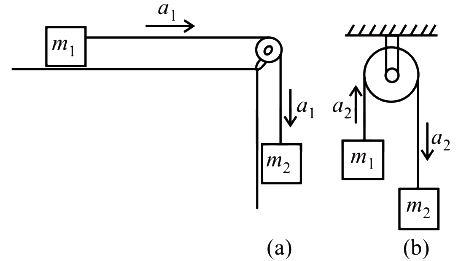
In each case, \(m_1=3 \mathrm{~kg}\) and \(m_2=4 \mathrm{~kg}\). If \(a_1, a_2\) are the respective accelerations of the blocks in these situations, then the values of \(a_1\) and \(a_2\) are respectively [ \(g=10 \mathrm{~ms}^{-2}\) ]AP EAMCET 2017 Easy - Which of the following is an example for heterogeneous catalysis reaction?AP EAMCET 2005 Easy
- Which one of the following is the correct order of ionic radii?AP EAMCET 2019 Medium
- If the angle between the curves \(y=e^{2(1+x)-4}\) and \(x^2 y=1\) at the point \((1,1)\) is \(\theta\), then \(|\sin \theta|+|\cos \theta|=\)AP EAMCET 2023 Medium