


AP EAMCET · Maths · Vector Algebra
\(\vec{a}\) and \(\vec{b}\) are two vectors such that \(\vec{a}\) is not parallel to \(\vec{b}\). If \(\overrightarrow{\mathrm{p}}=(\mathrm{x}+2 \mathrm{y}+3) \overrightarrow{\mathrm{a}}+(5 \mathrm{x}-\mathrm{y}+2) \overrightarrow{\mathrm{b}}\) and \(\overrightarrow{\mathrm{q}}=(2 \mathrm{x}+3 \mathrm{y}+5)\) \(\vec{a}+(x-5 y-2) \vec{b}\) are two vectors such that \(\vec{p}=2 \vec{q}\), then \(\mathrm{x}-2 \mathrm{y}=\)
- A 3
- B 2
- C -2
- D -3
Answer & Solution
Correct Answer
(B) 2
Step-by-step Solution
Detailed explanation
\[ \begin{aligned} & \text { } \bar{p}=2 \bar{q} \\ & \Rightarrow(x+2 y+3) \bar{a}+(5 x-y+2) \bar{b} \\ & (4 x+6 y+10) \vec{a}+(2 x-10 y-9) \vec{b} \end{aligned} \] Comparing both sides we get…
See the Complete Solution
Get step-by-step explanations for this and 2.5 Lakh+ more JEE, NEET & CET questions.
- Unlock all solutions
- Practice the full chapter
- Track accuracy across PYQs
4.8 rated on Google Play · 14,000+ reviews
More questions from Maths
- InAP EAMCET 2018 Medium
- If \(p_1\) and \(p_2\) denote the lengths of perpendiculars from \((2,3)\) onto the lines given by \(15 x^2+31 x y+14 y^2=0\), and if \(p_1>p_2\), then \(p_1^2+\frac{1}{74}-p_2^2+\frac{1}{13}\) is equal toAP EAMCET 2021 Medium
- The angle between the two circles, each passing through the centre of the other isAP EAMCET 2017 Medium
- If is a positive integer such that the roots of the equation are rational numbers, then the smallest possible value of isAP EAMCET 2021 Medium
- If the coefficients of \(x^{10}\) and \(x^{11}\) in the expansion of \(\left(1+\alpha x+\beta x^2\right)(1+x)^{11}\) are 396 and 144 respectively, then \(\alpha^2+\beta^2=\)AP EAMCET 2025 Medium
- If and are the roots of thenAP EAMCET 2018 Easy
More PYQs from AP EAMCET
- A capacitor of capacitance is charged using a battery. is then removed from the battery & connected to capacitors and of and respectively as shown in the figure. Find the charge on after equilibrium has reached is
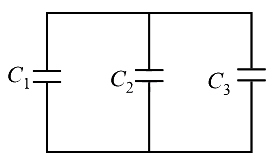 AP EAMCET 2022 Medium
 - If \(\cos \theta \neq 0\), and \(\sec \theta-1=(\sqrt{2}-1) \tan \theta\) then \(\theta=\)AP EAMCET 2019 Easy
- One die and a coin (both unbiased) are tossed simultaneously. The probability of getting 5 on the top of the die and tail on the coin isAP EAMCET 2002 Easy
- The coefficient of variation of the following distribution is
\(\begin{array}{l|c|c|c|c|c}
\hline \text {Class interval } & 0-5 & 5-10 & 10-15 & 15-20 & 20-25 \\
\hline \text {Frequency } & 4 & 1 & 10 & 3 & 2 \\
\hline
\end{array}\)AP EAMCET 2019 Easy - \(\int_1^2 \tan ^{-1}\left(\frac{x}{x^2+1}\right)+\tan ^{-1}\left(\frac{x^2+1}{x}\right) d x=\)AP EAMCET 2022 Medium
- The radical axis of the circles and cut the circle inAP EAMCET 2021 Hard