


AP EAMCET · Chemistry · Surface Chemistry
Which of the following general reaction is an example for heterogeneous catalysis?
- A \(\mathrm{A}_2(\mathrm{~g})+\mathrm{B}_2(\mathrm{~g}) \xrightarrow{C(\mathrm{~g})} 2 \mathrm{AB}(\mathrm{g})\)
- B \(\mathrm{A}(\mathrm{s})+\mathrm{B}(\mathrm{s}) \xrightarrow{C(\mathrm{~s})} \mathrm{D}(\mathrm{s})\)
- C \(\mathrm{A}(\mathrm{g})+\mathrm{B}(\mathrm{g}) \xrightarrow{C(s)} \mathrm{D}(\mathrm{g})\)
- D \(\mathrm{A}_2(\mathrm{~g})+\mathrm{B}_2(\mathrm{~g}) \xrightarrow{C(\mathrm{~g})} \mathrm{D}(\mathrm{s})\)
Answer & Solution
Correct Answer
(C) \(\mathrm{A}(\mathrm{g})+\mathrm{B}(\mathrm{g}) \xrightarrow{C(s)} \mathrm{D}(\mathrm{g})\)
Step-by-step Solution
Detailed explanation
In heterogeneous catalysis physical state of reactant and product is different
See the Complete Solution
Get step-by-step explanations for this and 2.5 Lakh+ more JEE, NEET & CET questions.
- Unlock all solutions
- Practice the full chapter
- Track accuracy across PYQs
4.8 rated on Google Play · 14,000+ reviews
More questions from Chemistry
- Which of the following is not an example of antacid ?AP EAMCET 2025 Easy
- Which one of the following alkali metals is the weakest reducing agent as per their \(\mathrm{E}^{\circ}\) values?AP EAMCET 2024 Easy
- Identify the best suitable reagent for the following reaction.
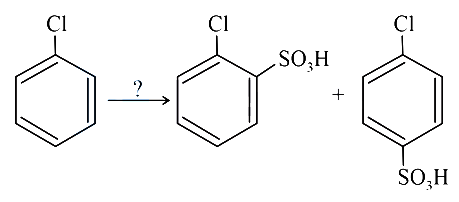 AP EAMCET 2021 Easy
 - Which of the following form an ideal sơlution?
I. Chloroethane and bromoethane
II. Benzene and toluene
III. \(n\)-hexane and \(n\)-heptane
IV. Phenol and anilineAP EAMCET 2022 Easy - If \(\mathrm{BaCl}_2\) ionizes to an extent of \(80 \%\) in aqueous solution, the value of van't Hoff factor isAP EAMCET 2010 Easy
- At \(T(\mathrm{~K})\) if the rate constant for a zero order reaction is \(2.5 \times 10^{-3} \mathrm{~ms}^{-1}\), the time required for the initial concentration of reactant, \(R\) to fall from \(0.10 \mathrm{M}\) to \(0.075 \mathrm{M}\) at the same temperature in seconds isAP EAMCET 2024 Easy
More PYQs from AP EAMCET
- The water on the surface of a lake is just about to freeze. The most likely temperature at the bottom of the lake isAP EAMCET 2021 Medium
- Which of the following statements is correct about photoelectric effect?
1. The number of electrons ejected from metal surface is inversely proportional to intensity of light.
2. Below threshold frequency, photoelectric effect can be observed.
3. At higher frequency than threshold frequency, the ejected electrons have certain kinetic energy.
4. At higher frequency than threshold frequency, the electron is still on the metal surface.AP EAMCET 2020 Medium - If the axes are rotated through an angle ' \(\alpha\) ', then the number of values of \(\alpha\) such that the transformed equation of \(x^2+y^2+2 x+2 y-5=0\) contains no linear terms isAP EAMCET 2024 Hard
- Given that \(a, b\) and \(c\) are real numbers such that \(b^2=4 a c\) and \(a>\gamma_0\). The maximal possible set \(D \subseteq R\) on which the function \(f: D \rightarrow R\) given by \(f(x)=\log \left\{a x^3+(a+b) x^2+(b+c) x+c\right\}\) is defined, isAP EAMCET 2018 Medium
- Which one of the following is used to convert sunlight into electricity in photovoltaic material?AP EAMCET 2017 Easy
- The random variable takes the values \(1,2,3\), \(\ldots, m\). If \(P(X=n)=\frac{1}{m}\) to each \(n\), then the variance of \(X\) isAP EAMCET 2013 Hard