


AP EAMCET · Chemistry · Electrochemistry
The standard free energy change \(\left(\Delta G^{\circ}\right)\) for the following reaction (in kJ ) at \(25^{\circ} \mathrm{C}\) is \(3 \mathrm{Ca}(\mathrm{s})+2 \mathrm{Au}^{3+}\) (aq. 1 M ) \(\rightarrow\) \(3 \mathrm{Ca}^{2+}(\mathrm{aq}, 1 \mathrm{M})+2 \mathrm{Au}(\mathrm{s})\)
(given : \(\mathrm{E}_{\mathrm{Au}^{3+} / \mathrm{Au}}^{\mathrm{o}}=+1.50 \mathrm{~V}, \mathrm{E}_{\mathrm{Ca}^{2+} / \mathrm{Ca}}^0=-2.87 \mathrm{~V}\), \(1 \mathrm{~F}=96500 \mathrm{C} \mathrm{mol}^{-1}\) )
- A \(-2.53 \times 10^3\)
- B \(+2.53 \times 10^3\)
- C \(-2.53 \times 10^4\)
- D \(+2.53 \times 10^4\)
Answer & Solution
Correct Answer
(A) \(-2.53 \times 10^3\)
Step-by-step Solution
Detailed explanation
\begin{aligned} & \text { } 3 \mathrm{Ca}(\mathrm{~s})+2 \mathrm{Au}^{3+}(\mathrm{aq} 1 \mathrm{M}) \rightarrow 3 \mathrm{Ca}^{2+}(\mathrm{aq} \mathrm{1M})+2 \mathrm{Au}(\mathrm{~S}) \\ & \mathrm{E}^0=\mathrm{E}_{\mathrm{L}}+\mathrm{E}_{\mathrm{R}} \\ & =\mathrm{E}_{\mathrm{Ca}…
See the Complete Solution
Get step-by-step explanations for this and 2.5 Lakh+ more JEE, NEET & CET questions.
- Unlock all solutions
- Practice the full chapter
- Track accuracy across PYQs
4.8 rated on Google Play · 14,000+ reviews
More questions from Chemistry
- The volume-temperature graphs of a given mass of an ideal gas at constant pressures are shown below. What is the correct order of pressures?
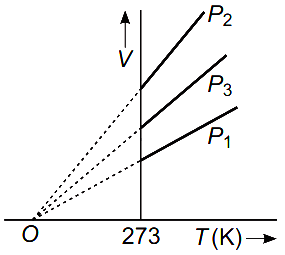 AP EAMCET 2006 Easy
 - When bauxite powder is mixed with coke and reacted with nitrogen at \(2075 \mathrm{~K}\), carbon monoxide and \(X\) are formed. What is the gas formed when \(X\) is reacted with water?AP EAMCET 2002 Medium
- The \% \(\left(\frac{W}{V}\right)\) of \(\mathrm{H}_2 \mathrm{O}_2\) in \(1.5 \mathrm{~N}\) solution isAP EAMCET 2021 Easy
- The correct order of coagulating power of the following ions to coagulate the positive sol is
\(\underset{\mathrm{I}}{\left[\mathrm{Fe}(\mathrm{CN})_6\right]^{4-},} \underset{\mathrm{II}}{\mathrm{Cl}^{-}}, \underset{\mathrm{III}}{\mathrm{SO}_4^{2-}}\)AP EAMCET 2022 Medium - The oxidation number of an element in a compound is evaluated on the basis of certain rules. Which of the following rules is not correct?
1. The oxidation number of hydrogen is always +1.
2. The algebraic sum of all the oxidation numbers of all elements in a compound is zero.
3. An element in the free or the uncombined state bears oxidation number zero.
4. In all its compounds, the oxidation number of fluorine is -1.AP EAMCET 2020 Easy - Which of the following is the correct order of increasing number of lone pair of electrons on the central atom?AP EAMCET 2023 Medium
More PYQs from AP EAMCET
- Which of the following reactions are not feasible?
I. \(\mathrm{CH}_3 \mathrm{CH}=\mathrm{CH}_2 \frac{\mathrm{HCl}}{\left(\mathrm{C}_6 \mathrm{H}_5 \mathrm{CO}\right)_2 \mathrm{O}_2} \longrightarrow \mathrm{CH}_3 \mathrm{CH}_2 \mathrm{CH}_2 \mathrm{Cl}\)
II. \(\mathrm{C}_6 \mathrm{H}_6+\mathrm{CH}_3 \mathrm{CH}_2 \mathrm{CH}_2 \mathrm{Cl} \stackrel{\mathrm{AlCl}_3}{\longrightarrow} \mathrm{C}_6 \mathrm{H}_5 \mathrm{CH}\left(\mathrm{CH}_3\right)_2\)
III. \(\mathrm{CH}_3 \mathrm{CHClCH}_2 \mathrm{Cl} \underset{\Delta}{\stackrel{\mathrm{KOH}}{\longrightarrow}} \mathrm{CH}_3 \mathrm{C} \equiv \stackrel{+}{\mathrm{CH}}\)
IV. \(\mathrm{CH}_3 \mathrm{CH}=\mathrm{CHCH}_3 \stackrel{\mathrm{KMnO}_4 / \mathrm{H}^{+}}{\longrightarrow} \mathrm{CH}_3 \mathrm{COOH}\)AP EAMCET 2023 Hard - If \(\cos (\theta-\alpha), \cos \theta\) and \(\cos (\theta+\alpha)\) are in harmonic progressions, then \(2 \tan ^2 \theta=\)AP EAMCET 2023 Hard
- Benzene and toluene form an ideal solution over the entire range of composition. The vapour pressure of pure benzene and toluene at \(T(\mathrm{~K})\) are \(50 \mathrm{~mm} \mathrm{Hg}\) and \(40 \mathrm{~mm} \mathrm{Hg}\) respectively. What is the mole fraction of toluene in vapour phase when \(117 \mathrm{~g}\) of benzene is mixed with \(46 \mathrm{~g}\) of toluene? (molar mass of benzene and toluene are 78 and \(92 \mathrm{~g} \mathrm{~mol}^{-1}\) respectively)AP EAMCET 2018 Hard
- From the following, identify the reactions which are responsible for depletion of ozone layer.
\(\begin{aligned}
& \mathrm{Cl} \dot{\mathrm{O}}(g)+\mathrm{NO}_2(g) \rightarrow \mathrm{ClONO}_2(g) \\
& \mathrm{CF}_2 \mathrm{Cl}_2(g) \xrightarrow{\text { uv }} \mathrm{Cl}(g)+\dot{\mathrm{CF}}_2 \mathrm{Cl}(g) \\
& \dot{\mathrm{Cl}}(g)+\mathrm{CH}_4(g) \rightarrow \mathrm{HCl}(g)+\dot{\mathrm{C}} \mathrm{H}_3(g) \\
& \dot{\mathrm{C}} \mathrm{l}(\mathrm{g})+\mathrm{O}_3(g) \rightarrow \mathrm{Cl} \dot{\mathrm{O}}(g)+\mathrm{O}_2(g) \\
& \mathrm{Cl} \dot{\mathrm{O}}(g)+\mathrm{O}(g) \rightarrow \dot{\mathrm{C}} \mathrm{l}(g)+\mathrm{O}_2(g)
\end{aligned}\)AP EAMCET 2017 Easy - The length of the subtangent at \((2,2)\) to the curve \(x^5=2 y^4\) isAP EAMCET 2008 Easy
- is equal toAP EAMCET 2021 Medium