


AP EAMCET · Chemistry · Chemical Bonding and Molecular Structure
The correct increasing order of number of lone pair of electrons on the central atom of \(\mathrm{SnCl}_2, \mathrm{XeF}_2, \mathrm{CIF}_3\) and \(\mathrm{SO}_3\) is
- A \(\mathrm{SO}_3 \lt \mathrm{CIF}_3 \lt \mathrm{SnCl}_2 \lt \mathrm{XeF}_2\)
- B \(\mathrm{SO}_3 \lt \mathrm{SnCl}_2 \lt \mathrm{CIF}_3 \lt \mathrm{XeF}_2\)
- C \(\mathrm{XeF}_2 \lt \mathrm{SnCl}_2 \lt \mathrm{CIF}_3 \lt \mathrm{SO}_3\)
- D \(\mathrm{XeF}_2 \lt \mathrm{CIF}_3 \lt \mathrm{SnCl}_2 \lt \mathrm{SO}_3\)
Answer & Solution
Correct Answer
(B) \(\mathrm{SO}_3 \lt \mathrm{SnCl}_2 \lt \mathrm{CIF}_3 \lt \mathrm{XeF}_2\)
Step-by-step Solution
Detailed explanation
\begin{array}{|c|c|c|c|}\hline \text{Molecule} & \begin{array}{c} \text{Valence electron} \\ \text{of CMI} \end{array} & \begin{array}{c} \text{Lone} \\ \text{pair} \end{array} & \begin{array}{c} \text{Bond} \\ \text{pair} \end{array} \\ \hline \mathrm{SnCl}_2 & 4 & 1 & 2 \\…
See the Complete Solution
Get step-by-step explanations for this and 2.5 Lakh+ more JEE, NEET & CET questions.
- Unlock all solutions
- Practice the full chapter
- Track accuracy across PYQs
4.8 rated on Google Play · 14,000+ reviews
More questions from Chemistry
- Identify the correct statements:
i. Oxidation of \(\mathrm{NaBH}_4\) with \(\mathrm{I}_2\) gives \(\mathrm{B}_2 \mathrm{H}_6\)
ii. \(\mathrm{B}_2 \mathrm{H}_6\) burns in oxygen and releases an enormous amount of energy
iii. \(\mathrm{B}_2 \mathrm{H}_6\) on hydrolysis gives a tribasic acidAP EAMCET 2024 Hard - Weak acids are partially ionised in aqueous solutions. The ionisation constants of some acids are given below. Arrange these acids in increasing order of their acid strength
\begin{array}{cll}
\hline Index & \multicolumn{1}{c}{ Acid } & \multicolumn{1}{c}{\begin{array}{c}
Ionisation \\
constant
\end{array}} \\
\hline 1 & Formic acid (\mathrm{HCOOH}) & 1.8 \times 10^{-4} \\
\hline 2 & Hypochlorous acid (\mathrm{HClO}) & 3.0 \times 10^{-8} \\
\hline 3 & Nitrous acid \left(\mathrm{HNO}_2\right) & 4.5 \times 10^{-4} \\
\hline 4 & Hydrocyanic acid (\mathrm{HCN}) & 4.9 \times 10^{-10}
\end{array}AP EAMCET 2020 Medium - If the radius of electron in the excited state of \(\mathrm{He}^{+}\)is \(0.4232 \mathrm{~nm}\), the energy of electron in that excited state in \(\mathrm{J}\) is :
(The radius and energy of electron in the first orbit of hydrogen atom are \(52.9 \mathrm{pm}\) and \(-2.18 \times 10^{-18} \mathrm{~J}\) respectively)AP EAMCET 2017 Hard - Identify the correct sets
i. Boron fibres - bullet proof vest
ii. Metal borides - protective shields
iii. Borax - glass wool
Correct option isAP EAMCET 2024 Easy - The mass \(\%\) of carbon in \(\mathrm{C}_{57} \mathrm{H}_{110} \mathrm{O}_6\) isAP EAMCET 2022 Easy
- Identify \(A, B, C\) and \(D\) in the reactions
(I) \(x \mathrm{Cl}_2+y \mathrm{NaOH} \longrightarrow A+B+\mathrm{H}_2 \mathrm{O}(l)\)
(Cold, dil)
(II) \(x \mathrm{Cl}_2+y \mathrm{NaOH} \longrightarrow \mathrm{C}+\mathrm{D}+\mathrm{H}_2 \mathrm{O}(l)\)
(Hot, conc.)AP EAMCET 2022 Medium
More PYQs from AP EAMCET
- A short bar magnet placed with its axis at \(45^{\circ}\) with a uniform external magnetic field of \(28.3 \times 10^{-3} \mathrm{~T}\) experiences a torque of magnitude equal to \(3.6 \times 10^{-5} \mathrm{~J}\). The magnitude of magnetic moment of the magnet is nearlyAP EAMCET 2022 Easy
- If \(\mathrm{A}(2, c)\) and \(\mathrm{B}(d, 2)\) are two points such that the polar of one point with respect to the circle \(x^2+y^2=16\) passes through the other, then \(c+d=\)AP EAMCET 2017 Medium
- If \(f(t)=\int_{-t}^t \frac{e^{-|x|}}{2} d x\), then \(\lim _{t \rightarrow \infty} f(t)\) is equalAP EAMCET 2007 Easy
- \(\int \frac{\cos x-\sin x}{5+\sin (2 x)} d x=\)AP EAMCET 2020 Easy
- Identify the correct statements from the following :
I. \(\mathrm{Ga}_2 \mathrm{O}_3\) is an amphoteric oxide.
II. The dimer of aluminium chloride has three \(\mathrm{Al}-\mathrm{Cl}-\mathrm{Al}\) bridge bonds.
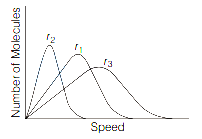
III. Boron is very hard refractory solid of high melting temperature.AP EAMCET 2019 Easy - If \(r_1, r_2\) and \(r_3\) represent the most probable speeds of three different gases at the same temperature as shown in figure with molar masses \(M_1, M_2\) and \(M_3\) respectively. The correct order of molar masses of these gases is
 AP EAMCET 2018 Easy