


AP EAMCET · Chemistry · Polymers
Match the following:
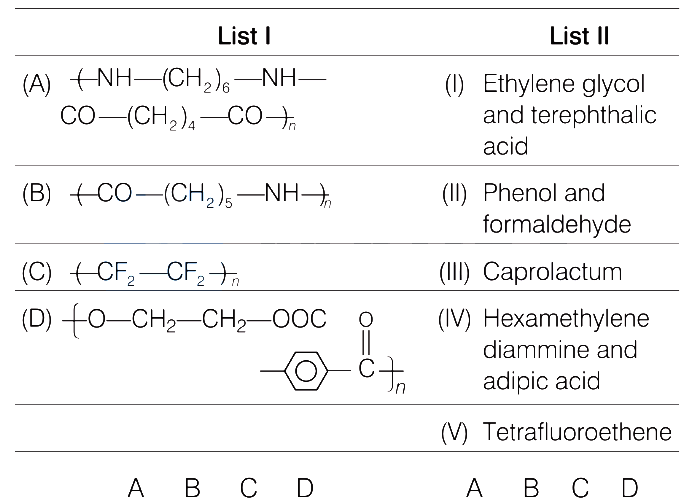
- A IV III V I
- B III II IV I
- C IV III II I
- D II IV III V
Answer & Solution
Correct Answer
(A) IV III V I
Step-by-step Solution
Detailed explanation
See the Complete Solution
Get step-by-step explanations for this and 2.5 Lakh+ more JEE, NEET & CET questions.
- Unlock all solutions
- Practice the full chapter
- Track accuracy across PYQs
4.8 rated on Google Play · 14,000+ reviews
More questions from Chemistry
- Which among the following polymers can be formed by using caprolactam monomer unit?AP EAMCET 2020 Easy
- When \(10 \mathrm{~g}\) of methane is completely burnt in oxygen, the heat evolved is \(560 \mathrm{~kJ}\). What is the heat of combustion (in \(\mathrm{kJ} \mathrm{mol}^{-1}\) ) of methane?AP EAMCET 2003 Easy
- Which of the following is the most effective in causing
coagulation of ferric hydroxide solution?AP EAMCET 2015 Medium - The ratio of anion radius to cation radius of a crystal is \(10: 9.3\). Then, the coordination number of the cation in the crystal isAP EAMCET 2010 Medium
- The acidic character of the group- 15 elements in the increasing order isAP EAMCET 2021 Easy
- In which of the following options order of arrangement does not agree with the variation of property indicated against it?AP EAMCET 2020 Easy
More PYQs from AP EAMCET
- Four positive point charges are kept at the four corners of a square of side . The net electric field at the midpoint of any one side of the square is take )AP EAMCET 2018 Easy
- The initial rates of decrease of \(\mathrm{I}_2\) in acetone - iodine reaction catalysed by \(\mathrm{H}^{+}\) are given in the table.
\(\begin{array}{|c|c|c|c|c|}
\hline \begin{array}{c}
\text { Experiment } \\
\end{array} & \begin{array}{c}
\text { Initial } \\
{\left[\mathrm{I}_2\right]} \\
\left(\mathrm{mol} \mathrm{L}^{-1}\right)
\end{array} & \begin{array}{c}
\text { Initial } \\
{\left[\mathrm{H}^{+}\right]} \\
\left(\mathrm{mol} \mathrm{L}^{-1}\right)
\end{array} & \begin{array}{c}
\text { Initial } \\
{\left[\mathrm{CH}_3 \mathrm{COCH}_3\right]} \\
\left(\mathrm{mol} \mathrm{L}^{-1}\right)
\end{array} & \begin{array}{c}
\text { Initial rate of decrease of } \mathrm{I}_2 \\
\left(\mathrm{mol} \mathrm{L}^{-1} \mathrm{~s}^{-1}\right)
\end{array} \\
\hline 1 & 0.01 & 0.1 & 0.1 & 0.096 \\
2 & 0.01 & 0.2 & 0.1 & 0.192 \\
3 & 0.02 & 0.2 & 0.1 & 0.192 \\
4 & 0.01 & 0.2 & 0.2 & 0.384 \\
\hline
\end{array}\)
The order with respect to \(\mathrm{I}_2, \mathrm{H}^{+}\), acetone and total order of the reaction respectively are:AP EAMCET 2018 Easy - Observe the following
\(\mathrm{P}_4+\mathrm{SOCl}_2 \longrightarrow\) Products
\(\mathrm{P}_4+\mathrm{SO}_2 \mathrm{Cl}_2 \longrightarrow\) Products
In both the reactions, a common product ' \(x\) ' is obtained. The number of lone pair of elecrons on the central atom of \(x\) isAP EAMCET 2025 Medium - \(\lim _{n \rightarrow \infty}\left(\frac{1^2}{n^3+1^3}+\frac{2^2}{n^3+2^3}+\ldots+\frac{1}{2 n}\right)=\)AP EAMCET 2022 Medium
- The average translational kinetic energy of \(\mathrm{O}_2\) molecules at a particular temperature is \(0.048 \mathrm{eV}\). The average translational kinetic energy of equal number of \(\mathrm{N}_2\) molecules at the same temperature is (in \(\mathrm{eV}\))AP EAMCET 2017 Easy
- The area of the triangle formed by the pair of lines \(23 x^2-\) \(48 x y+3 y^2=0\) with the line \(2 x+3 y+5=0\) isAP EAMCET 2024 Medium