


AP EAMCET · Chemistry · Carboxylic Acid Derivatives
In the reaction, if \(\mathrm{X}\) is the reagent and \(\mathrm{Y}\) is the product, which of the following is not feasible?
In the reaction, if \(\mathrm{X}\) is the reagent and \(\mathrm{Y}\) is the product, which of the following is not feasible?
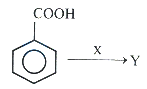
- A \(\mathrm{X}=\) Conc. \(\mathrm{HNO}_3+\) Con. \(\mathrm{H}_2 \mathrm{SO}_4\);
\(\mathrm{Y}=3-\) Nitrobenzoic acid - B \(\mathrm{X}=\mathrm{Br}_2 / \mathrm{Fe} \quad \mathrm{Y}=3-\) Bromobenzoic acid
- C \(\mathrm{X}=\mathrm{NaOH}, \mathrm{CaO} \quad \mathrm{Y}=\) Benzene
- D \(\mathrm{X}=\mathrm{CH}_3 \mathrm{Cl} / \mathrm{AlCl}_3 \quad \mathrm{Y}=3-\) Methylebenzoic acid
Answer & Solution
Correct Answer
(D) \(\mathrm{X}=\mathrm{CH}_3 \mathrm{Cl} / \mathrm{AlCl}_3 \quad \mathrm{Y}=3-\) Methylebenzoic acid
Step-by-step Solution
Detailed explanation
This reaction is not feasible because the \(-\mathrm{COOH}\) group interacts with the lewis acid \(\mathrm{AlCl}_3\) and forms acylium ion instead of the usual electrophilic substitution at the ring.
See the Complete Solution
Get step-by-step explanations for this and 2.5 Lakh+ more JEE, NEET & CET questions.
- Unlock all solutions
- Practice the full chapter
- Track accuracy across PYQs
4.8 rated on Google Play · 14,000+ reviews
More questions from Chemistry
- Which one of the following statements is correct?AP EAMCET 2017 Easy
- Which of the following complex ion shows geometrical isomerism?AP EAMCET 2020 Medium
- Identify the product \((A)\) of the following reaction,
\(\mathrm{C}_2 \mathrm{H}_5-\mathrm{O}-\mathrm{C}_2 \mathrm{H}_5+\mathrm{CO} \underset{500 \mathrm{~atm}}{\stackrel{\mathrm{BF}_3 / 150^{\circ} \mathrm{C}}{\longrightarrow}} A\)AP EAMCET 2010 Hard - An aryl carboxylic acid on treatment with sodium hydrogen carbonate liberates a gaseous molecule. Identify the gas molecule liberated.AP EAMCET 2022 Medium
- Which one of the following is present in gas mask?AP EAMCET 2018 Easy
- \(\mathrm{CaCO}_3\) was reacted with dil \(\mathrm{HCl}\) to form three products. One of the products formed, when passed into slaked lime gave \(\mathrm{X}\). What is \(\mathrm{X}\) ?AP EAMCET 2022 Medium
More PYQs from AP EAMCET
- Which of the following property is less for \(\mathrm{D}_2 \mathrm{O}\) than \(\mathrm{H}_2 \mathrm{O}\) ?AP EAMCET 2025 Easy
- Suppose the slopes \(m_1\) and \(m_2\) of the lines represented by \(a x^2+2 h x y+b y^2=0\) satisfy \(3\left(m_1-m_2\right)-7=0\) and \(m_1 m_2-2=0\). Then, which of the following is true?AP EAMCET 2022 Medium
- \(6 \mathrm{~g}\) of urea (molar mass \(=60 \mathrm{~g} \mathrm{~mol}^{-1}\) ) and \(9 \mathrm{~g}\) of glucose \(\left(\right.\) molar mass \(\left.=180 \mathrm{~g} \mathrm{~mol}^{-1}\right)\) were dissolved in \(35 \mathrm{~g}\) of water. The mass percent of urea and glucose is respectivelyAP EAMCET 2023 Medium
- If \(\mathbf{a}, \mathbf{b}\) and \(\mathbf{c}\) are three vectors such that \(|\mathbf{a}|=3,|\mathbf{b}|=4\) and \(|\mathbf{c}|=5\) and \(\mathbf{a}+\mathbf{b}+\mathbf{c}=0\), then \(\mathbf{a} \cdot \mathbf{b}\) is equal toAP EAMCET 2021 Easy
- A coil of area is placed in a uniform magnetic field of lb. , with its plane perpendicular to the field. The coil rotates at a uniform rate to complete the revolution in . find the average emf . in the coil during intervals when the coil rotates from
i. to position
ii. to position
ii. to position
iv. to positionAP EAMCET 2020 Hard - Let \(\mathrm{a}\) and \(\mathrm{b}\) be arbitrary constants and \(\mathrm{C}\) be a fixed constant. If \(y=a e^{2 x}+b x e^{2 x}+C\) is the general solution of a differential equation, then the order of that differential equation isAP EAMCET 2023 Medium