


AP EAMCET · Chemistry · p Block Elements (Group 13 & 14)
In the following reactions:
\[
\begin{aligned}
& \mathrm{B}_2 \mathrm{H}_6+\mathrm{NH}_3 \text { (excess) } \stackrel{\Delta}{\longrightarrow} X+\mathrm{H}_2 \\
& \mathrm{NaH}+\mathrm{BF}_3 \stackrel{450 \mathrm{~K}}{\longrightarrow} Y+\mathrm{NaF} \\
& \mathrm{B}_2 \mathrm{H}_6+\mathrm{H}_2 \mathrm{O} \longrightarrow \mathrm{Z}+\mathrm{H}_2
\end{aligned}
\]
\(X, Y\) and \(Z\) are respectively.
- A \(\mathrm{B}_2 \mathrm{H}_6, \mathrm{LiBH}_2, \mathrm{H}_3 \mathrm{BO}_3\)
- B \(\mathrm{B}_3 \mathrm{~N}_3 \mathrm{H}_6, \mathrm{~B}_2 \mathrm{H}_6, \mathrm{H}_3 \mathrm{BO}_3\)
- C \((\mathrm{BN})_n, \mathrm{LiBH}_4, \mathrm{HBO}_2\)
- D \(\mathrm{B}_2 \mathrm{H}_6, \mathrm{~B}_2 \mathrm{H}_6, \mathrm{HBO}_2\)
Answer & Solution
Correct Answer
(B) \(\mathrm{B}_3 \mathrm{~N}_3 \mathrm{H}_6, \mathrm{~B}_2 \mathrm{H}_6, \mathrm{H}_3 \mathrm{BO}_3\)
Step-by-step Solution
Detailed explanation
Therefore, \[ \begin{aligned} & X=\mathrm{B}_3 \mathrm{~N}_3 \mathrm{H}_6 \\ & Y=\mathrm{B}_2 \mathrm{H}_6 \\ & Z=\mathrm{H}_3 \mathrm{BO}_3 \end{aligned} \] Hence, option (b) is correct.
See the Complete Solution
Get step-by-step explanations for this and 2.5 Lakh+ more JEE, NEET & CET questions.
- Unlock all solutions
- Practice the full chapter
- Track accuracy across PYQs
4.8 rated on Google Play · 14,000+ reviews
More questions from Chemistry
- If the rate constant for a first order reaction is , find the time required to reduce of the reactant to .AP EAMCET 2024 Hard
- The value of work function of a metal \(\mathrm{X}\) is \(3.1 \mathrm{eV}\). The threshold frequency of it (in \(\mathrm{Hz})\left(\mathrm{h}=6.62 \times 10^{-34} \mathrm{Js}\right)\)AP EAMCET 2022 Easy
- Arrange the following in decreasing order of electrophilicity of carbonyl carbon.
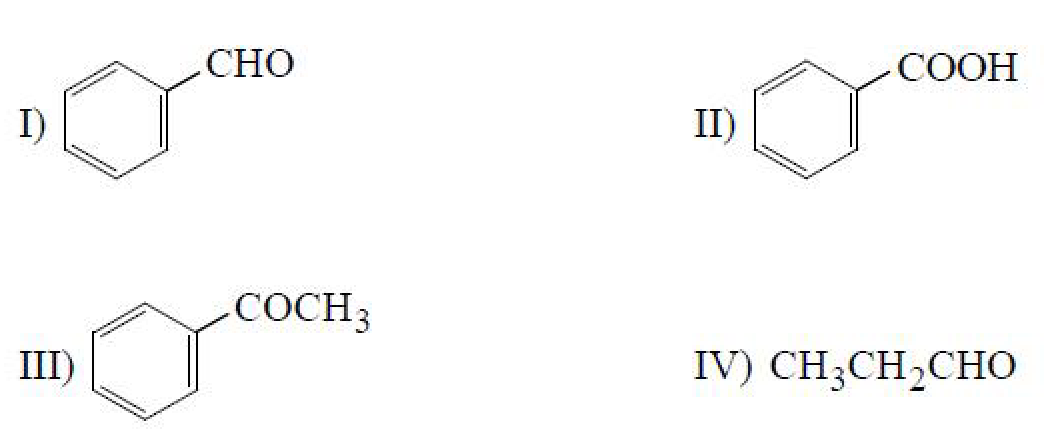 AP EAMCET 2025 Medium
 - Acetic acid on heating with \(\mathrm{NH}_3\) forms \(A\). When \(A\) reacts with \(\mathrm{LiAlH}_4\) followed by hydrolysis gives \(B\). When \(B\) is heated with chloroform in \(\mathrm{KOH}\) medium gives \(C\). What are \(B\) and \(C\) respectively?AP EAMCET 2019 Medium
- At same temperature and pressure, the rate of diffusion of gas ' \(X\) ' is \(3 \sqrt{3}\) times that of a gaseous hydrocarbon of molar mass \(54 \mathrm{~g} \mathrm{~mol}^{-1}\). The molar mass of \(X\) in \(\mathrm{g} \mathrm{mol}^{-1}\) isAP EAMCET 2018 Medium
- In which of the following reactions, hydrogen is liberated?
(i) \(\mathrm{Al}(s)+\mathrm{HCl}(a q) \longrightarrow\)
(ii) \(\mathrm{Al}(s)+\mathrm{NaOH}(a q) \longrightarrow\)
(iii) \(\mathrm{NaBH}_4+\mathrm{I}_2 \longrightarrow\)AP EAMCET 2017 Easy
More PYQs from AP EAMCET
- \(\operatorname{cosec} 15^{\circ}+\sec 15^{\circ}\) is equal to :AP EAMCET 2006 Easy
- The perpendicular distance from the point \((1, \pi)\) to the line joining \(\left(1,0^{\circ}\right)\) and \(\left(1, \frac{\pi}{2}\right)\), (in polar coordinates) isAP EAMCET 2013 Easy
- If the angle \(2 \theta\) is acute, then the acute angle between the pair of straight lines
\[
\begin{aligned}
& x^2(\cos \theta-\sin \theta)+2 x y \cos \theta \\
& \quad+y^2(\cos \theta+\sin \theta)=0, \text { is }
\end{aligned}
\]AP EAMCET 2002 Hard - The domain of the function defined by
\(f(x)=\frac{-5}{4 x^2+1}+\sqrt{x^2-4}\) isAP EAMCET 2021 Easy - The electric field associated with a mono chromatic light wave is given by \(E=E_0 \sin \left[\left(1.57 \times 10^7 \mathrm{~m}^{-1}\right](x-c t)\right]\) then the stopping potential when this light is used in a photoelectric experiment with the metal having work function \(1.9 \mathrm{eV}\) is.
[Planck's constant, \(h=6.64 \times 10^{-34} \mathrm{~J}-\mathrm{s}\) ]AP EAMCET 2022 Medium - For all \(\mathrm{n} \in \mathrm{N}\), if \(\mathrm{n}\left(\mathrm{n}^2+3\right)\) is divisible by k, then the maximum value of k isAP EAMCET 2025 Medium