


AP EAMCET · Chemistry · Chemical Kinetics
Consider the reaction given below
\(\mathrm{A}+2 \mathrm{~B} \longrightarrow 3 \mathrm{C}+2 \mathrm{D}\).
If rate of disapperance of B is \(x \times 10^{-2} \mathrm{~mol} \mathrm{~L}^{-1} \mathrm{~s}^{-1}\), the ratio of rate of reaction and rate of appearance of C is
- A 1:3
- B 3:1
- C 1:2
- D 2:1
Answer & Solution
Correct Answer
(A) 1:3
Step-by-step Solution
Detailed explanation
NO SOLUTION
See the Complete Solution
Get step-by-step explanations for this and 2.5 Lakh+ more JEE, NEET & CET questions.
- Unlock all solutions
- Practice the full chapter
- Track accuracy across PYQs
4.8 rated on Google Play · 14,000+ reviews
More questions from Chemistry
- The solubility of \(A_2 X_3\) is ' \(y\) ' M. Its solubility product is \(\mathrm{M}^5\).AP EAMCET 2020 Medium
- Which of the following compounds will exhibit cis-trans isomerism?AP EAMCET 2020 Easy
- The greater the valence of the flocculating ion added, the greater is its power to cause precipitation of a colloid. This rule isAP EAMCET 2023 Easy
- Metal ' \(\mathrm{M}\) ' in the following reaction is
\(2 \mathrm{MNO}_3 \rightarrow \mathrm{M}_2 \mathrm{O}+2 \mathrm{NO}_2+\frac{1}{2} \mathrm{O}_2\)AP EAMCET 2022 Easy - Freundlich adsorption isotherms for the physical adsorption of a gas at temperature and are shown in the graph given below. The correct relationship between and is
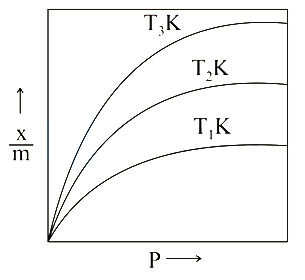 AP EAMCET 2018 Easy
 - Which of the following are extensive properties?
 AP EAMCET 2022 Easy
More PYQs from AP EAMCET
- A few grams of sodium carbonate is added to \(1 \mathrm{~L}\) of water. What is the \(\mathrm{pH}\) or \(\mathrm{pH}\) range of resultant solution?AP EAMCET 2022 Easy
- The sum of all the real roots of the equation isAP EAMCET 2022 Medium
- If the first three terms in the binomial expansion of \((1+b x)^n\) in ascending powers of \(x\) are \(1,6 x\) and \(6 x^2\) respectively then \(b+n=\)AP EAMCET 2017 Medium
- The solution of \(\cos y+(x \sin y-1) \frac{d y}{d x}=0\) isAP EAMCET 2014 Easy
- The differential equation of the family \(y=a e^x+b x e^x+c x^2 e^x\) of curves, where \(a, b, c\) are arbitrary constants, isAP EAMCET 2009 Easy
- Consider the following standard electrode potentials ( \(\mathrm{E}^0\) in volts) in aqueous solution
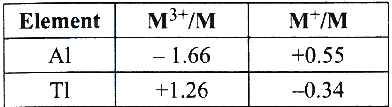
Based on this data, which of the following statements is correct?AP EAMCET 2024 Medium