


AP EAMCET · Chemistry · Carboxylic Acid Derivatives
\[
\mathrm{CH}_3 \mathrm{MgBr}+\mathrm{CO}_2 \stackrel{\text { Dry ether }}{\longrightarrow} Y \stackrel{\mathrm{H}_3 \mathrm{O}^{\oplus}}{\longrightarrow} Z
\]
Identify \(Z\) from the following.
- A Ethyl acetate
- B Acetic acid
- C Propanoic acid
- D Methyl acetate
Answer & Solution
Correct Answer
(B) Acetic acid
Step-by-step Solution
Detailed explanation
When Grignard's reagent is treated with \(\mathrm{CO}_2\), a magnesium complex is formed, which on further hydrolysis yields monocarboxylic acid.
See the Complete Solution
Get step-by-step explanations for this and 2.5 Lakh+ more JEE, NEET & CET questions.
- Unlock all solutions
- Practice the full chapter
- Track accuracy across PYQs
4.8 rated on Google Play · 14,000+ reviews
More questions from Chemistry
- Which of the following conversion represents Fries rearrangement?AP EAMCET 2019 Medium
- Match the following vitamins with their sources and the corresponding diseases caused by their deficiency.
\begin{array}{llllll}
\hline & Vitamins & & Sources & & Diseases \\
\hline (A) & Vitamin-B _1 & (i) & Egg-whites & (p) & Convulsions \\
\hline (B) & Vitamin-B _2 & (ii) & Fish & (q) & \begin{array}{l}
Pernicious \\
anemia
\end{array} \\
\hline (C) & Vitamin-B _6 & (iii) & \begin{array}{l}
Green \\
vegetables
\end{array} & (r) & Cheilosis \\
\hline (D) & Vitamin-B _{12} & (iv) & Grams & (s) & Beri-Beri \\
\hline
\end{array}AP EAMCET 2021 Easy - Which of the following statements are correct?
I. \(\quad \mathrm{P}\) is having least negative electron gain enthalpy among \(\mathrm{P}, \mathrm{S}, \mathrm{Cl}\), and \(\mathrm{F}\)
II. In \(\mathrm{Eu}, \mathrm{Yb}\) Lanthanoid contraction is not observed
III. \(\mathrm{Ce}(\mathrm{OH})_3\) is most basic among lanthanoid hydroxides
IV. The radii of \(\mathrm{Na}\) and \(\mathrm{Na}^{+}\)are \(95 \mathrm{pm}, 186 \mathrm{pm}\) respectivelyAP EAMCET 2023 Easy - Arrange the following in decreasing order of electrophilicity of carbonyl carbon.
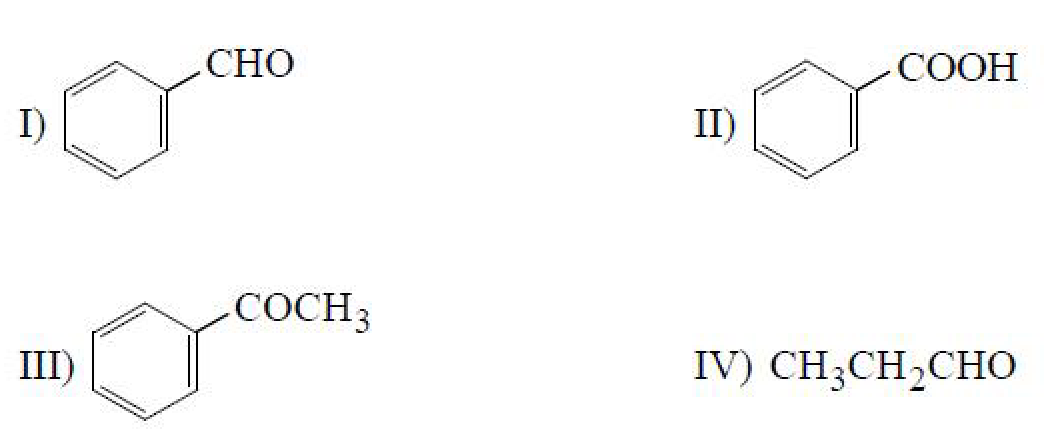 AP EAMCET 2025 Medium
 - The standard reduction potentials of \(2 \mathrm{H}^{+} / \mathrm{H}_2, \mathrm{Cu}^{2+} / \mathrm{Cu}\). \(\mathrm{Zn}^{2+} / \mathrm{Zn}\) and \(\mathrm{NO}_3{ }^{-}, \mathrm{H}^{+} / \mathrm{NO}\) are \(0.0,-0.34,-0.76\) and 0.97 V respectively. Observe the following reactions
I. \(\mathrm{Zn}+\mathrm{HCl} \rightarrow\)
II. \(\mathrm{Cu}+\mathrm{HCl} \rightarrow\)
III. \(\mathrm{Cu}+\mathrm{HNO}_3 \rightarrow\)
Which reactions does not liberate \(\mathrm{H}_2(\mathrm{~g})\) ?AP EAMCET 2024 Medium - In each molecule of carbon tetrachloride, the mass percent of carbon and chlorine respectively areAP EAMCET 2021 Easy
More PYQs from AP EAMCET
- The \(\mathrm{K}_{\mathrm{a}}\) values of \(\mathrm{A}, \mathrm{B}\) and \(\mathrm{C}\) are \(1.8 \times 10^{-4}, 5 \times 10^{-10}\) and \(3 \times 10^{-8}\) respectively. The correct order of their acidic strength isAP EAMCET 2022 Medium
- What are \(\mathrm{X}\) and \(\mathrm{Y}\) in the following reaction?
\(\mathrm{R}-\mathrm{OH}+\mathrm{PCl}_5 \rightarrow \mathrm{X}+\mathrm{Y}+\mathrm{HCl}\)AP EAMCET 2017 Medium - If \(1.5 \mathrm{~L}\) of an ideal gas at a pressure of \(20 \mathrm{~atm}\) expands isothermally and reversibly to a final volume of \(15 \mathrm{~L}\), the work done by the gas in \(\mathrm{L}\) atm isAP EAMCET 2018 Medium
- Consider the matrices
\(A=\left[\begin{array}{ccc}
x & y & 0 \\
-3 & 1 & 2 \\
1 & -2 & z
\end{array}\right] \text { and } B=\left[\begin{array}{ccc}
1 & -2 & -2 \\
2 & 0 & 1 \\
2 & 1 & 0
\end{array}\right]\)
If the cofactors of the elements \(z, 1\) in \(3{ }^{\text {rd }}\) row and \(x\) of \(A\) are \(9,4,3\) respectively then \(A B=\)AP EAMCET 2025 Medium - If the lines and lie along diameters of a circle of area then the equation of the circle isAP EAMCET 2019 Easy
- One junction of a certain thermoelectric couple is at a fixed temperature \(T_r\) and the other junction is at temperature \(T\). The thermo-electromotive force for this is
expressed by \(E=k\left(T-T_r\right)\left[T_0-\frac{1}{2}\left(T+T_r\right)\right]\). At temperature \(T=\frac{1}{2} T_0\), the thermoelectric power isAP EAMCET 2008 Hard