


AP EAMCET · Chemistry · Chemical Bonding and Molecular Structure
\(\mathrm{AlCl}_3\) is an electron deficient compound but \(\mathrm{AlF}_3\) is not. This is because
- A atomic size of \(\mathrm{F}\) is smaller than \(\mathrm{Cl}\) which makes \(\mathrm{AlF}_3\) more covalent
- B \(\mathrm{AlCl}_3\) is a covalent compound while \(\mathrm{AlF}_3\) is an ionic compound
- C \(\mathrm{AlCl}_3\) exists as dimer but \(\mathrm{AlF}_3\) does not
- D \(\mathrm{Al}\) in \(\mathrm{AlCl}_3\) is in \(s p^3\) hybrid state but \(\mathrm{Al}\) in \(\mathrm{AlF}_3\) is in \(s p^2\) hybrid state
Answer & Solution
Correct Answer
(B) \(\mathrm{AlCl}_3\) is a covalent compound while \(\mathrm{AlF}_3\) is an ionic compound
Step-by-step Solution
Detailed explanation
According to Fajan's rule, larger is the size of anion, more is the covalent character. So, \(\mathrm{AlCl}_3\) is a covalent, while \(\mathrm{AlF}_3\) is ionic, so \(\mathrm{AlCl}_3\) is electron deficient but \(\mathrm{AlF}_3\) is not.
See the Complete Solution
Get step-by-step explanations for this and 2.5 Lakh+ more JEE, NEET & CET questions.
- Unlock all solutions
- Practice the full chapter
- Track accuracy across PYQs
4.8 rated on Google Play · 14,000+ reviews
More questions from Chemistry
- The number of hydrogen molecules possible from its isotopes isAP EAMCET 2022 Easy
- Which one of the following statements is not correct?AP EAMCET 2002 Medium
- Name the kind of silicate formed, when two silicate units \(\left(\mathrm{SiO}_4\right)^{4-}\) share one oxygen atom.AP EAMCET 2020 Medium
- In the Lewis dot structure of carbonate ion shown under the formal charges on the oxvgen atoms 1,2 and 3 are respectively
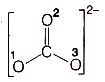 AP EAMCET 2022 Easy
 - The masses of an electron, a proton and a neutron respectively will be in the ratioAP EAMCET 2021 Easy
- Which of the following is a neurologically active drug?AP EAMCET 2020 Easy
More PYQs from AP EAMCET
- At high concentration of soap in water, soap behaves as aAP EAMCET 2021 Easy
- The coefficient of viscosity of an ideal fluid isAP EAMCET 2020 Easy
- The range of the function \(f(x)=\frac{x^2+x+1}{x^2-x+1}\) isAP EAMCET 2022 Easy
- If \(\mathrm{X}\) is random variable with probability distribution \(P(X=k)=\frac{(k+1) c}{2^k}, k=0,1,2, \ldots\), then \(P(X \geq 3)=\)AP EAMCET 2023 Medium
- If \(\mathrm{X}_1, \mathrm{X}_2, \ldots \mathrm{X}_{\mathrm{n}}\) are \(\mathrm{n}\) independent events such that \(\mathrm{P}\left(\mathrm{X}_{\mathrm{r}}\right)\) \(=\frac{1}{r+1}, r=1,2, \ldots, n\), then the probability that none of the \(n\) events occur isAP EAMCET 2023 Easy
- The required percentage increase in the energy of the earth's satellite to shift it from an orbit of radius \(r\) to \(\frac{3 r}{2}\).AP EAMCET 2017 Easy