


NEET · Biology · STD 12 - 11. organisms and populations
नीचे दो कथन दिये गये हैं : कथन \(I\) : गासे के 'स्पर्धी अपवर्जन नियम' के अनुसार एक ही स्रोत के लिए स्पर्धा करने वाली दो निकटस्थ सम्बन्धी जातियाँ अनंत काल तक साथ-साथ नहीं रह सकतीं और स्पर्धी रूप से घटिया जाति अंततः विलुप्त हो जाती है। कथन \(II\) : साधारणतया शाकाहारियों की बजाय मांसाहारी स्पर्धा द्वारा अपेक्षाकृत अधिक प्रभावित होते हैं। उपर्युक्त कथनों के संदर्भ में, नीचे दिये गये विकल्पों में से सही उत्तर चुनिए :
- A कथन \(I\) गलत है परन्तु कथन \(II\) सत्य है।
- B कथन \(I\) और कथन \(II\) दोनों सत्य हैं।
- C कथन \(I\) और कथन \(II\) दोनों असत्य हैं।
- D कथन \(I\) सही है परन्तु कथन \(II\) असत्य है।
Answer & Solution
Correct Answer
(D) कथन \(I\) सही है परन्तु कथन \(II\) असत्य है।
Step-by-step Solution
Detailed explanation
Gause's 'Competitive Exclusion Principle' states that two closely related species competing for the same resources cannot co-exist indefinitely and the competitively inferior one will be eliminated eventaully. Thus, statement \(I\) is correct. Statement II is incorrect as in general, herbivores and plants appear to be more adversely affected by competition than carnivores.
See the Complete Solution
Get step-by-step explanations for this and 2.5 Lakh+ more JEE, NEET & CET questions.
- Unlock all solutions
- Practice the full chapter
- Track accuracy across PYQs
4.8 rated on Google Play · 14,000+ reviews
More questions from Biology
- उन पदार्थों को पहचानिए, जिनकी संरचनाओं में क्रमश: ग्लाइकोसाइडिक बंध और पेप्टाइड बंध पाये जाते हैंNEET 2020 Easy
- सूची I का सूची II से मिलान कीजिए :
सूची I (कोशिका चक्र की प्रावस्था) सूची II (क्रिया) A. \(G_1\) प्रावस्था I. वास्तविक कोशिका विभाजन होता है B. S प्रावस्था II. कोशिका उपापचय रूप से सक्रिय होती है तथा लगातार वृद्धि करती है परंतु अपने DNA का प्रतिकृतिकरण नहीं करती है C. \(G_2\) प्रावस्था III. DNA का संश्लेषण होता है तथा प्रति कोशिका DNA की मात्रा दुगुनी हो जाती है D. M प्रावस्था IV. प्रोटीन का संश्लेषण होता है जबकि कोशिका वृद्धि जारी रहती है NEET 2026 Hard -
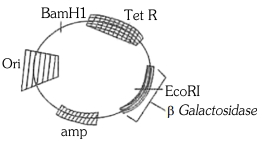
ऊपर दर्शाए गए प्लास्मिड में, EcoRI स्थल पर एक विजातीय DNA खंड डाला गया है। पुनःसंयोजक कॉलोनियों का चयन करने के लिए निम्नलिखित में से कौन सी रणनीति चुनी जाएगी?NEET 2025 Medium - स्तम्भ \(I\) में दी गई मदों का स्तम्भ \(II\) की मदों से मिलान कीजिए और नीचे दिए गए विकल्पों में से सही विकल्प का चयन कीजिए
स्तम्भ \(I\) (कार्य) स्तम्भ \(II\) (उत्सजन तंत्र का भाग) \((a)\) अतिसूक्ष्म निस्यंदन \((i)\) हेनले पाश \((b)\) मूत्र का सांद्रण \((ii)\) मूत्रवाहिनी \((c)\) मूत्र का अभिगमन \((iii)\) मूत्राशय \((d)\) मूत्र का संग्रहण \((iv)\) समीपस्थ संवालित नलिका \((v)\) समीपस्थ संवलित नलिका NEET 2018 Medium - बेमेल का चयन करें।NEET 2016 Medium
- प्रतिरक्षा के संदर्भ में गलत कथन को पहचानिएNEET 2020 Medium
More PYQs from NEET
- समतलीय कोण एवं घन कोण में होता है :NEET 2022 Easy
- केल्विन चक्र के दौरान ग्लूकोस के एक अणु के संश्लेषण के लिए कितने \(ATP\) और \(NADPH_2\) की आवश्यकता होती है?NEET 2023 Medium
- किसी गेंद को ऊर्ध्व दिशा से \(60^{\circ}\) के कोण पर \(10\,ms ^{-1}\) के वेग से प्रक्षेपित किया जाता है। प्रक्षेप्य पथ की अधिकतम ऊँचाई पर इसकी चाल होगी \(............... ms ^{-1}\)NEET 2022 Medium
- द्रव्यमान \(m _{1}\) तथा लम्बाई \(L\) की कोई एकसमान रस्सी किर्सी दृढ टेक से ऊर्ध्वाधर लटकी है। इस रस्री के मुक्त सिरे से द्रव्यमान \(m _{2}\) का कोर्ई गुटका जुड़ा है । रस्सी के मुक्त सिरे पर तरंगदैर्ध्य \(\lambda_{1}\) का कोई अनुप्रस्थ स्पन्द उत्पत्र किया जाता है। यदि रस्सी के शीर्प तक पहुँचने पर इस स्पन्द की तरंगदैर्ध्य \(\lambda_{2}\) हो जाती है, तब अनुपात \(\lambda_{2} / \lambda_{1}\) का मान हैNEET 2016 Hard
- सूची \(I\) का सूची \(II\) के साथ मिलान कीजिए:
नीचे दिए गए विकल्पों से सही उत्तर चुनिए:List \(I\) List \(I\) \(A\) एक्सोथैलेमिक गलंगंड \(I\) कोर्टीसोल का अत्याधिक स्रवण, चंद्राकार चेहरा एवं अतिग्लूकोज रक्तता \(B\) अतिकायता \(II\) थाइरॉइड हार्मोन का अल्प स्रवण एवं अवरुद्ध वृद्धि \(C\) कुशिंग सिंड्रोम \(III\)थाइरॉइड हार्मोन का अति स्र्रवण एवं उभरे हुए नेत्र गोलक \(D\) क्रेटीनता \(IV\) वृद्धि हार्मोन का अत्याधिक स्ववण NEET 2024 Medium - पादपों की दो किस्मों को सम्मिलित करने पर कायिक संकरण में निम्नलिखित में से किनका युग्मन होता है ?NEET 2024 Medium