


enEnglishguગુજરાતી
NEET · Biology · STD 11 - 12. Respiration in plants
ઑક્સિડેટીવ ફૉસ્ફોરાયલેશન એ \(...........\)
- A \(ATP\) નું સર્જન, પદાર્થમાંથી \(ADP\) તરફ ફૉસ્ફેટ સમૂહ બદલાવાથી થાય છે.
- B \(ATP\) માં ફૉસ્ફેટ સમૂહ જોડાય છે.
- C \(ATP\) માં ફૉસ્ફેટ સમૂહના ઓક્સિડેશન દ્વારા થાય છે.
- D પદાર્થના ઓક્સિડેશન દરમિયાન મુક્ત થયેલ ઈલેક્ટ્રોન દ્વારા મુક્ત થયેલ શક્તિના ઉપયોગ દ્વારા \(ATP\) બને છે.
Answer & Solution
Correct Answer
(D) પદાર્થના ઓક્સિડેશન દરમિયાન મુક્ત થયેલ ઈલેક્ટ્રોન દ્વારા મુક્ત થયેલ શક્તિના ઉપયોગ દ્વારા \(ATP\) બને છે.
Step-by-step Solution
Detailed explanation
(d) : Oxidative phosphorylation is the synthesis of energy rich \(ATP\) molecules with the help of energy liberated during oxidation of reduced coenzymes \((NADH, FADH_2)\) produced in respiration.The enzyme required for this synthesis is called \(ATP\) synthase. It is located in \(F_1\) or head piece of \(F_0 -F_1\) or elementary particles present in the inner mitochondrial membrane. \(F_1\) particle is capable of \(ATP\) synthesis. \(ATP\) synthase becomes active in \(ATP\) formation only when there is a proton gradient having higher concentration of \(H^+\) or protons on the \(F_0\) side as compared to \(F_1\) side.This higher concentration creates an electric potential across the mitochondrial membrane. The proton gradient and membrane electric potential together form proton motive force \((PMF)\). The flow of protons through the \(F_0\) channel which induces \(F_1\) particle to function as \(ATP\) synthase. The energy of the proton gradient is used in attaching a phosphate radicle to \(ADP\) by highenergy bond. This produces \(ATP.\)
See the Complete Solution
Get step-by-step explanations for this and 2.5 Lakh+ more JEE, NEET & CET questions.
- Unlock all solutions
- Practice the full chapter
- Track accuracy across PYQs
4.8 rated on Google Play · 14,000+ reviews
More questions from Biology
- નીચે પૈકી કયું વિધાન ખોટું છે ?NEET 2021 Medium
- નીચેના પાંચ વિધાનો \((A\) થી \(E)\) વાંચો અને બધા સાચા વિધાનો ધરાવતો વિકલ્પ પસંદ કરો.
\(A.\) મોસ અને લાઈકેન એ ખુલ્લા ખડક પર વસવાટ કરનાર પ્રથમ સજીવો છે.
\(B.\) સેલાજીનેલા એક સમબીજાણુમય ત્રિઅંગી વનસ્પતિ છે.
\(C.\) સાયકસમાં પ્રવાળમૂળ \(VAM\) ધરાવે છે.
\(D.\) દ્વિઅંગીઓમાં મુખ્ય વનસ્પતિદેહ જન્યુજનક હોય છે, જ્યારે ત્રિઅંગીઓમાં તે બીજાણુજનક હોય છે.
\(E.\) અનાવૃત બીજધારી વનસ્પતિઓમાં, નર અને માદા જન્યુજનક બીજાણુધાનીમાં હોય છે જે બીજાણુજનક પર સ્થિત હોય છે.NEET 2015 Medium - સુકોષકેન્દ્રી સજીવોમાં, \(DNA\) નું સ્વયંજનન શેમાં થાય છે:NEET 2023 Medium
- લિપિડ્સ વિશેના નીચેના વિધાનો વાંચો અને સાચા વિધાનોનો સમૂહ શોધો:
\((a)\) કોષરસ પટલમાં જોવા મળતું લેસીથિન એ ગ્લાયકોલિપિડ છે.
\((b)\) સંતૃપ્ત ફેટી એસિડ્સ એક અથવા વધુ \(c = c\) બંધ ધરાવે છે.
\((c)\) તલનું તેલ નીચું ગલનબિંદુ ધરાવે છે, તેથી તે શિયાળામાં તેલ તરીકે રહે છે.
\((d)\) લિપિડ્સ સામાન્ય રીતે પાણીમાં અદ્રાવ્ય હોય છે પરંતુ કેટલાક કાર્બનિક દ્રાવકોમાં દ્રાવ્ય હોય છે.
\((e)\) જ્યારે ફેટી એસિડનું ગ્લિસરોલ સાથે એસ્ટરીકરણ થાય છે, ત્યારે મોનોગ્લિસરાઇડ્સ બને છે.
નીચે આપેલા વિકલ્પોમાંથી સાચો જવાબ પસંદ કરો:NEET 2022 Medium - જેલ ઇલેક્ટ્રોફોરેસીસ દરમિયાન અગારોઝ જેલ ઉપર \(DNA\) ના ટુકડાઓને ખસવા માટેનો શું માપદંડ હોય છે ?NEET 2017 Medium
- આપેલી આકૃતિમાં, કયા ઘટકમાં પાતળી બાહ્ય દીવાલો અને અતિશય જાડી આંતરિક દીવાલો હોય છે?
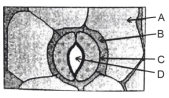 NEET 2024 Medium
More PYQs from NEET
- પ્રગામી હાર્મોનિક તરંગ \(y(x, t)=2.0 \cos 2 \pi(10 t-0.0080 x+0.35)\) માટે, જ્યાં x અને y cm માં અને t s માં છે. 0.5 m ના અંતરે આવેલા બે બિંદુઓની દોલિત ગતિ વચ્ચેનો કળા તફાવત ____________ છે :NEET 2026 Easy
- સંગત જોડ પસંદ કરો. સાંધાનો પ્રકાર ઉદાહરણNEET 2014 Medium
- નીચે આપેલા આલ્કોહોલ પૈકી કયો એક જે સાંદ્ર \(HCl\) અને નિર્જળ \(ZnCl_2\) સાથે સૌથી ઝડપથી પ્રક્રિયા કરે છે તે ?NEET 2017 Medium
- એક કણ એવી રીતે ગતિ કરે છે કે જેથી તેનો સ્થાન સદિશ \(\overrightarrow {\;r} = cos\omega t\,\hat x + sin\omega t\,\hat y\) અનુસાર આપવામાં આવે છે.અહીં \(\omega \) અચળાંક છે. નીચે આપેલાં વિધાનોમાંથી કયું વિધાન સાચું છે?NEET 2016 Medium
- એક ઇલેક્ટ્રોન (દળ \(9 \times 10^{-31} kg\) અને વિદ્યુતભાર \(1.6 \times 10^{-19} C\) ) \(c / 100\) (જ્યાં \(c =\) પ્રકાશનો વેગ) ની ઝડપથી ગતિ કરતો એક ચુંબકીય ક્ષેત્ર \(\vec{B}\) માં દાખલ થાય છે, જેનું મૂલ્ય \(9 \times 10^{-4} T\) છે અને તે તેની ગતિની દિશાને લંબ છે. આપણે ચુંબકીય ક્ષેત્ર સાથે એક સમાન વિદ્યુતક્ષેત્ર \(\vec{E}\) લાગુ પાડવા માંગીએ છીએ જેથી ઇલેક્ટ્રોન તેના માર્ગ પરથી વિચલિત ન થાય. તો... (પ્રકાશનો વેગ \(c =3 \times 10^8 ms^{-1}\) )NEET 2025 Easy
- જો પ્રક્રિયા,\([\)ચિત્ર\(]\) નો વેગ સૌથી વધુ હોય તો \(Z\) શોધો ?
 NEET 2017 Medium