


WBJEE · Physics · Mathematics in Physics
In a triangle \(A B C\), the sides \(A B\) and \(A C\) are represented by the vectors \(3 \mathrm{i}+\mathrm{j}+\mathrm{k}\) and \(\mathrm{i}+2 \mathrm{j}+\mathrm{k}\), respectively. Calculate the angle \(\angle A B C\)
- A \(\cos ^{-1} \sqrt{\frac{5}{11}}\)
- B \(\cos ^{-1} \sqrt{\frac{6}{11}}\)
- C \(\left(90^{\circ}-\cos ^{-1} \sqrt{\frac{5}{11}}\right)\)
- D \(\left(180^{\circ}-\cos ^{-1} \sqrt{\frac{5}{11}}\right)\)
Answer & Solution
Correct Answer
(A) \(\cos ^{-1} \sqrt{\frac{5}{11}}\)
Step-by-step Solution
Detailed explanation
\(A B=3 i+j+\hat{k}\) and \(A C=i+2 j+i\) \(8 A=-(3 i+j+k)\) \(\angle A B C\) is angle between \(B A\) and \(B C\) \(B C=A C+B A\) \(=A C-A B\) \(=\hat{i}+2 \hat{j}+\hat{k}-(3 \hat{i}+\hat{j}+\hat{k})=-2 \hat{i}+\hat{j}\) \(B A \cdot B C=|B A \| B C| \cos \theta\)…
See the Complete Solution
Get step-by-step explanations for this and 2.5 Lakh+ more JEE, NEET & CET questions.
- Unlock all solutions
- Practice the full chapter
- Track accuracy across PYQs
4.8 rated on Google Play · 14,000+ reviews
More questions from Physics
- A ray of light is incident at an angle \(i\) on a glass slab of refractive index \(\mu\). The angla between reflected and refracted light is \(90^{\circ}\) Then, the relationship between \(i\) and \(\mu\) isWBJEE 2015 Easy
- An infinite sheet carrying a uniform surface charge density \(\sigma\) lies on the \(x y\) -plane. The work done to carry a charge \(q\) from the point \(\mathbf{A}=a(\mathbf{i}+2 \hat{\mathbf{j}}+3 \hat{\mathbf{k}})\) to the point \(\mathbf{B}=a(\mathbf{i}-2 \hat{\mathbf{j}}+6 \hat{\mathbf{k}})\)
(where \(a\) is a constant with the dimension of length and \(\varepsilon_{0}\) is the permittivity of free space) isWBJEE 2014 Medium - In the bandgap between valence band and conduction band in a material is \(5.0 \mathrm{eV},\) then the material isWBJEE 2014 Easy
- If \(\mathrm{R}\) is the Rydberg Constant in \(\mathrm{cm}^{-1}\), then hydrogen atom does not emit any radiation of wave-length in the range ofWBJEE 2020 Medium
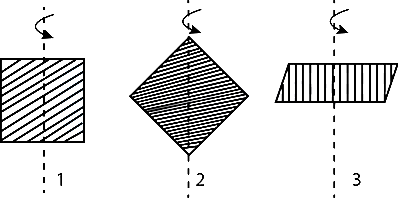
- Sound waves are passing through two routes-one in atraight path and the other along a semicireular path of radius \(r\) and are again combined into one pipe and superposed as shown in the figure. If the velocity of sound waves in the pipe is \(v\), then frequencies of resultant waves of maximum amplitude will be integral multiples of
 WBJEE 2014 Easy
 -
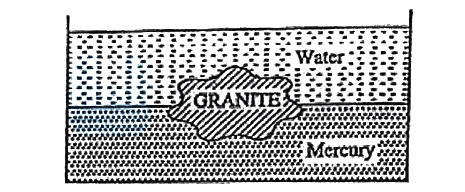
A piece of granite floats at the interface of mercury and water contained in a beaker as in figure. If the densities of granite, water and mercury are \(\rho, \rho_1\) and \(\rho_2\) respectively, the ratio of the volume of granite in water to the volume of granite in mercury isWBJEE 2025 Medium
More PYQs from WBJEE
- The order of the differential equation \(\frac{d^2 y}{d x^2}=\sqrt{1-\left(\frac{d y}{d x}\right)^2}\) isWBJEE 2009 Easy
- The number of amino acids and number of peptide bonds in a linear tetrapeptide (made of different amino acids) are respectivelyWBJEE 2014 Easy
- In a mercury thermometer, the ice point (lower fixed point) is marked as \(10^{\circ}\) and the steam point (upper fixed point) is marked as \(130^{\circ}\). At \(40^{\circ} \mathrm{C}\) temperature, what will this thermometer read?WBJEE 2012 Easy
- "Extraction of gold \((\mathrm{Au})\) involves the formation of complex ions \(X\) and \(Y\)

\(X\) and \(Y\) respectively areWBJEE 2015 Easy - An object placed in front of a concave mirror at a distance of \(x\) cm from the pole gives a 3 times magnified real image. If it is moved to a distance of \((x+5) \mathrm{cm},\) the magnification of the image becomes 2 . The focal length of the mirror isWBJEE 2012 Medium
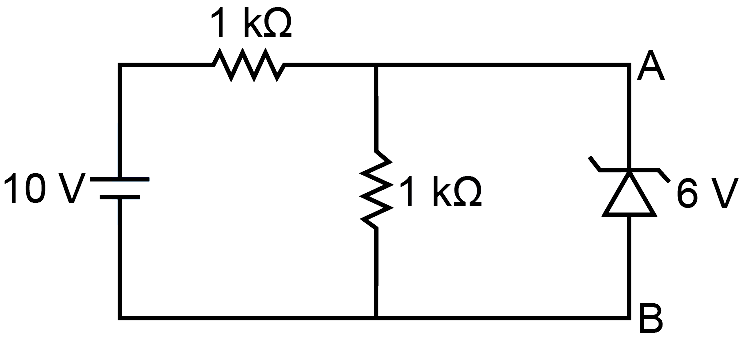
- In the circuit shown, what will be the current through the \(6 \mathrm{V}\) zener?
 WBJEE 2019 Easy