


WBJEE · Physics · Laws of Motion
A metallic block of mass \(20 \mathrm{~kg}\) is dragged with a uniform velocity of \(0.5 \mathrm{~ms}^{-1}\) on a horizontal table for \(2.1 \mathrm{~s}\). The co-efficient of static friction between the block and the table is \(0.10\). What will be the maximum possible rise in temperature of the metal block if the specific heat of the block is \(0.1\) C.G.S unit ? Assume \(g=10 \mathrm{~ms}^{-2}\) uniform rise in temperature throughout the whole block. [lgnore absorption of heat by the table]
- A \(0.0025^{\circ} \mathrm{C}\)
- B \(0.025^{\circ} \mathrm{C}\)
- C \(0.001^{\circ} \mathrm{C}\)
- D \(0.05^{\circ} \mathrm{C}\)
Answer & Solution
Correct Answer
(A) \(0.0025^{\circ} \mathrm{C}\)
Step-by-step Solution
Detailed explanation
Hint: friction \(f=\mu \mathrm{mg}=0.1 \times 20 \times 10=20\) \(\mathrm{~W}_{\mathrm{f}}=\) heat \(\Rightarrow(\mathrm{f.u}) \mathrm{t}=\mathrm{mc} \Delta \mathrm{T}\) \(\Rightarrow 20 \times 0.5 \times 2.1=20 \times 0.1 \times 4.2 \times 10^{3} . \Delta \mathrm{T}\)…
See the Complete Solution
Get step-by-step explanations for this and 2.5 Lakh+ more JEE, NEET & CET questions.
- Unlock all solutions
- Practice the full chapter
- Track accuracy across PYQs
4.8 rated on Google Play · 14,000+ reviews
More questions from Physics
- A straight wire of length \(2 \mathrm{m}\) carries a current of \(10 \mathrm{A}\). If this wire is placed in a uniform magnetic field of 0.15 T making an angle of \(45^{\circ}\) with the magnetic field, the applied force on the wire will beWBJEE 2012 Easy
- Given : The percentage error in the measurements of \(\mathrm{A}, \mathrm{B}, \mathrm{C}\) and \(\mathrm{D}\) are respectively, \(4 \%, 2 \%, 3 \%\) and \(1 \%\). The relative error in \(Z=\frac{A^4 B^{\frac{1}{3}}}{C D^{\frac{3}{2}}}\) isWBJEE 2022 Easy
- Consider a particle of mass 1 gm and charge 1.0 Coulomb is at rest. Now the particle is subjected to an electric field \(E(t)=E_0 \sin \omega t\) in the \(x\)-direction, where \(E_0=2\) Newton/Coulomb and \(\omega=1000 \mathrm{rad} / \mathrm{sec}\). The maximum speed attained by the particle isWBJEE 2025 Medium
- The ratio of magnetic field and magnetic moment at the centre of a current carrying circular loop is \(x\). When both the current and radius is doubled the ratio will beWBJEE 2010 Medium
- In the electrical circuit shown in the figure, the current through the \(4 \Omega\) resistor is
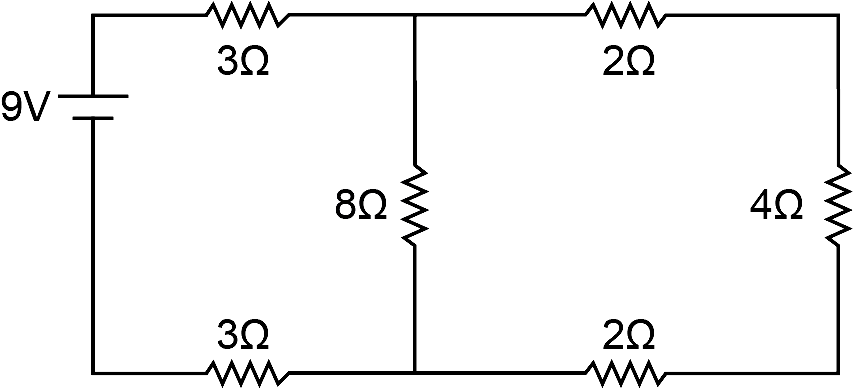 WBJEE 2013 Medium
 - To write the decimal number 37 in binary, how many binary digits are required?WBJEE 2009 Hard
More PYQs from WBJEE
- \(\mathrm{I}=\int \cos (\ln \mathrm{x}) \mathrm{dx}\). Then \(\mathrm{I}=\)WBJEE 2022 Easy
- Let \(P\) and \(Q\) be the points on the parabola \(y^{2}=4 x\) so that the line segment \(P Q\) subtends right angle at the vertex. If \(P Q\) intersects the axis of the parabola at \(R,\) then the distance of the vertex from \(R\) isWBJEE 2012 Medium
- In a third order matrix \(A\), \(a_{0}\) denotes the element in the ith row and \(j\) th column. If \(a_{i j}=0\) for \(i=j,1\) for \(i>j,-1\) for \(i < j\) Then the matrix isWBJEE 2018 Easy
- Let \(S\) be the set of points, whose abscissae and ordinates are natural numbers. Let \(P \in S\), such that the sum of the distance of \(P\) from (8,0) and (0,12) is minimum among all elements in \(S .\) Then, the number of such points \(P\) in \(S\) isWBJEE 2016 Medium
- Avogadro's law is valid forWBJEE 2022 Easy
- If \(\sin 6 \theta+\sin 4 \theta+\sin 2 \theta=0\) then the general value of \(\theta\) isWBJEE 2010 Hard