


WBJEE · Maths · Application of Derivatives
Let \(p(x)\) be a polynomial with real co-efficients, \(p(0)=1\) and \(p^{\prime}(x) > 0\) for all \(x \in \mathbb{R}\). Then
- A \(p(x)\) has at least two real roots
- B \(p(x)\) has only one positive real root
- C \(\mathrm{p}(\mathrm{x})\) may have negative real root
- D \(p(x)\) has infinitely many real roots
Answer & Solution
Correct Answer
(C) \(\mathrm{p}(\mathrm{x})\) may have negative real root
Step-by-step Solution
Detailed explanation
\(P(x)=0\) has exactly one negative real root.
See the Complete Solution
Get step-by-step explanations for this and 2.5 Lakh+ more JEE, NEET & CET questions.
- Unlock all solutions
- Practice the full chapter
- Track accuracy across PYQs
4.8 rated on Google Play · 14,000+ reviews
More questions from Maths
- A student answers a multiple choice question with 5 alternatives, of which exactly one is correct. The probability that he knows the correct answer is \(p, 0 < p < 1 .\) If he does not know the correct answer, he randomly ticks one answer. Given that he has answered the question correctly, the probability that he did not tick the answer randomly, isWBJEE 2014 Medium
- Lines \(x+y=1\) and \(3 y=x+3\) intersect the ellipse \(x^{2}+9 y^{2}=9\) at the points \(P, Q\) and \(R\). The area of the \(\triangle P Q R\) isWBJEE 2013 Hard
- Let \(\mathrm{I}(\mathrm{n})=\mathrm{n}^{\mathrm{n}}, \mathrm{J}(\mathrm{n})=1.3 .5 \ldots . .(2 \mathrm{n}-1)\) for all \((\mathrm{n}>1), \mathrm{n} \in \mathrm{N}\), thenWBJEE 2020 Easy
- If \(y=\tan ^{-1} \sqrt{\frac{1-\sin x}{1+\sin x}}\), then the value of \(\frac{d y}{d x}\) at \(x=\frac{\pi}{6}\) isWBJEE 2009 Hard
- \(\omega\) is an imaginary cube root of unity and \(\left|\begin{array}{ccc}x+\omega^2 & \omega & 1 \\ \omega & \omega^2 & 1+x \\ 1 & x+\omega & \omega^2\end{array}\right|=0\) then one of the values of \(x\) isWBJEE 2010 Medium
- \(\int \frac{d x}{x(x+1)}\) equals
where \(c\) is an arbitrary constant.WBJEE 2009 Medium
More PYQs from WBJEE
- \(y=\int \cos \left\{2 \tan ^{-1} \sqrt{\frac{1-x}{1+x}}\right\} d x\) is an equation of a family ofWBJEE 2019 Medium
- The equivalent capacitance of a combination of connected capacitors shown in the figure between the points P and N
is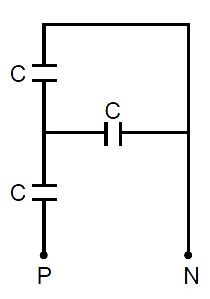 WBJEE 2024 Easy
 - A radioactive atom \(\mathrm{X}_{\mathrm{Y}}\) emits two \(\alpha\) particles and one \(\beta\) particle successively. The number of neutrons in the nucleus of the product will beWBJEE 2011 Easy
- The maximum number of atoms that can be in one plane in the molecule p-nitrobenzonitrile areWBJEE 2021 Easy
- The value of \(\lim _{x \rightarrow 2} \int_{2}^{x} \frac{3 t^{2}}{(x-2)} d t\) isWBJEE 2015 Easy
- If \(0 \leq a, b \leq 3\) and the equation \(x^2+4+3 \cos (a x+b)=2 x\) has real solution, then the value of \((a+b)\) isWBJEE 2025 Hard