


WBJEE · Maths · Continuity and Differentiability
Let \(f\) and \(g\) be differentiable on the interval \(I\) and let \(a, b \in I, a < b\). Then,
- A If \(f(a)=0=f(b)\), the equation \(f^{\prime}(x)+f(x) g^{\prime}(x)=0\) is solvable in \((a, b)\)
- B If \(f(a)=0=f(b)\), the equation \(f^{\prime}(x)+f(x) g^{\prime}(x)=0\) may not be solvable in \((a, b)\)
- C If \(g(a)=0=g(b)\), the equation \(g^{\prime}(x)+k g(x)=0\) is solvable in \((a, b), k \in \mathbb{R}\)
- D If \(g(a)=0=g(b)\), the equation \(g^{\prime}(x)+k g(x)=0\) may not be solvable in \((a, b), k \in \mathbb{R}\).
Answer & Solution
Correct Answer
(C) If \(g(a)=0=g(b)\), the equation \(g^{\prime}(x)+k g(x)=0\) is solvable in \((a, b), k \in \mathbb{R}\)
Step-by-step Solution
Detailed explanation
From option (a) We have, \(f(a)=f(b)=0\) \(\Rightarrow f^{\prime}(a) \cdot f^{\prime}(b) < 0\) Again, let \(h(x)=f^{\prime}(x)+f(x) g^{\prime}(x)\) \(\Rightarrow h(a)=f^{\prime}(a)+fg^{\prime}(a)=f^{\prime}(a)\) and \(h(b)=f^{\prime}(b)+f(b) g^{\prime}(b)=f^{\prime}(b)\)…
See the Complete Solution
Get step-by-step explanations for this and 2.5 Lakh+ more JEE, NEET & CET questions.
- Unlock all solutions
- Practice the full chapter
- Track accuracy across PYQs
4.8 rated on Google Play · 14,000+ reviews
More questions from Maths
- Integrating Factor (I.F.) of the defferential equation
\(\frac{d y}{d x}-\frac{3 x^2 y}{1+x^3}=\frac{\sin ^2(x)}{1+x} \text { is }\)WBJEE 2011 Easy - If \(\sin \theta+\cos \theta=0\) and \(0 < \theta < \pi\), then \(\theta\)WBJEE 2011 Easy
- The area of the region \(\left\{(x, y): x^{2}+y^{2} \leq 1 \leq x+y\right\}\) isWBJEE 2020 Medium
- The length of the chord of the parabola \(y^{2}=4 a x(a>0)\) which passes through the vertex and makes an acute angle \(\alpha\) with the axis of the parabola isWBJEE 2020 Medium
- The integrating factor of the differential equation \(\left(1+x^{2}\right) \frac{d y}{d x}+y=e^{\tan ^{-1} x}\) isWBJEE 2014 Medium
- If \(I_n=\int_0^{\frac{\pi}{2}} \cos ^n x \cos n x d x\), then \(I_1, I_2, I_3 \ldots\) are inWBJEE 2023 Medium
More PYQs from WBJEE
- A simple pendulum of length \(\ell\) is displaced so that its taught string is horizontal and then released. A uniform bar pivoted at one end is simultaneously released from its horizontal position. If their motions are synchronous, what is the length of the bar?WBJEE 2020 Medium
- The correct order of decreasing \(\mathrm{H}-\mathrm{C}-\mathrm{H}\) angle in the following molecule is
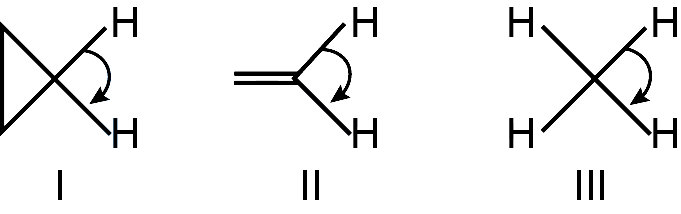 WBJEE 2014 Hard
 - If \(f(x)=2^{100} x+1, g(x)=3^{100} x+1\), then the set of real numbers \(x\) such that \(f[g(x)\}=x\) isWBJEE 2013 Easy
- The melting points of (i) BeCl\(_{2}\) (ii) \(\mathrm{CaCl}_{2}\) and (iii) \(\mathrm{HgCl}_{2}\) follows the orderWBJEE 2019 Medium
- The maximum and minimum values of \(\cos ^{6} \theta+\sin ^{6} \theta\) are respectivelyWBJEE 2013 Easy
- For any two real numbers \(a\) and \(b\), we define \(a R b\) if and only if \(\sin ^{2} a+\cos ^{2} b=1\). The relation \(R\) isWBJEE 2013 Medium