


WBJEE · Maths · Application of Derivatives
Let \(\mathrm{a}, \mathrm{b}, \mathrm{c}\) be three real numbers such that \(\mathrm{a}+2 \mathrm{~b}+4 \mathrm{c}=0\). Then the equation \(\mathrm{ax}^2+\mathrm{bx}+\mathrm{c}=0\)
- A has both the roots complex
- B hat its roots lying within \(-1 < x < 0\)
- C has one of roots equal to \(\frac{1}{2}\)
- D has its roots lying within \(2 < x < 6\)
Answer & Solution
Correct Answer
(C) has one of roots equal to \(\frac{1}{2}\)
Step-by-step Solution
Detailed explanation
Hints: \(\frac{1}{4} \mathrm{a}+\frac{1}{2} \mathrm{~b}+\mathrm{c}=0\) \(\begin{aligned} & \left(\frac{1}{2}\right)^2 a+\left(\frac{1}{2}\right) b+c=0 \\ & \therefore x=\frac{1}{2} \end{aligned}\)
See the Complete Solution
Get step-by-step explanations for this and 2.5 Lakh+ more JEE, NEET & CET questions.
- Unlock all solutions
- Practice the full chapter
- Track accuracy across PYQs
4.8 rated on Google Play · 14,000+ reviews
More questions from Maths
- The equation of hyperbola whose coordinates of the foci are (±8,0) and the length of latusrectum is 24 units, isWBJEE 2014 Medium
- The equation of one of the curves whose slope at any point is equal to \(\mathrm{y}+2 \mathrm{x}\) isWBJEE 2010 Medium
- Let \(I=\int_{10}^{19} \frac{\sin x}{1+x^{6}} d x\). Then,WBJEE 2017 Medium
- The value of \(\sum_{\mathrm{n}=1}^{10} \int_{-2 n-1}^{-2 \pi} \sin ^{27} x d x+\sum_{n=1}^{10} \int_{2 n}^{2 n+1} \sin ^{27} x d x\) is equal toWBJEE 2020 Medium
- Let \(f(x)=2 x^{2}+5 x+1\). If we write \(f(x)\) as \(f(x)=a(x+1)(x-2)+b(x-2)(x-1)+c(x-1)(x+1)\)
for real numbers \(a, b, c,\) thenWBJEE 2014 Hard - In a certain test, there are n questions. In this test \(2^{n-i}\) students gave wrong answers to at least i questions, where i \(=1,2, \ldots \ldots \mathrm{n}\). If the total number of wrong answers given is 2047 , then \(\mathrm{n}\) is equal toWBJEE 2020 Hard
More PYQs from WBJEE
- In the following electron - dot structure, calculate the formal charge from left to right nitrogen atom; \(\ddot{\mathrm{N}}=\mathrm{N}=\ddot{\mathrm{N}}\)WBJEE 2011 Medium
- Tangents are drawn to the ellipse \(\frac{x^{2}}{9}+\frac{y^{2}}{5}=1\) at the ends of both latusrectum. The area of the quadrilateral, so formed isWBJEE 2017 Medium
- Two spheres \(\mathrm{S}_1\) and \(\mathrm{S}_2\) of masses \(\mathrm{m}_1\) and \(\mathrm{m}_2\) respectively collide with each other. Initially \(\mathrm{S}_1\) is at rest and \(\mathrm{S}_2\) is movingwith velocity v along x -axis. After collision \(\mathrm{S}_2\) has a velocity \(\frac{\mathrm{v}}{2}\) in a direction perpendicular to the original direction. The sphere \(\mathrm{S}_1\) moves after collisionWBJEE 2025 Medium
- The ratio of volumes of \(\mathrm{CH}_{3} \mathrm{COOH } \text{ 0.1}\) (N) to CH COONa 0.1 (N) required to prepare a buffer solution of \(\mathrm{pH} 5.74\) is (Given, \(p K_{a}\) of \(C H_{3} C O O H\) is \(\left.4.74\right)\)WBJEE 2015 Medium
- Let \(S, T, U\) be three non-void sets and \(f: S \rightarrow T, g: T \rightarrow U\) be so that \(g o f: s \rightarrow U\) is surjective. Then,WBJEE 2019 Easy
-
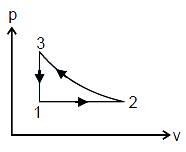
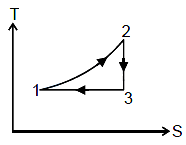
A cyclic process is shown in \(\mathrm{p}-\mathrm{v}\) diagram and \(\mathrm{T}-\mathrm{S}\) diagram. Which of the following statement(s) is/are true?WBJEE 2023 Easy